
National report: Richmond’s asthma death rate is fifth highest. What’s happening in Henrico?

While it’s no secret that Metro Richmond has a reputation for allergies, a new national report suggests the region’s breathing problems run deeper.
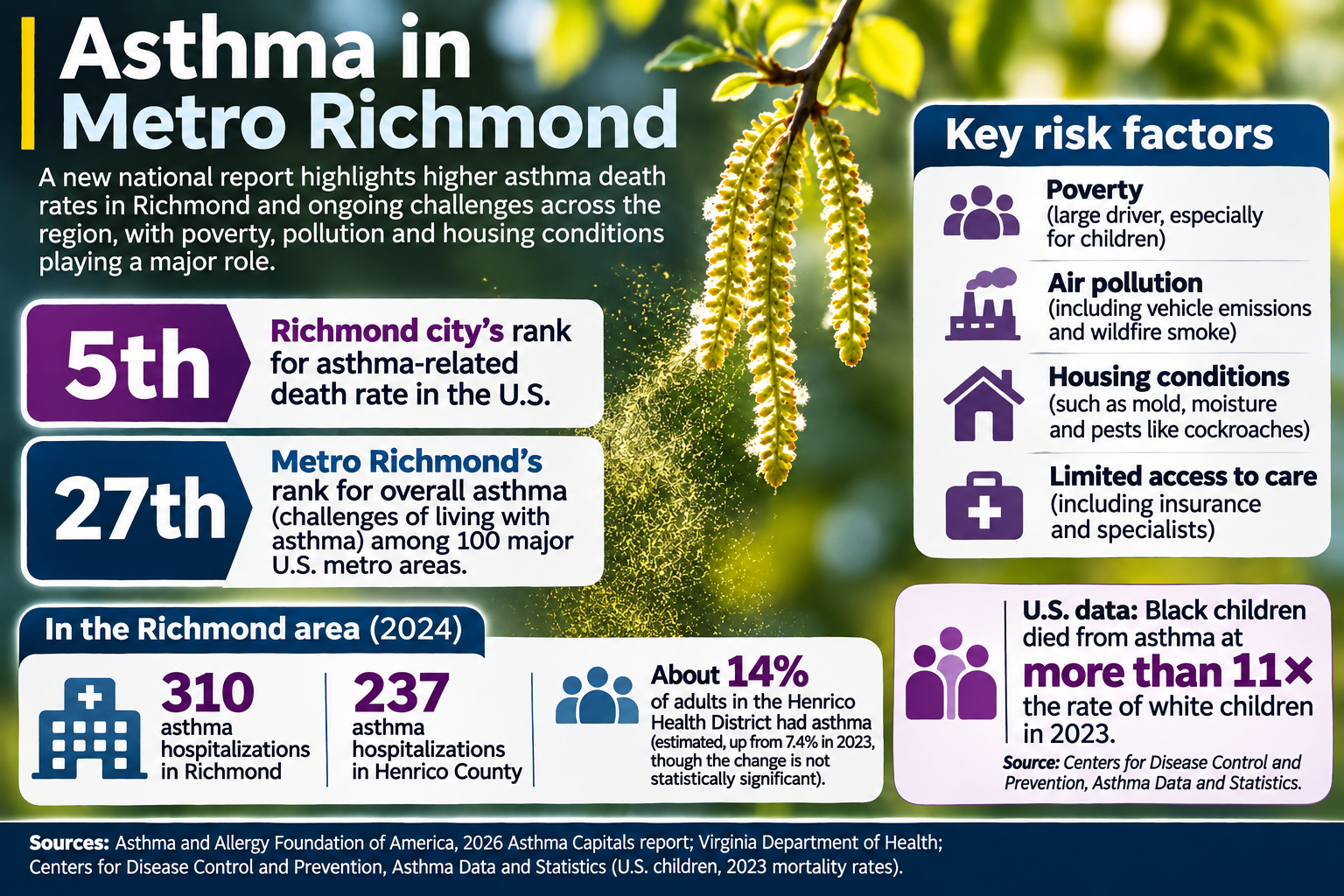
Richmond ranks fifth nationally for its asthma-related death rate, and the broader metro area ranks as the 27th worst place in the nation for asthma (among the 100 most populated metros studied), according to the Asthma and Allergy Foundation of America’s 2026 Asthma Capitals report. The report used several measures of asthma severity, including asthma-related death rates from 2020 through 2024 and emergency department visits in 2025.
AAFA officials believe that asthma-related deaths are preventable.
But there's good news, according to Children's Hospital of Richmond at VCU pediatric pulmonologist Michael Schechter, who directs the UCAN (yoU CAN Control Asthma Now) community asthma program. When he arrived in Richmond 15 years ago, the area consistently ranked near the top of the list, meaning among the worst nationally. Landing at 27th is progress, he said.
The Richmond region does have higher pollen levels than most of the country, Schechter said, but that is not the most important driver, particularly in children. The bigger driver is poverty.
“This is not an issue that necessarily affects people in Short Pump,” he said. “This is a factor that affects the people in Eastern Henrico.”
The county witnessed 237 asthma hospitalizations in 2024, second only to Richmond’s 310, according to the Virginia Department of Health. (Each admission does not necessarily represent a different person.). A separate VDH survey estimated that approximately 14% of adults in the Henrico Health District had asthma in 2024, compared with an estimate of 7.4% in 2023. The estimates have varied considerably from year to year, and the figures alone do not establish that asthma prevalence increased by that amount.
Bryan Hooten of the Richmond and Henrico Health Districts said the jump may overstate the change.
The estimates rely on small samples, and the confidence intervals for the two years overlap, so the difference would not be considered statistically significant. Hooten also cautioned against reading too much into the city’s ranking. AAFA uses five-year crude rates, while VDH’s dashboard is age-adjusted, and the five-year window includes the COVID-19 pandemic years, when asthma deaths rose.
Who is most at risk?
Nationally, 3,279 people died from asthma in 2024, according to the report. That’s 9 to 11 a day, and AAFA officials said the numbers have not meaningfully improved in a decade.
“The more than 28 million people in the U.S. with asthma face missed days of school and work, emergency room visits, and hospitalizations,” AAFA President and CEO Kenneth Mendez said in the report’s release. He called the rankings “a wake-up call for policymakers.”
The foundation names poverty, lack of insurance, lack of access to specialists and exposure to air pollution as top risk factors, and argues that decisions on health care spending, housing standards, air quality permits and public health investment are all effectively asthma policy.
Schechter said national data (such as this study) show the biggest risk factors for asthma illness and death are poverty and non-white race. Black children die of asthma at about 10 times the rate of white children, he said, and lower socioeconomic status is linked to two to three times higher mortality.
In Virginia, he said, Richmond’s childhood asthma hospitalization rate is about seven times the state and national rates, which is similar to Norfolk and Roanoke.
Mapping compiled in Metro Richmond shows the neighborhoods with the most asthma-related emergency room visits are public housing properties, downtown Richmond and Eastern Henrico, Schechter said. Poverty and pollution go hand in hand.
Indoor triggers and air pollution
Some of the most powerful asthma triggers for children are indoors, Schechter said. The most important allergens for children with asthma are dust, mold and cockroaches, and he said exposure to them is closely tied to more severe asthma.
Those exposures are more likely in homes with moisture problems, plumbing issues or pests. Other factors like limited access to care, distrust of the health care system and inconsistent treatment can compound the problem, he said.
Outdoor air matters, too. Schechter said research clearly links living near highways to asthma flare-ups, and wildfire smoke from Canada that drifted to Virginia was associated with more emergency room visits. Henrico earned a C from the American Lung Association for particle pollution, and federal data put the county’s particulate matter level at 7.2 micrograms per cubic meter (PM2.5), the same as in Richmond.
Neither VDH data set breaks out Eastern Henrico, where some residents live near either a landfill, the airport, a gas plant or a medical sterilization facility. A VCU study maps those sources. VCU professor Beth Kreydatus told WTVR in June that when many pollution sources cluster together, “the combination of all of those pollution sources starts to overburden the community.”
The available countywide asthma data do not establish whether residents of Eastern Henrico experience higher asthma hospitalization rates than residents elsewhere in the county or whether exposure to any particular pollution source contributes to those hospitalizations.
Disparities in severe asthma
New research from UVA Health Children’s found that among 451 children with severe asthma in rural and urban Virginia, Black children had a higher risk of elevated type 2 (T2) inflammation, an allergy-associated pattern that can make asthma harder to control, even after researchers accounted for air quality, family income and where the children lived.
“Black children have higher attacks, more hospital admissions, more severe asthma outcomes compared to white children,” said W. Gerald Teague, a UVA pediatric pulmonologist.
The study identifies an association, not a genetic cause. Teague emphasized that race alone doesn’t give doctors a full picture and that treatment must consider a child’s lifestyle and environment.
Focusing on individual care
RHHD has focused on individual-level guidance for Henrico and Richmond families.
“We encourage parents and caregivers of children with asthma to develop action plans with their healthcare provider,” Hooten said.
In a May press release for Asthma and Allergy Awareness Month, RHHD School Health Coordinator Carolina Lugo said an asthma action plan “provides clear, step-by-step guidance so kids, caregivers, and school staff know how to manage symptoms, reduce or prevent flare-ups, and respond quickly in an emergency.”
The district urges families to share the plans with school nurses and summer camp staff. It also recommends managing indoor air quality and getting updated respiratory vaccines.
RHHD’s 2025–2028 Community Health Improvement Plan does not mention asthma specifically. It does identify chronic disease as a growing concern, and the 2024 Community Health Assessment found residents worried about access to care, health education, places for physical activity, and nutritious food. Housing quality, economic stability, transportation, and access to health services are among the social factors that can affect people with asthma.
UCAN, which is funded by the Children’s Hospital Foundation, follows nearly 2,000 children and focuses on high-risk patients who use the emergency room often.
The program works to raise expectations for care. Asthma runs in families, Schechter said, and many children have parents who have endured repeated ER visits and hospital stays, so families come to see that as normal.
UCAN staff helps ensure children get appropriate care, delivered in a more personalized way. A social worker and a community health worker, trained to spot environmental triggers, visit homes to help families fix them. Medical-legal partnerships bring in lawyers when housing violations are hard to resolve, and staff connect families with food and transportation.
Compared with the year before enrollment, hospitalizations and emergency room visits drop by 67 % to 75%, Schechter said, and children miss fewer school days and parents fewer workdays.
Most children who land in the ER or hospital are ones UCAN has never met, he said.
Many rely mainly on rescue medicines rather than controller medicines, which treat underlying airway inflammation. Their asthma may not have been recognized as severe by primary care doctors, or they bounce between urgent care and emergency rooms with no one tracking their care.
Deaths, among both children and adults, are more complicated, he said. Many patients prescribed controllers don’t get the right amount because of broken connections with providers, trouble accessing medication or confusion about how to use it. Fights over insurance coverage can add to the problem.
UCAN relies on philanthropy, because Schechter said he could not find another way to fund case management. He has discussed the issue with large insurers and with Medicaid and believes the state program should develop a way to pay for case management, which is more complicated than standard fee-for-service billing.
Because UCAN can show lower hospitalizations and lower costs of care, he said, a new payment approach should not cost more, but he has been unable to move the needle. Other states and communities pay for this kind of care, he said. Virginia does not.
“Public health insurance like Medicaid should help pay for case management, which leads to much better health outcomes at equal or lower cost than the way we’re doing it right now,” he said.