
Henrico removes all Flock cameras, won't seek reimbursement for efforts after initially indicating it would

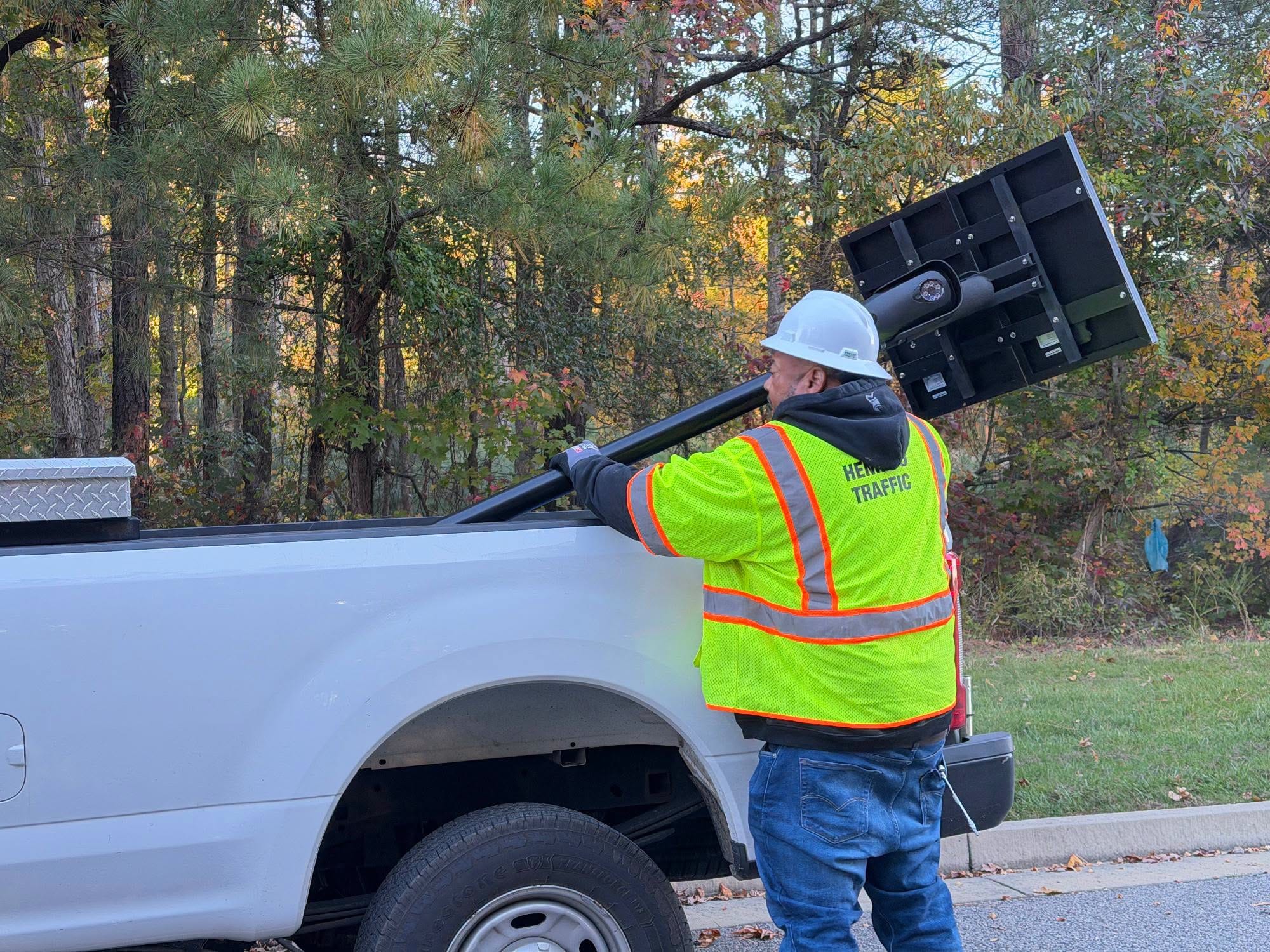
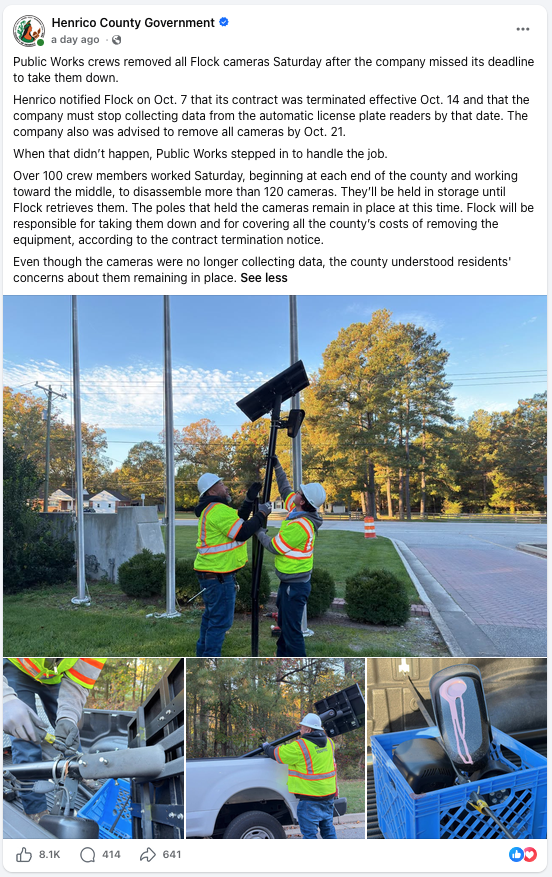
More than two dozen Henrico County Public Works employees spent Halloween removing all of the Flock Safety license plate reader cameras that the county had been leasing from the company, Henrico officials reported Nov. 2.
Crews began at opposite ends of the county and worked toward the middle, dismantling the cameras, which will remain in storage until Flock retrieves them. The poles that held the cameras remain in place in most locations for now.
In a statement and social media post Monday, county officials wrote that they had directed Public Works employees to remove the cameras after Flock "missed its deadline" of Oct. 21 to take them down, adding that the company would have to remove the poles itself.
"Flock will be responsible for taking them down and for covering all the county’s costs of removing the equipment, according to the contract termination notice," they wrote.
Henrico notified Flock Oct. 7 that its contract would terminate effective Oct. 14 and instructed the company to stop collecting license plate data by that date.
But although the county directed Flock to remove all of its equipment by Oct. 21, that date amounted only to a request and not a contractually obligated deadline, Henrico County spokesperson Ben Sheppard confirmed to the Citizen Nov. 3.
On Tuesday, a Flock official told the Citizen that the company would not provide Henrico with a financial reimbursement.
"They went ahead and chose to do that on their own," company spokesperson Andrew Smith said of the county's decision to remove the cameras, adding that he could not provide a timeline for Flock's removal of the poles. "We're working as fast as we can."
Late Tuesday afternoon, Sheppard told the Citizen that the county was not seeking reimbursement from Flock for the removal of the cameras, although Henrico's social media post suggesting otherwise remained up.
"We've decided it's not worth seeking reimbursement and prolonging the matter," Sheppard told the Citizen. "Our main objective in removing the cameras was to give our residents and community peace of mind and assurance that the cameras were no longer active."
In a statement Monday, Flock officials had written that they were planning to remove the cameras "within a commercially reasonable time period," as required by their standard contracts and would have adhered to that requirement had the county not removed the cameras on its own.
In a follow-up statement, officials indicated that specific removal deadlines could not be established in advance because of a number of variables, including the number of cameras and their locations.
"The county's demand to have the cameras removed by Oct. 21 is not based on the contract," a spokesperson wrote.
A Citizen review of the county's original 2022 contract with Flock found no provision in the publicly available 40-page document requiring removal within seven days of official termination or explicitly authorizing Henrico to recover the costs of removing the equipment itself. However, the document incorporates additional general contract terms that were not included in the publicly available package.
The county has not disclosed the cost of Saturday's operation.
Henrico officials said they decided to remove the cameras because residents remained concerned about their presence, even though the devices had been deactivated.
County Attorney Andrew Newby told the Citizen Oct. 29 that the cameras were no longer collecting or transmitting information.
"They're deactivated. They're not connected to anything," Newby said.
Three Chopt District Supervisor Misty Roundtree previously indicated that Public Works officials might remove the cameras if Flock did not act, though she said that was not the preferred approach.
Henrico Police began using Flock's license plate readers in 2022 and eventually expanded the program to 128 cameras, including six mobile units. Police officials had praised the technology as a valuable crime-fighting tool, but privacy concerns and questions about data sharing prompted growing opposition.
The county terminated its relationship with Flock in October amid those concerns.