Skip to content
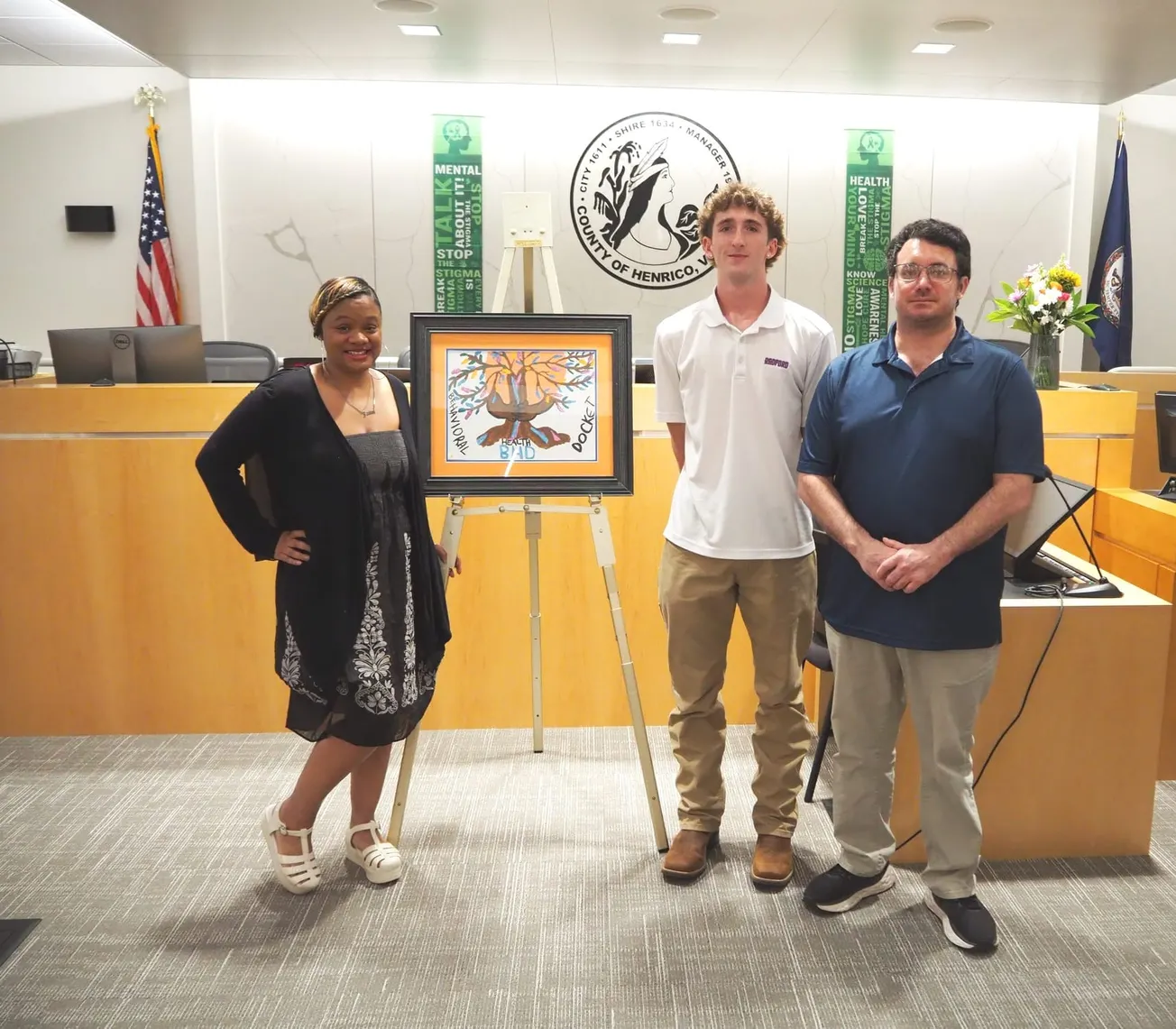
Recent Henrico Behavioral Health Docket graduates Jessica McGowin, Tyler Latham and Evan Perez-Pantoja (left to right) pose with a commemorative painting. (Dina Weinstein/Henrico Citizen)

The Henrico Behavioral Health Docket graduation had all the markings of many formal ceremonies this time of year, with official speeches, certificates handed out, grateful families looking on and hopeful candidates waiting for their turn to shake officials’ hands.  

But the recent afternoon ceremony in the upstairs Henrico County Circuit Court courtroom was more than a new credential and new leaf for the three graduates – it meant clearing their records and functioning in society. Others currently in the program awaited the opportunity to turn that leaf.

A year ago, one of the three Behavioral Health Docket graduates, 19-year-old Tyler Latham, was an area college student who stopped taking his psychotropic medicine.

“I kind of went off the walls,” Latham said. “I shaved my hair, started acting not like myself, ended up in the middle of Richmond in a car that wasn't mine. And then I went to jail.”

When he was arrested and charged, he said he was not aware of what was going on.

“I felt like I was in a video game or a movie,” Latham said. “Nothing felt like it was real. It was crazy.”

He was charged with grand larceny, destruction of property and reckless driving. And he was kept in solitary confinement as he began to be evaluated for mental illness by mental health professionals.

“I still felt like I didn't need medicine and I didn't need help,” Latham said. “Once the medicine started kicking in, after two weeks, they finally let me go back in and I came back to reality. I was like, ‘Oh shoot, I'm in jail. I did something pretty bad.’”

During the nine-month program participants in the Henrico Circuit Court Behavioral Health Docket are lined up with support systems – they go to probation, address substance use, participate in counseling and work with a peer counselor within the program while court staffers constantly evaluate cases. Participation is completely voluntary.

During the recent Behavioral Health Docket graduation, Latham stood at a podium with Judge Lauren Caudill as she reflected on his growth in the program and how his presence in the courtroom was for a markedly more positive reason than what had brought him there months earlier and landed him in jail.

Most importantly, Latham and the other participants had their charges dismissed as family members stood with them. Each participant’s mother banged Caudill’s gavel on the podium, signaling the finality of the decision.

Latham said the program staffers were available if he had questions or needed help and assisted him with finding a psychiatrist and therapist.

“And everything was up from there,” said Latham, who is headed back to college in the fall, determined to get supports in place to succeed in his academics.

Graduates at the recent Henrico County Mental Health Docket pose around a painting surrounded by court and jail staffers, including Judge Lauren Caudill, who is wearing her robe. (Dina Weinstein/Henrico Citizen)

Improved outcomes, fatal overdose prevention

“The shared support and participation of everybody have resulted in the success of our program,” Caudill told the crowd at the ceremony.

The 18 court and law enforcement staffers listed on the graduation program attest to the expansive effort involved in diverting the participants from incarceration.

This year, 35 people have passed through the Mental Health Diversion Program, working toward the goal of learning to self-manage their own treatment and their recovery. The program has been operational for five years.

As participants near graduation, staff back off on services. Graduates have a termination plan with court staffers, which includes going to a long-term service provider.

In the Mental Health Diversion Program, jail-based clinicians can intercept people who are suffering from a mental health emergency quickly and begin treatment. People suffering from serious mental illness who are out on bond can also participate.

Participants' mental health release plan involves them adhering to all treatment recommendations, including taking their medication as prescribed. Treatment is individualized based upon needs – group therapy, individual therapy, case management or medication assisted treatment.

The treatment court saves an average of more than $6,000 for every person it serves, as it reduces court and prison costs.

Across the United States, treatment courts annually refer more than 150,000 people to life saving treatment and recovery support services. Henrico County’s is just one of more than 4,000 treatment courts nationwide, including one in Richmond.

According to All Rise, an advocacy organization for improving justice system responses to substance use and mental health disorders, treatment courts significantly improve substance use and mental health disorder treatment outcomes and prevent fatal overdoses.

Public safety and public health partnership

A key part of diverting people with serious mental illness from jail who have been convicted of a crime is officer training, since it is jail staffers who communicate with the mental health team that a mental health subject is on the way, providing an explanation of what happened.

The program gets referrals from judges, attorneys and family members, as well as self-referrals.

“There has to be a nexus between their charge and their mental health diagnosis, because that way we know we can help treat them and reduce recidivism,” said Sara Tolentino, program manager for Henrico County Jail and Diversion services. The program works to quickly intervene and try to release qualifying participants into programs and treatment.

Tolentino cited the efforts of many people – including defense attorneys – who, with kindness, assist people in the program to help them not just with their cases but with other life tasks, such as helping them get IDs or claim their cars from impound lots.

Two of the current program participants in the audience got certificates marking progress closer to their goal.

“The first thing I thought I wanted to do, I would do. And now I think things out and realize that there's consequences for your actions. A lot of times you don't realize that you need help,” Latham said reflecting on his success, bolstered by his supportive family members, who had been telling him he needed help.

Tolentino praised the three participants, each of whom is now employed.

“We want to teach people how to self-manage their own recovery,” Tolentino said. “And I am pleased to say that all of these graduates here today have been able to do that.”

“Unfortunately, jail has become the default for a lot of folks who have a serious mental illness. I'm so fortunate and happy that I'm able to work and live in a county that meets the needs of our residents where they are, recognizes that we have to help individuals who are incarcerated, take really good care of them while they're incarcerated, and link them to services and treatment in the community.”

The Behavioral Health Docket is just one of four courtrooms with a niche focus. Participants in the program in jail, when they get evaluated, come in under mental health diversion. People on bond come in under the behavioral health docket. The programs are run together as staffers pinpoint what the participants’ mental health diagnosis is and the proper treatment.

Taking injections rather than oral medications, since they provide a consistent level of medication, often helps problems disintegrate, according to administrators.

“They just go away, because the truth of the matter is if they're on their medications and they're stabilizing their situation, the rest of it falls in place,” Tolentino said.

At any given point in time, there are about 90 people in Henrico's criminal justice system whose competency to stand trial is in question because of their mental health. The Mental Health Diversion program, therefore, provides hope, according to Caudill.

“If folks aren't competent, you can get them through the competency process, get them restored to competency and get them the proper treatment,” Caudill said. “Everybody wins in the end. They win because they're better citizens, we win because we’re not being subjected to the crimes. The system wins because they're not paying for incarceration. And you have people in society who are now productive members of society again.”

While Caudill said 96% of the participants who graduate do not re-offend, there are sometimes bumps and relapses, which are viewed as a part of recovery.

'Phenomenal' relief

For another program graduate Jessica McCowin, her incarceration came after assaulting her mother.

During the ceremony, Caudill recalled McCowin’s initial resistance to the program that her older sister convinced her to join.

"Phenomenal" is how McCowin described the program, which led to her finding a job.

“Things are more straight, more clear,” McCowin said.

Relief was how McCowin’s mother, Gloria, described how she was feeling, recalling many episodes of confrontation and aggression from her daughter.

“This program has just been a blessing for families that don't know exactly where to go. You think that when they go to jail that they won't have a support system. But this program is unique in that it provides an alternative to jail,” said Norma McCowin, Jessica’s sister.

“We had called several agencies trying to get help, and because she was her own adult, as a family, we couldn't do anything about it. That's what needs to change, your ability to be able to help a family member who is mentally ill and be able to step in on their behalf and be there, be their power of attorney and power of health. It should be immediate. When somebody has a mental health illness and they've been identified, that alone should help you to be able to help with decision making for them.”

She said her family’s frustrations highlighted a need for reform for families to be able to push for help for their adult relatives who are suffering.

Gloria felt the program was a godsend in comparison to her daughter’s previous experiences being in and out of the jail system. She now can go to a nail salon with her daughter, who proudly holds down a job at a restaurant. She still feels that more focus and investment in mental illness is needed from the federal government.

“But I'm upset that this country, with all the money that they have, they can take spaceships up to the moon and all of that, we got a serious problem of mental illness, and nobody in the government want to do anything about it,” Gloria McCowin said. “It is major. A lot of these shootings, they are related to mental illness.”

Tolentino said the mental health docket’s approach to serving the participants is compassionate.

“Oftentimes folks with mental illness engage in behavior because of their symptoms, that is criminal sometimes, and that if it's treated, they can recover and do better and not make those same mistakes again,” Tolentino said. “We want to support people in being healthy. When we treat people and they’re well, it makes the community safer.“


Dina Weinstein is the Citizen’s community vitality reporter and a Report for America corps member, covering housing, health and transportation. Support her work and articles like this one by making a contribution to the Citizen.

Comments