Skip to content

Birthplace of Powhatan at Henrico's Tree Hill Farm added to list of Virginia's most endangered historic places

New developer plans 10-year buildout of Tree Hill site but has pledged to 'honor the rich historical and cultural contributions made by the Powhatan Chiefdom' there
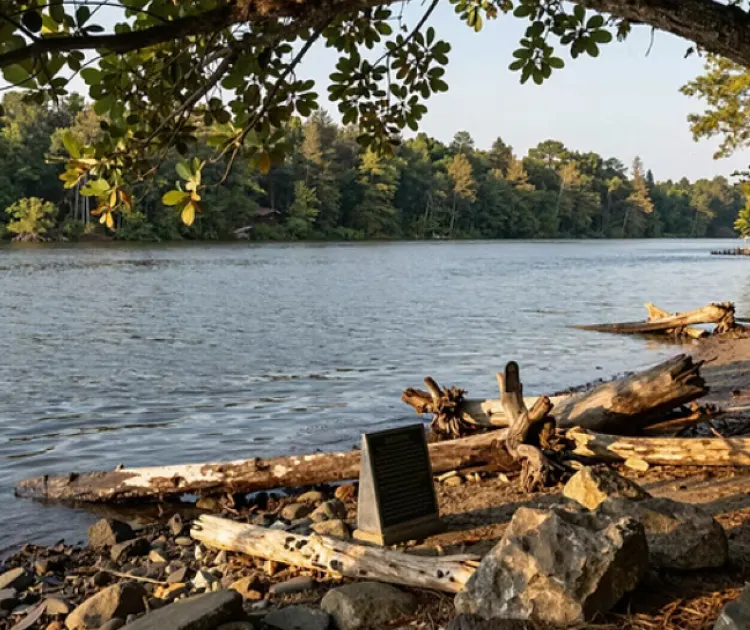
A view of the James River from near the site of Chief WaHōnSeNaKah's birth on the Tree Hill Farm property in Varina. (Courtesy powhatanbirthplace.org)

The birthplace of Powhatan (Chief WaHōnSeNaKah) in Varina is among nine historic sites added to the list of most endangered historic sites in Virginia May 19 by the nonprofit Preservation Virginia.

The site is located on the 523.8-acre Tree Hill Farm property at 6404 Osborne Turnpike, along the north bank of the James River just downstream from the City of Richmond. Rezoning plans for a massive mixed-use development project there were approved by the Henrico County Board of Supervisors in 2007, but a downturn in the economy put those plans on hold in the years since.

But in 2024, developer Brookfield Residential announced the execution of a purchase agreement to buy the site from Gray Land and Development Co. - Tree Hill LLC, which had purchased it from the Ferguson family in late 2006 for $13.3 million. Brookfield, part of a worldwide property development and management company, now intends to “bring much of the 2007 vision to reality,” according to its Tree Hill website. (Gray Land and Development Co. still owns the site, according to the county's Real Estate Assessment Division website.)

The rebirth of the Tree Hill project – with an anticipated buildout of about 10 years once development work begins – prompted Preservation Virginia to add the site to its "most endangered" list this year, although Brookfield officials say they already intend to honor the history of the site.

“As a site believed to have been part of the early years of Chief Powhatan, this area is significant to many of Virginia’s Indian tribes,” Brookfield's Tree Hill website reads. “In collaboration with these tribal groups, we intend to honor the rich historical and cultural contributions made by the Powhatan Chiefdom.”

It's unclear, though, exactly how the developer intends to recognize that history; the company has not yet responded to the Citizen's request for comment.

An artist's rendition in 2007 of the planned Town at Tree Hill in Varina (Courtesy Henrico County/Gray Land and Development Co.)

Original Town of Tree Hill plans called for 2,770 housing units

In 2006, consulting firm Duany Plater-Zyberk and Company conducted a 10-day charrette, or intensive planning session, during which community members and others helped shape what the planned Tree Hill development could look like.

That eventually resulted in plans by Gray Land and Development Co.-Tree Hill LLC's for the Town of Tree Hill, envisioned as a mixed-use development that would include 2,770 housing units, 1.16 million square feet of retail and office space, a town square, 250 acres of open space and parks and a number of restored historical elements, among other components (see "Town of Tree Hill Master Plan" linked above.)

By the time the proposal came before the Henrico Board of Supervisors for approval Dec. 11, 2007, it had earned the endorsement of state officials, local historians, neighbors and Native American tribes.

The plans were developed to preserve some of the key features of the site, such as positioning buildings so that they wouldn't interfere with commuters views of the Richmond skyline, for example, the Citizen reported Dec. 20, 2007.

Mahlon G. Funk, Jr., who lived next to the property, told supervisors at the time: "Neither Tree Hill nor Varina will ever be the same, and we accept that. I believe that it will enhance the quality of life not only for us but for all our Varina neighbors."

Plans approved by the Henrico Board of Supervisors in December 2007 for the Town of Tree Hill included a 150-acre nature preserve fronting the James River, with sweeping views of the Richmond skyline (above), with other renditions of the planned community below. (Courtesy Henrico County/Gray Land and Development Co.)

The development was slated to have six separate neighborhoods, each designed around a focal point and each including a mixture of uses. The development was to be easily accessible by pedestrians throughout, in the mold of a traditional village.

It's unclear how closely Brookfield intends to follow those original plans in its development of the site.

At the time the project was approved in 2007, Chickahominy Tribe Chief Stephen Adkins told supervisors that his tribe and other Native Americans were grateful to the developers for the provision of a site on which to teach others about their beginnings.

"There's a lot of history there that we'd like to make sure doesn't get buried," he said.

The site's developers at the time donated a three-acre site for a library and 10-acre tract for the construction of an elementary school and also pledged to give $250,000 toward the construction of a new off-site firehouse.

Six native tribes have joined forces to host a website urging the protection of the birthplace of Chief WaHōnSeNaKah on Tree Hill farm in Varina. (Courtesy powhatanbirthplace.org)

Tribes: Development 'would permanently alter a place that cannot be recreated'

In 2010, development officials and the United Indians of Virginia signed a memorandum of understanding at the site to establish a vision for a permanent, interactive settlement to commemorate Native American heritage in Eastern Henrico.

But at that time, “Virginia’s Tribes had not received federal recognition and had far more limited capacity to engage in state and local decision-making processes,” according to officials with the Southern Environmental Law Center, which is assisting efforts to help preserve the site.

Officials from SELC and other preservation groups now are calling for renewed tribal engagement and coordination to determine future plans for the property. A coalition of six tribal nations has created a website designed to help protect the Tree Hill site from development, arguing that much has changed in the nearly two decades since the site was rezoned.

“Development here would not simply change the appearance of the land,” the group wrote on its site. “It would permanently alter a place that cannot be recreated.

“The question before the community is not simply whether development can occur. The question is whether this particular place should be developed at all.”

The 2007 approved master plan for the Town of Tree Hill includes a designated "Native American site" in the southwestern corner of the property, near where Powhatan's birthplace is believed to have been located. (Courtesy Henrico County/Gray Land and Development Co.)

But because the site already earned rezoning for the type of mixed-use development Brookfield envisions, there is no obvious legal avenue for the tribes or others who want the land preserved to prevent it from taking shape.

“Powhatan’s Birthplace is a sacred landscape, shaped by more than 13,000 years of Indigenous history, memory, and survival — and it now stands on the brink of irreversible loss,” said Pamunkey Tribal Citizen and Executive Director of Kenah Consulting Ashley Spivey. “This irreplaceable site, where generations lived, were buried, and endured, is now threatened by a multi-billion-dollar international developer that has failed to equitably collaborate with Virginia’s Tribal Nations. If we fail to act now, we will not only destroy one of the Chesapeake’s most significant cultural sites, we will sever a living connection to the ancestors, descendants, and histories that still call this place home.”

Initial archaeological work uncovered tens of thousands of artifacts at the site, according to SELC officials, who added that the site “holds immense cultural significance to Virginia’s Tribes and reflects a long-standing and ongoing relationship between Tribal Nations and the landscape.”

Tree Hill farm later was home to a plantation and is the location at which Richmond surrendered at the end of the Civil War. (The famed “surrender tree” that stood at the entrance to the property for decades, was uprooted by fierce winds in June 2012.)

The farm is one of the last undeveloped parcels near Richmond on Route 5/Old Osborne Turnpike, which is one of the oldest roads in the state and a designated Virginia Byway.

“In my view there is never a wrong time to do the right thing,” said Adkins, the Chickahominy Tribe chief, earlier this month. “Such is the case with Powhatan’s birthplace. The right thing to do is preserve, protect, and interpret this space in order for present and future generations to gain an understanding of this powerful leader. A leader who has inspired indigenous leaders for centuries.”

“Powhatan’s birthplace is among those sacred places that connect us to our culture and spirituality, said Connor Tupponce of the Upper Mattaponi Tribe Tribal Historic Preservation Advisory Board. “This designation by Preservation Virginia affirms the understanding that we’ve known for generations: our sacred places are in critical danger of permanent desecration. Today, the Upper Mattaponi people stand with our sister tribes in calling for this sacred place to be protected in perpetuity, not only for our ancestors, but for the next generation to come.”

“We deeply respect and honor this sacred site, and it must not be disturbed,” said Chief Mark T. Falling Star Custalow of the Mattapoini Indian Tribe.

Comments