GRTC's fare-free service to continue for another year, as agency passes FY27 budget
Agency also presents ideas for Pulse North-South expansion line; public feedback sought through May 31
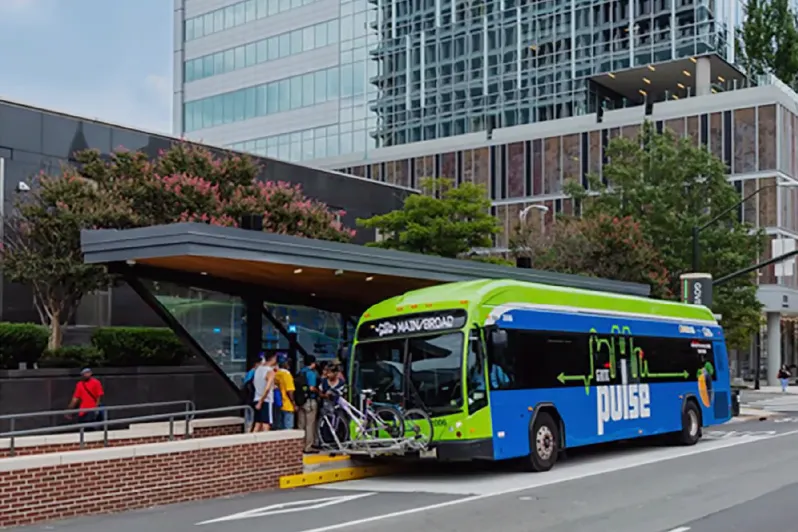
Fare-free service on GRTC transit routes will continue for at least another year.
The GRTC Board of Directors approved the organization’s 2027 operating and capital budget May 19, pledging to continue fare-free transit for the next fiscal year – through June 30, 2027 – while advancing major transit and infrastructure investments across the Richmond region.
GRTC’s 2027 fiscal year balanced budget totals just more than $101 million, with $7.5 million of that being grant-funded projects. GRTC’s capital budget for Fiscal Year 2027 totals nearly $43 million.
“It shows that we can sustain reliability, accessibility and free transit while holding costs,” said GRTC CEO Sheryl Adams.
The board discussed how the budget responds to several priorities, including providing paratransit services and fare-free buses, while maintaining awareness of an expected diminished investment by the federal government.
The public transit system will identify additional revenue potentials to present at a future meeting, analyzing a five-year plan to ensure fare-free sustainability as part of GRTC's vision, GRTC Chief of Staff Adrienne Torres said.
Torres explained that the zero-fare is included in the budget – something made possible in part by carrying over a $2-million budget surplus. That amount, coupled with increased advertising revenues and about $1 million in funding from the Virginia Department of Rail and Public Transit, will allow the agency to fund the $6 million or so that it costs to keep service free for riders.
“About fare-free, is it going to continue to be an every-year question?” GRTC board member and Brookland District Supervisor Dan Schmitt asked. “I think we were looking for, 'what's the commitment?' Every year, are we going to come back and say ‘Well, fare-free really depends on if we have a surplus and we’ve found advertising money. . . ’ Is it going to become a priority of this organization, so it's not contingent upon, ‘Oh we had a bad year?’”
GRTC Board Chair and Varina District Supervisor Tyrone Nelson urged the board and staff to commit to making zero-fare a priority so that riders don't have to wait every year for media reports that the board met and said ‘Well thank God last year was okay, we can continue.’
“What I’m hearing as we move forward is that fare-free is costing $6 million, and we need to know where that $6 million is targeted to come from. We know where that $6 million is coming from this year but that is part of the discussion as we move forward,” Nelson said.
GRTC continues to fundraise to help meet those goals, according to officials.
The budget conversation also focused on rising costs, challenges and shortages.
GRTC’s projected operating revenues for FY27 reflects a decrease of $6.4 million, which is 6% less compared to FY26. This decline is primarily driven by the unavailability of federal highway administration Congestion Mitigation and Air Quality funding, a reduction in Federal Transit Administrations Urbanized Area Formula Program Flex funding, and decreased grant-funded consulting services.
The operating and capital budget documents explained that these reductions are partially offset by continued growth in Central Virginia Transportation Authority revenues, statutory Consumer Price Index for All Urban Consumers adjustments to local government contributions, and ongoing support from the Virginia Department of Rail and Public Transportation.
As wholesale gasoline prices have increased significantly and remain highly volatile, exceeding original budget assumptions, the board voted to approve a change order to GRTC’s gasoline fuel delivery services contract with Colonial Oil Industries increasing that amount to $386,000 to cover projected fuel expenditures through Aug. 20.
GRTC is still awaiting potential support from the Commonwealth of Virginia related to a data center tax.

Plans for North-South Pulse expansion discussed
The City of Richmond, Chesterfield County and Henrico County all contribute to GRTC’s operations. For the 2027 budget, Richmond is the top contributor at $12 million, followed by Henrico ($5.3 million) and Chesterfield ($2.2 million).
Other contributions come from the Central Virginia Transportation Authority, Virginia Department of Rail and Public Transportation, grants, and federal COVID relief.
Henrico County Public Works Director Terrell Hughes, who sits on the GRTC board, said he believes county residents are receiving their fair share. Bus expansions in Henrico have increased during the past few years, and several plans for bus mobility are progressing in the county.

On May 18, consultants with the Design Collective firm spoke at a public online presentation of the North-South Pulse Transit-Oriented Development Study, which explored during the past year how transit-supportive development can thoughtfully complement existing communities along the North–South Pulse Bus Rapid Transit Expansion, which is expected to be complete in 2031. They shared key findings, community feedback, and the vision for shaping the future of local transit corridors.

Plans call for a station along Brook Road near Azalea Avenue in Henrico County, at the norther terminus of the planned BRT route, near the city-county line and not far from I-95.
Cecily Bedwell, a principal planner with Design Collective said it was important to make sure there were some park-and-rides so that people coming from the county would be able to exit their vehicles and then get on the BRT and head south.
There are several abandoned or vacant commercial sites there, one of which is the former site of Azalea Mall at Azalea Avenue and Brook Road. Surface lots and vacant commercial spaces sets this site up for an ability to redevelop a mixed-use destination.
During workshops and online survey, the contractors heard from stakeholders that building a mixed-use environment there as well as providing varied housing types should be a focus of the area.
Bedwell emphasized pedestrian and walkable conditions include continuous sidewalks, trees that will shade those sidewalks as well as some gathering spaces along the corridor.
A concept plan, showing a potential redevelopment scenario, illustrated larger multifamily buildings in the range of five to seven stories near the transit station, with ground floor retail along with open spaces and a civic building.
Moving outward from the core of development would transition the area to single-family neighborhoods with some single family attached units at the periphery.
A final report will lay out a set of phases that show what could potentially happen in the next five to 10 years and what could happen over the longer term. The public can still provide feedback on the TOD online through May 31.
Looking ahead, while certain GRTC bus routes have been cut back due to staffing shortages this winter (including the Pulse bus rapid transit evening service) in June, when GRTC reconsiders the bus schedules and staff scheduling, Pulse trips are due to be added back.
Dina Weinstein is the Citizen’s community vitality reporter and a Report for America corps member, covering housing, health and transportation. Support her work and articles like this one by making a contribution to the Citizen.