DEQ weighs new PFAS requirements for Richmond airport as residents seek tougher limits
Stormwater leaving Richmond International Airport has carried PFAS – the persistent “forever chemicals” long used in firefighting foam – in every sample tested during a nearly two-and-a-half-year study, according to a March report prepared for the Capital Region Airport Commission, which owns and operates the airport.
At a public hearing in Henrico Oct. 28, speakers told state regulators that a draft permit meant to address the contamination doesn’t go far enough.
David Sligh, water quality program director at Wild Virginia, called the draft “a plan to have a plan.”
“The goal of this permitting and the whole system of regulation is to protect the public and the environment,” he said. “But, frankly, DEQ has a long history of failing to do that in relation to PFAS controls and discharge permits.”
The Virginia Department of Environmental Quality is weighing whether to reissue the airport’s stormwater discharge permit, which would for the first time require the Capital Region Airport Commission to monitor for PFAS and develop a plan to reduce them. Written comments are due Nov. 12.
PFAS, short for per- and polyfluoroalkyl substances, are a group of chemicals that have been used in industry and consumer products since the 1940s. They break down very slowly and build up in the environment. Research links exposure to certain PFAS to health issues including reduced fertility, weakened immunity, and cancer.
What testing found
DEQ’s fact sheet says PFAS concentrations at all three of the airport’s stormwater outfalls exceed EPA’s drinking-water standards for certain PFAS compounds. EPA’s limits for PFOA and PFOS are 4 parts per trillion, with compliance determined using running annual averages. DEQ emphasizes that these drinking-water standards do not apply directly to the airport’s stormwater discharges.
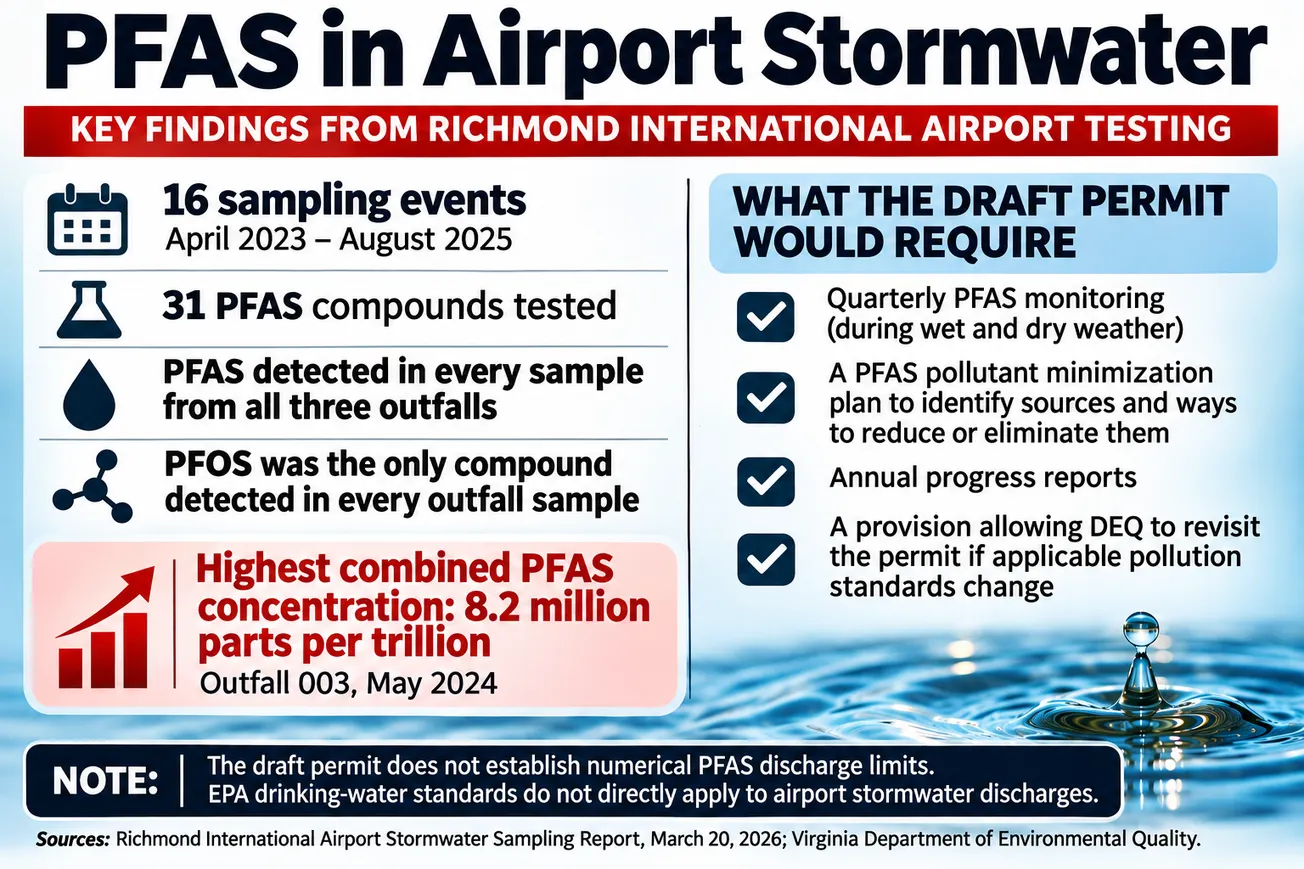
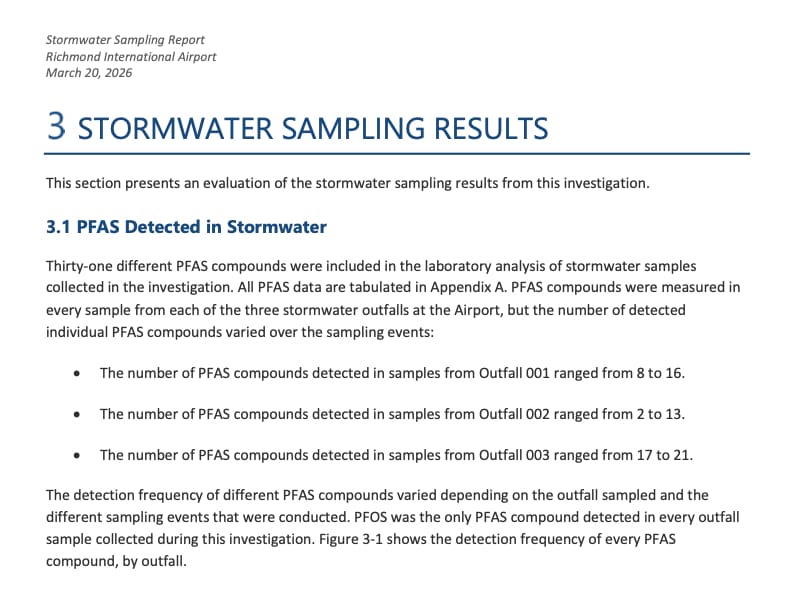
The airport’s permit application includes a March sampling report, prepared for the commission, covering 16 sampling events between April 2023 and August 2025 at the airport’s three stormwater outfalls. Lab analysis looked for 31 PFAS compounds. PFAS turned up in every sample from every outfall, and PFOS – one of the two most studied PFAS compounds – was the only compound detected in every outfall sample.
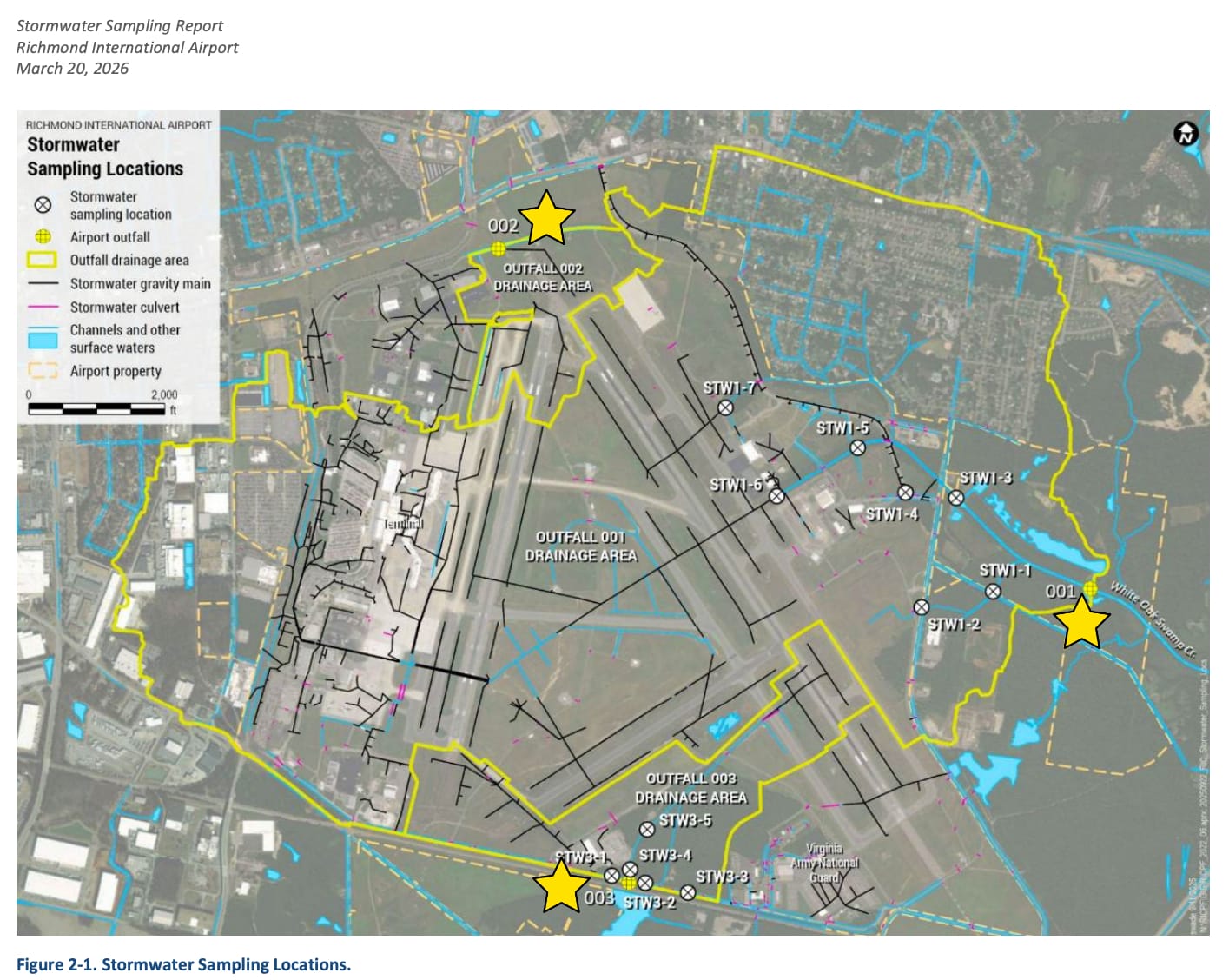
The airport’s sampling shows that its stormwater contains PFAS at concentrations exceeding certain EPA drinking-water standards. According to the airport's permit application, its three stormwater outfalls discharge into White Oak Swamp Creek, an unnamed tributary of Gillies Creek, and an unnamed tributary of White Oak Swamp Creek, respectively.
The report ties much of the contamination to aqueous film-forming foam, which federal aviation rules historically required certain commercial airports to use and test. It identifies seven locations where the foam has been used, including a former firefighter training area and former Air National Guard sites.
DEQ has conducted extensive PFAS sampling in White Oak Swamp and the Middle Chickahominy watershed, according to its communications department. This webpage shows a dashboard with a map and the associated data.
Of the airport's three stormwater outfalls, Outfall 003 (located on the southern end of the airport's footprint, near Portugee Road) recorded particularly high concentrations of PFAS during the study. The highest combined concentration measured there was 8.2 million parts per trillion in May 2024, according to the airport's March sampling report.
The report also concluded that four PFAS compounds (PFTriA, PFNS, PFOSA, and 8:2 FTS) were detected only at Outfall 003 and suggested "that the source of PFAS at Outfall 003 may be from a different AFFF formulation or from a different non-AFFF source."
(View Richmond International Airport's entire application for a National Pollutant Discharge Elimination System permit to discharge wastewater below)
What the draft permit would require
The draft permit would require the airport to conduct quarterly PFAS monitoring during both wet- and dry-weather conditions and report the results to DEQ, according to the agency's presentation at the hearing.
It also would require the airport to submit a PFAS pollutant minimization plan identifying sources, ways to reduce or eliminate them, a schedule and measures of progress, with annual progress reports.
Once approved, the plan becomes an enforceable part of the permit, and a “reopener” would let DEQ add limits as new state or federal standards are adopted.
Separately, a 2026 state law requires the Capital Region Airport Commission to develop a plan to discontinue the use of PFAS-containing firefighting materials at the airport by Jan. 1, 2030. The commission must complete the plan and submit a report to the Virginia Aviation Board by Nov. 15, 2026.
Troy Bell, the airport’s public relations director, said RIC does not currently have a comment or additional details about the plan that must be submitted to the board.
Eight people spoke at the hearing held at the Henrico Theatre, each limited to three minutes. DEQ staff did not answer questions.
Most speakers asked for the same three changes: enforceable PFAS limits or at least numeric benchmarks, public review of the pollutant minimization plan, and firm limits on PFAS firefighting foam.
“Monitoring is important, but monitoring alone does not prevent pollution,” said Dana Adkins, Tribal environmental director for the Chickahominy Indian Tribe.
He discussed how these local watersheds face potential contamination from multiple sources, including stormwater runoff, industrial, and commercial activities, airport operations, and legacy pollution.
“These sources must be considered collectively, because contaminants can move through wetlands, sediments, waterways, and food webs creating cumulative impacts beyond individual properties and permit boundaries,” Adkins said.
PFAS is a particular concern, he continued, pointing out that elevated PFAS concentrations had previously been identified in the middle of the Chickahominy River watershed.
“This history underscores the need for proactive protection, rather than waiting for every scientific uncertainty to be resolved, or for widespread harm to become evident,” he said.
James Riverkeeper: RIC's steps are 'not a substitute' for enforceable-limit permit
Tom Dunlap, James Riverkeeper with the James River Association, said the airport’s voluntary steps are appreciated but “not a substitute” for a permit with enforceable limits.
Carroll Courtenay, a senior attorney with the Southern Environmental Law Center, said the plan should be open to the public. Choosing the airport’s actions “should not be carried out in the dark.”
“The airport is unknowingly polluting our water, soil, and groundwater with harmful PFAS,” said a Sandston resident who recently moved to the area. “I did not predict that my move would bring on discussions of whether I should test my well water for PFAS. How do I test my well? And how do I pay for that test?”
Henrico has tested private wells near White Oak Swamp for PFAS since 2021 and offers free well testing to residents.
Bentley Chan, director of Henrico County’s Department of Public Utilities, said the county is continuing the program.
“We’re continuing our free testing and filter installations on private drinking water wells (over 400 tests and almost 50 filters) and recently got a grant from U.S. Rep. Jennifer McClellan to begin public drinking water extensions,” he said.
The county also recently announced that McClellan had secured $1.09 million in federal funding to extend public drinking-water service to 41 homes in the Cedar Ridge neighborhood off Portugee Road, providing an alternative to private wells in an area affected by PFAS contamination.
Asked in writing why the draft relies on monitoring and a minimization plan rather than limits, and what would trigger the reopener, DEQ Communications Manager Irina Calos said the permit is still a draft, and the agency has not made a final decision on any limits.
Asked whether the minimization plan would be made public or open to comment before approval, Calos said DEQ has received comments requesting that and will weigh them with the rest.
Next steps
After the comment period closes, DEQ will evaluate all comments, publish a summary with its responses, and then decide whether to issue, modify or deny the permit.
A second public hearing is tentatively set for January or February 2027. DEQ says it will notify everyone who commented or signed in at the Oct. 28 hearing by email or mail.
Anyone can submit written comments on the draft permit through Thursday, Nov. 12. Emailed comments must be received by 11:59 p.m., while mailed comments must arrive by the close of business. DEQ asks that comments address the technical merits of the draft permit (VPDES permit VA0090301) and include the commenter's name and either a mailing address or email address.
Members of the public can write to DEQ by email to joy.abel@deq.virginia.gov, or by mail to: Joy Abel, DEQ Piedmont Regional Office, 4949 A Cox Road, Glen Allen, VA 23060.