The fish that swam with dinosaurs: Sturgeon are full of surprises, including that they’re here
Last fall on Marshyhope Creek, which flows into the Nanticoke River on Maryland’s Eastern Shore, biologists found something they thought they might never see: six adult female sturgeon that appeared ready to spawn.
“For us to get a female is, like, a monumental thing. But to get six of them in one year…,” said Chuck Spence, a fisheries biologist with the Maryland Department of Natural Resources.
Even better, he said, one of them was a “spent female,” meaning she appeared to have just released her eggs into the creek.
Stence and other DNR biologists have been trying to prove that the endangered fish spawn in the creek since 2013. That’s when a sturgeon, a species biologists thought had long vanished from the waterway, proved it was present. The five-and-a-half foot fish jumped into the boat of two fishermen.
Sturgeon have been providing such surprises for decades — including the mere fact that they still exist.
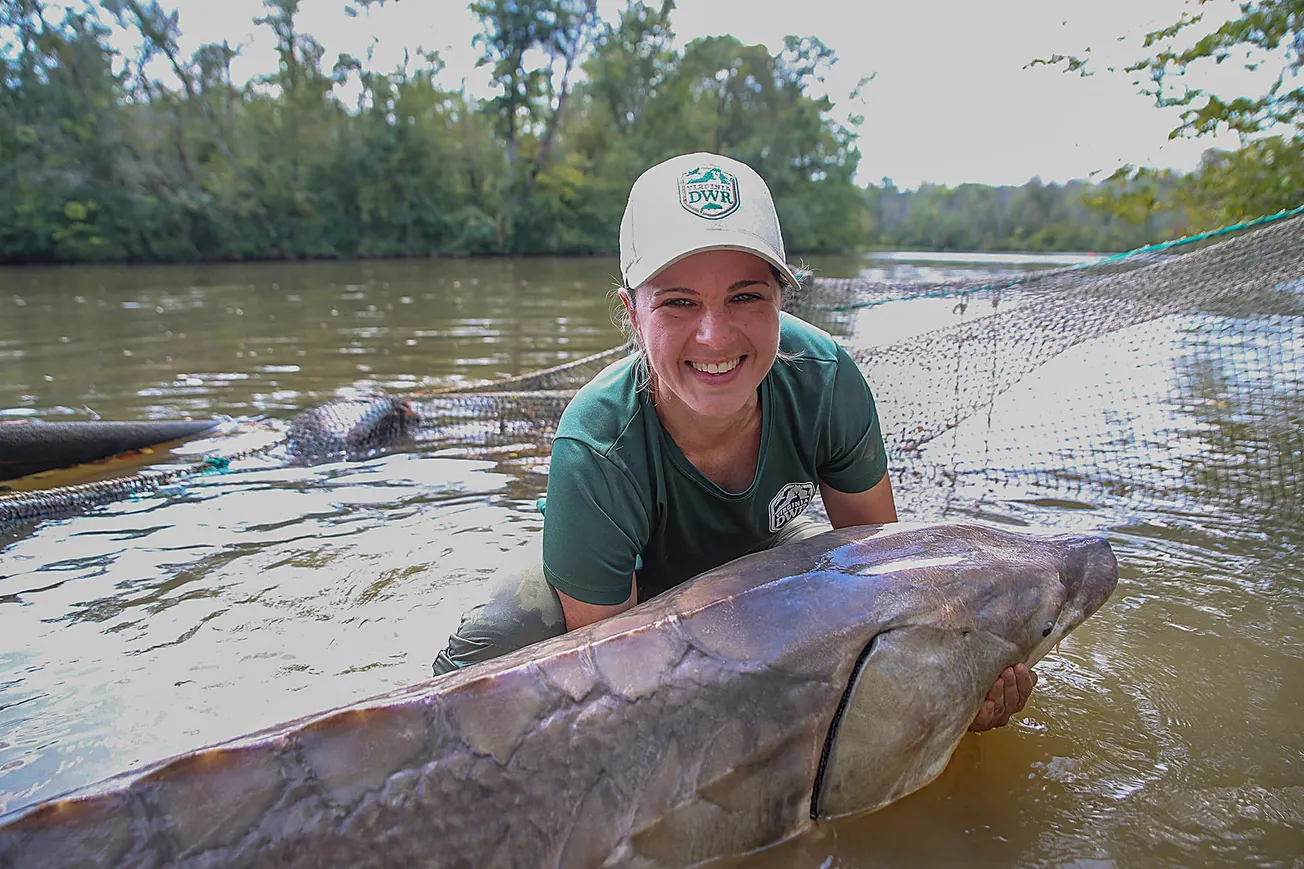
Atlantic sturgeon are the largest fish native to the Chesapeake Bay. Adults are routinely five to six feet long, sometimes larger, and weigh 100-300 pounds. Historically, they reached lengths of 14 feet and weights of 800 pounds.
That such gigantic fish could be overlooked seems remarkable, especially given that Capt. John Smith reported in 1609 that the James River was filled with “more sturgeon than could be devoured by dog and man.”
But sturgeon were a victim of overfishing to meet global caviar demand in the 1800s and early 1900s. By the 1990s, many thought spawning populations had vanished from the Bay region.
Biologists were surprised when evidence of remnant spawning populations emerged first in the James, then the neighboring York River, and potentially in the Marshyhope/Nanticoke system.
The discoveries may not be over.
Biologists suspect a remnant population remains in Virginia’s Rappahannock River, and some believe there is potential for their presence in several Maryland rivers, including the Potomac, Pocomoke, Patuxent, Chester and Susquehanna.
There’s reason for their optimism.“If there’s one thing that’s been consistent across the coast over the last 30 years with Atlantic sturgeon, it is that the more we look, the more we find,” said Dave Kazyak, who specializes in fish genetics at the U.S. Geological Survey’s Eastern Ecological Science Center.
Those discoveries have forced biologists to reconsider what they thought they knew about sturgeon. That’s led to even more questions, many of which are critical for trying to manage and protect the species, which was listed as endangered in 2012.
They may live longer than previously thought — perhaps more than a century. Populations in some rivers spawn in the fall; in others, they spawn in the spring. In some places, like the James River, they spawn in both seasons.
Sturgeon wander among rivers more than other fish, and in some cases they seem to visit spawning grounds but not spawn. In some rivers, they spawn in deep water. In others, they spawn in tiny, shallow creeks you could skip a stone across.
Understanding those details is critical to protecting the fish. Their complex life cycle exposes them to a host of threats, from invasive blue catfish in Bay spawning grounds to ship strikes in the ocean. They could be caught in the bycatch of other fisheries, and they are vulnerable to pollution. Some people worry about the impacts of offshore wind farms, and development can threaten spawning areas.
“They’re constantly surprising you,” said Margi Whitmore, a fisheries biologist with the Virginia Department of Wildlife Resources. “And it feels like the more you learn, the more you need to know.”

Genetic confusion
One of the surprising things about sturgeon in the Bay region involves the Marshyhope/Nanticoke fish, and it illustrates why so little about the species is straightforward.
Sturgeon are anadromous fish. That means they spawn in freshwater but spend much of their lives in the ocean before returning to their native river to create the next generation.
Typically, anadromous fish that spawn in a particular river are genetically distinct — presumably because, over time, each population adapted to conditions unique to that system.
But genetic analysis of Nanticoke sturgeon in Maryland turned that idea on its head: They look just like sturgeon from the York River in Virginia, 100 miles further south and on the other side of the Bay.
“They’re very, very, very similar,” Kazyak said. He studies sturgeon DNA and has identified 18 unique populations along the East Coast. Right now, the Nanticoke is not one of them.
“Looking up and down the coast, they are the only spot that I see where we have two different rivers [with populations] that look basically identical to one another,” he said.
Nor is it the only genetic surprise in the Bay. While sturgeon from the York and the Nanticoke seem to be the same, the James has twodistinct populations.
One spawns in the spring, like other anadromous fish on the East Coast, while the other spawns in the fall, like sturgeon in the Bay. Genetically, the spring and fall fish are not closely related, and neither population is closely related to York fish.
Kazyak said there could be logical explanations. Sturgeon are an ancient fish, dating back tens of millions of years — they’re called the “fish that swam with dinosaurs.”
They also outlasted the dinosaurs, and of course they predate the Bay and the current arrangement of the East Coast, the ages of which are measured in mere thousands of years.
At one point, perhaps millions of years ago, Kazyak said separate spring and fall populations may have formed along the coast, and spread independently to different rivers, explaining why two populations in the James are not closely related.
Similarly, their spawning habitats may trace back to ancient rivers that predate the Bay. That could explain the similarities of York and Nanticoke fish. Together they could be a “meta-population” from the same long-gone river. Or the Nanticoke could represent efforts of York sturgeon that have tried to colonize new areas but have not had time to differentiate themselves.
Or they could just be passing through.

Implications for management
It is more than an academic question. Fish from different populations often behave differently.
Fish in the James, for instance, seem to spawn in deep water, while those in the York and Nanticoke go far upstream into small, shallow creeks that many biologists thought, until recently, were off-limits to such big fish.
Spring and fall spawning fish in the James appear to spawn in different areas of the same river.
Sturgeon science has benefitted from tracking efforts taking place along the coast over the last 10-15 years. Telemetry tags in thousands of captured fish have allowed scientists to track their movements and to recapture them.
It shows that sturgeon from different populations take different routes in and out of the Bay and at slightly different times. Trying to manage distinct populations doing different things complicates management and protection efforts.
“There are so many little nuances about what these fish are doing,” said Matt Breece, a fisheries scientist at St. Mary’s College in Maryland. “All these populations are behaving a little bit differently, so it’s pretty fascinating. But also makes it a little bit tricky to manage.”
Scientists once thought that sturgeon, which don’t reach maturity until they are about 10 years old — likely older for females — only returned to spawning rivers about every five years.
But tracking has shown that males often return every year, and females every two-to-three years. Tracking has also revealed a surprising degree of “wandering” from river to river, especially within the Chesapeake.
In some cases, sturgeon from one river venture to spawning grounds in another river during spawning time. But it’s unclear whether they intend to spawn there. In some cases, they seem ready to attempt spawning. In others, recaptured fish don’t seem likely to spawn. Why would a fish spend the energy swimming up a river with no intent to spawn?
“It’s one of those sturgeon mysteries, and one of those things that we really need to dig down into, because it affects how we measure their abundance,” Whitmore said.
It’s important because scientists assume that fish returning to spawning grounds are from that river — and that they actually spawn.
While fish like striped bass occasionally wander, too, it is more pronounced among sturgeon. “It’s really a lot,” said Dave Secor, a migratory fish expert with the University of Maryland Center for Environmental Science. “It’s a real head scratcher.”
It’s also why Maryland biologists were relieved to find a “spent” female in the Nanticoke system last fall: It was the most concrete sign to date that the fish were still spawning in the river and not just passing through.
“It’s the only fish we ever captured that had eggs actively flowing out of her when they caught her,” said Ashlee Horne, a Maryland DNR fisheries biologist.
Survival concerns
Perhaps the biggest mystery about sturgeon, though, is whether they will persist.
While there are signs that populations on the York and James are increasing — and hopeful evidence of spawning on the Nanticoke — these long-lived, wide-ranging fish face threats throughout their lives.
Spawning habitats, especially in shallow water, can be threatened by development. That’s one reason scientists are anxious to learn whether sturgeon are spawning in more rivers around the Bay.
But their top concerns are blue catfish predation and ship strikes.
In the last 20 years, nonnative blue catfish have surged in Bay tributaries, first in Virginia and more recently in Maryland.
Scientists in both states say that when they trawl for young sturgeon, their nets get filled with thousands of young blue catfish that would happily eat any sturgeon eggs or larvae in the area.
“I think blue catfish is kind of, unfortunately, a smoking gun here for predation on juvenile native species,” said Secor, who has participated in fruitless searches for young sturgeon and eggs in the Marshyhope.
Biologists have been tagging adult sturgeon on the James since the late 1990s, hundreds of which have been recaptured as they return to spawn. But recaptured fish are mostly from the 1990s and early 2000s, said Matt Balazik, a conservation biologist with Virginia Commonwealth University.
Fish spawned later, which are now old enough to return to spawning grounds, are mostly absent, Balazik said. “That’s the red flag,” he said. “They should be spawning around age 10 for males, and we’re not seeing them.”
While blue catfish threaten young sturgeon, ship strikes are a growing concern for adults. Dead sturgeon thought to be boat strike victims often turn up in both the Bay and the Atlantic.
Biologists worry that egg-bearing females, which grow larger than males and do not return to spawning grounds as often, may be particularly vulnerable. Balazik found an egg-filled dead female that he estimated to be 15 years old, clearly ready to spawn.
“This was probably her first spawning run, but she never spawned,” he said. “She was chopped up probably hours before her first spawn. That is a big concern.”
The toll on adult fish in relatively small populations can be substantial.
On the Nanticoke, where the spawning population is estimated in the dozens, biologists have found one sturgeon killed in recent years from a boat strike. They suspect two others were also victims, but the bodies were too decomposed to be certain.
Outside the Chesapeake, sturgeon are vulnerable to strikes as they migrate along the coast. A study in the Delaware River estuary found 28 adults were killed by ships between 2005 and 2008. But that is likely just a fraction of the mortalities, because most the bodies of dead sturgeon likely sink, drift out to sea or wash up on deserted shorelines. A follow-up study, in which scientists released dead sturgeon into the water, found that only 5% got reported.
It’s not just a threat to the Delaware population.
“We’ve done some genetics work on carcasses that have appeared in the Delaware River and estuary, and there are many, many populations represented amongst those mortalities, including quite a few Chesapeake Bay fish,” Kazyak said.
A resilient fish
But the characteristics that make sturgeon surprising in so many ways may help their survival.
Their straying between rivers, Secor said, means that if the population in one river gets severely depleted, it might get bolstered by fish from another river. “These systems can beg and borrow from each other.”
Work on the York and James rivers has shown that adult fish grow much more slowly than thought — adult males nearly stop growing altogether. And biologists now think sturgeon may be living a century or more, rather than the 60-year maximum once thought.
That surprising longevity means their populations can continue even if fish are only occasionally successful at spawning.
And the fact that they eluded detection in the Bay for so long gives biologists hope that they will continue to turn up in more Bay tributaries and along the coast. Rivers with only fall spawning populations might turn out to have spring spawners. No one is actively looking.
“They are rule breakers,” said Chris Hager, a biologist with the research firm Chesapeake Scientific who has worked extensively with sturgeon. “That’s how they’ve maintained their existence for millions of years. When one of them is doing ‘this,’ there’s always another group doing ‘that.’ This is why [a comet] killed the dinosaurs, yet the sturgeon are still here.”
This article originally appeared in the Chesapeake Bay Journal and is republished here with permission through a partnership. The Bay Journal is an award-winning nonprofit news organization that has been covering environmental issues in the Bay region, such as water quality, land use, forest health, fish, agriculture, crabs and other related topics, for more than 30 years.