Richmond SailFest highlights area history, marks the nation’s 250th anniversary
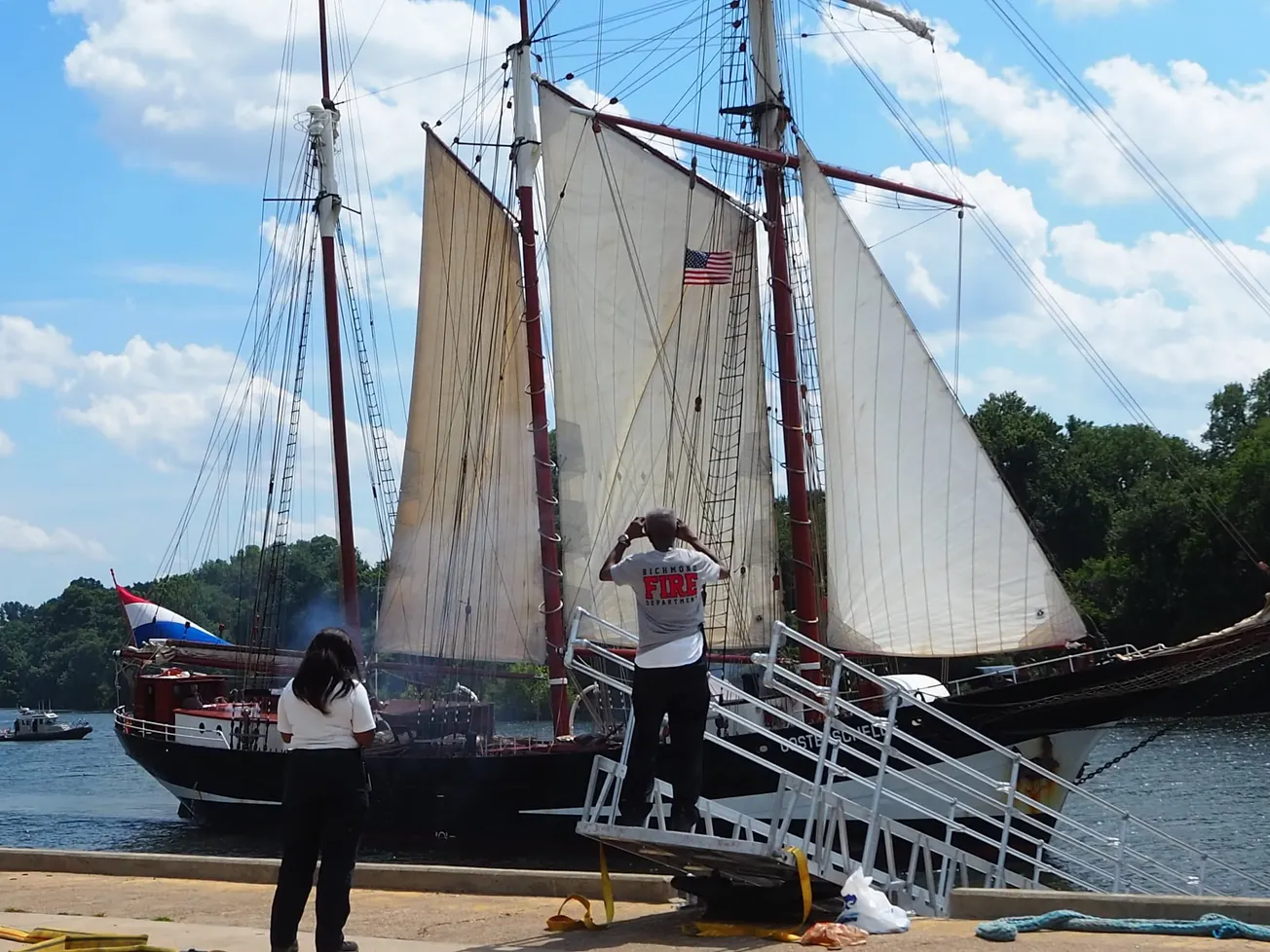
Historical boats with tall masts and sails, like the ones that once traveled up the James River, are docked and opened for viewing at Rocketts Landing along the Henrico-Richmond border this weekend in celebration of the nation’s 250th birthday celebration.
The Pride of Baltimore, the Virginia from Norfolk and the Oosterschelde from the Netherlands, all from around 1917 with crews that are devoted to maritime education, are centerpieces at the weekend-long celebration. The location of the ships harkens back to Richmond’s past.
In his opening remarks at Richmond SailFest Friday morning, Richmond Mayor Danny Avula remarked that the James River is the lifeblood of the city today as it has been for hundreds of years, playing an important role in the history of the state and nation.
Oosterschelde first mate Matu O'Flaugherty (top left), crew member Famke Opdam (top right). A view of the navigational bridge as the ship has an engine (lower left) and the galley (lower right). The active working ship takes on a guest crew including scientists when the ship sailed in the route of Charles Darwin. O'Flaugherty wants visitors to observe the details of the working ship which was a cargo ship built after the First World War. (Dina Weinstein/Henrico Citizen)
Avula called the 250th anniversary events part wrestling with the complexity of the past and part inspiration for how the nation forms a more perfect union for the next 250 years.
“Richmond does not shy away from its past,” Avula said. “Our city is seeped in history. And I think the greatness of our city is our beauty, our diversity and the richness of Richmond is the direct result of the honest reckoning that we have done and have been doing for decades here.”
He called SailFest another example of how people reckon with that history and become stronger because of it.
“As we stand here on the banks of the river we celebrate the fact that we would not be here if not for the arrival of ships like this so many years ago,” Avula said. “But we also recognize the history of ships sailing up the James River is really complicated.”
When Christopher Newport planted a cross on a hill here in 1607, that brought years of persecution of the Powhatan people, Avula acknowledged; in the years before Europeans arrived, the people here thrived.
Back then, as today, the river connected people. The James River carried thousands of enslaved Africans into the city, where kidnapped men, women and children were brought from Ancarrow’s Landing to Shockoe Bottom to be confined, tortured and sold into a life of slavery, Avula recounted. In the 19th Century, Richmond became one of the biggest slave markets in the United States.
With the development of the Kanawha Canal, built by Irish and Black laborers, routes of commerce developed. The city’s flag shows a faceless James River boatman, just one of many who were important points of the city’s economy. At one time, at least 98% of the boatmen were men of color, with the James River being a point of freedom, as it gave daily freedom but also a route for enslaved people fleeing North.
“I’m so proud that they are represented on the center city’s flag, as a representative of our city and also our aspiration to live up to it as a city,” Avula said. “While the tall ships aren’t representative of Richmond’s complicated past, they do allow us to reflect on that past, and to celebrate the progress that we’ve made, but also to acknowledge the work that we have to do. You know, we are still working on the promise of freedom and equality for the past 250 years, but you know, we are still working on it. The work to create a truly democratic nation remains unfinished.”
'It keeps history alive'
Organized collaboratively with the Virginia Museum of History & Culture, the three day event includes exhibitions of history and art, historical re-enactors, performances and an epic fireworks, drone and music experience over the James River.
At the Friday morning opening event Jamie Boskin, president and CEO of the Virginia Museum of History & Culture said SailFest was kicking off exactly 250 years to the day in 1776 that Virginia adopted the Virginia Declaration of Rights drafted by Virginian George Mason, which served as the basis of the Bill of Rights.
“All power is vested in the power of the people, ideas that we have seen challenged right here and ideas we’ve seen contested. It has inspired immense progress, for us and also for many nations around the world. Let us always be inspired by that progress, and be inspired by those ideas that we were founded on and be recommitted to those ideas every day and for every generation to come,” said Boskin.
On Friday morning, on board the Virginia, Henrico resident Sherman Gifford, who docks a sailboat in Norfolk, was trying to keep cool and tidy up the boat.
He volunteered on the Virginia ship to learn specific skills and be a part of a historical reenactment.
“It keeps history alive. Every day I learn something I didn’t know, sail handling, rigging, all these terms that you hear are out of history books, it’s wonderful,” said Gifford who emphasized the importance of safety. “We’re all looking for things that are out of place.”
Gifford took in the fact that boats were back where they would have been in Richmond’s maritime heyday.
Gifford wants people who visit to gain an appreciation of the history while looking at a boat that was launched in 1916. The original boat had no engine. The 20-plus member crew must work together to hoist sails.
“It’s a great equalizer that needs teamwork. It’s all manual. The sails weigh 2,000 pounds. It takes two halyards with teams pulling in unison to hoist them up,” Gifford said.
As the boats moved up the James on Thursday, volunteer re-enactors at the Henricus Historical Park, which overlooks the James River in Chesterfield, wore mid-17th century dress and fired up a cannon to give a loud traditional salute to each of the three ships passing by, as a crowd of nearly 100 people looked on.
“The river was the highway, and this was the place where all the traffic went,” said Charlie Grant, history division manager of Chesterfield County. “You didn’t have anything going over land. And this is why all these ships were important to historic sites like this, because these were the train, the truck, the bus. These ships were all extremely important.”
“It’s wonderful. These ships are really big. You feel lucky to be able to watch it,” said Dennis Strawterman, a marine veteran and the captain of the Henricus Militia who was dressed in 17th century period clothing.
After Richmond SailFest, the boats are visiting other U.S. cities, including Norfolk, Baltimore, New York and Boston.

If you go to Richmond SailFest:
Docked at Intermediate terminal or 3101 Wharf Street, admission to tour the ships is free but staggered and requires a free timed ticket.
With thousands of people expected, organizers want the public to know that there is no on-site parking for SailFest. Limited public parking is available in both Stone Brewing parking lots.
There is free parking in the lots immediately connected to Main Street Station. Attendees can board the free GRTC Pulse bus at the Main Street Station stop and ride east to the festival site near East Riverfront Station. The free parking is available at Main Street Station only in Lots A, B, and C during Richmond SailFest.
GRTC buses, including the Pulse, are free and fully accessible. The walk from the East Riverfront Station to the festival site is a quarter mile along paved sidewalks and streets.
Bike parking is available.
Richmond SailFest hours: Friday, June 12, 11 a.m. to 6 p.m. Saturday, June 13, 10 a.m. to 9:30 p.m., Sunday, June 14, 10 a.m. to 4 p.m.
The event spans across the connected Dock Street Park (3021 Dock Street) and Intermediate Terminal (3101 Wharf Street). Fireworks will be launched across the river at Ancarrow’s Landing (1200 Brander Street) without public access.

Dina Weinstein is the Citizen’s community vitality reporter and a Report for America corps member, covering housing, health and transportation. Support her work and articles like this one by making a contribution to the Citizen.