
Skip to content

From concrete construction projects to international ambitions, airport commission aims for RIC to be region’s gateway to the world
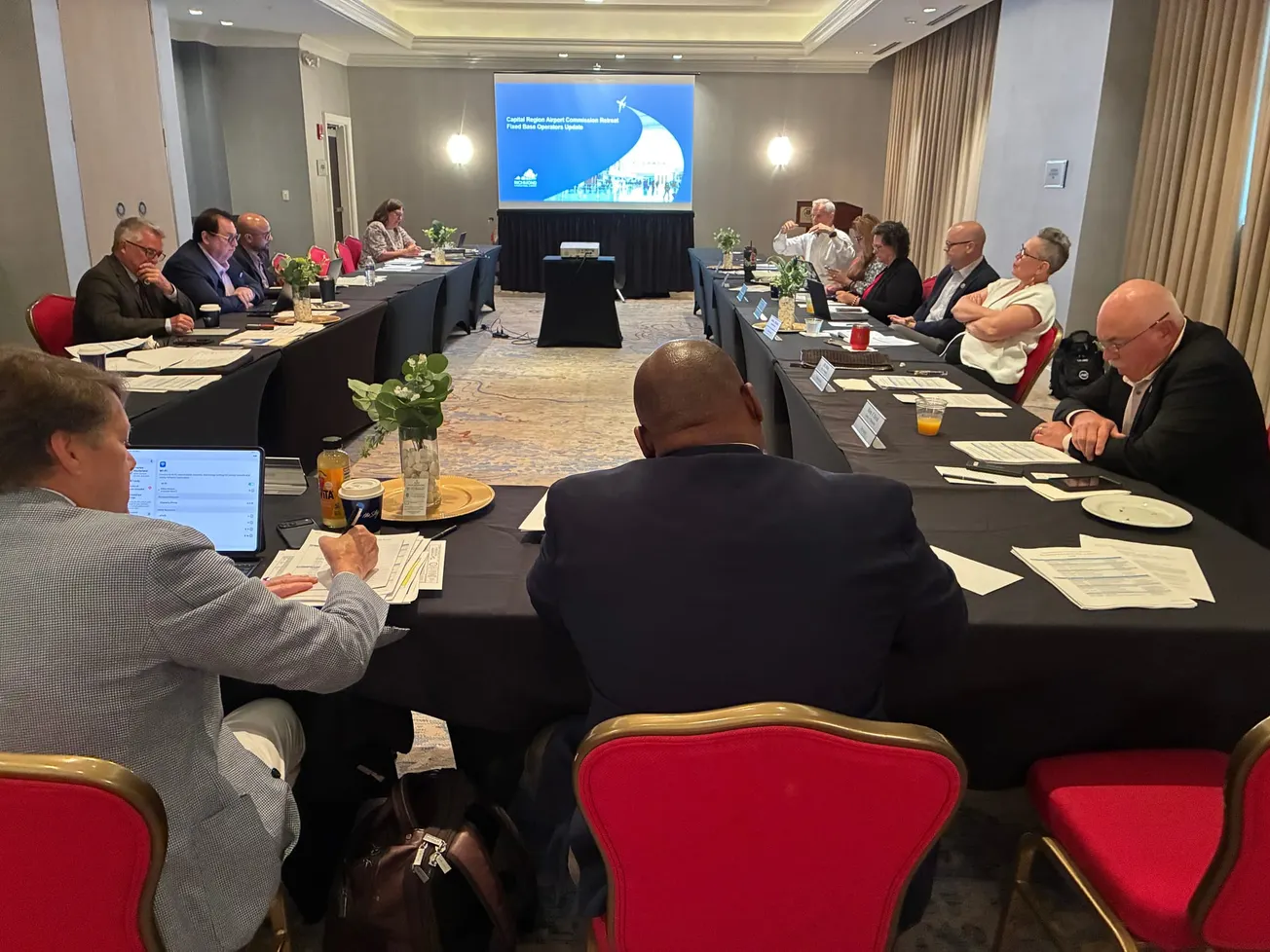
Robert Ukrop, (upper right) who represents Henrico County makes a point at the Capital Region Airport Commission annual retreat. (Dina Weinstein/Henrico Citizen)

A recent two-day working meeting covering Richmond International Airport’s scheduled construction projects and aspirational concepts for potential global growth covered sustainability as well as quick fixes to address employee and passenger satisfaction.

The Capital Region Airport Commission, which is composed of elected officials and business leaders from four jurisdictions surrounding Richmond International Airport, meets monthly to make decisions on finances, contracts and expansion.

Airport president and CEO Perry Miller said the working meeting went beyond the day-to-day decisions to set a vision for a future with the airport acting as Richmond’s gateway to the world.

“We'll talk about airport performance and how we're prioritizing the projects to achieve what we all have agreed on,” Miller told the board at the beginning of the meeting. “If we deliver on providing world-class customer experience and operational excellence, that regional prosperity would translate into this airport. That's a big, big, big deal.”

Focusing on a direction for growth and funding for critical projects, as the airport plans numerous construction projects, the meeting balanced the staff and commission’s aspirations against the realities of industry and economic trends.

Commissioner Robert Ukrop, who represents Henrico County, urged the group to think far into the future to set forth ideas envisioning what the area around the airport would look like 20 years from now. (Other Henrico commission members are supervisors Roscoe Cooper III of the Fairfield District; Tyrone Nelson of the Varina District, who also serves as CRAC vice chair; and Misty Roundtree of the Three Chopt District.

At the retreat, the Miami-Opa Locka Executive airport provided a luxurious aspirational visualization for potential renovations for Richmond Jet Center and Million Air (RIC's two fixed base operators), as a vision for the airport to attract and grow airline service. The FBOs' leases expire in 2031.

RIC wants to move the FBOs – which provide fueling services, maintenance, ground services support and baggage equipment repair – to the east side of the airport. (Airlines provide their own de-icing services at RIC.)

The luxury level of the Miami-Opa Locka airport level of design and commerce set off a discussion of RIC’s distinct identity and economy, leading into a conversation about the possibility of increasing global routes.  

Timeline critical for adding international flights

The formal conversation about RIC’s international flight aspirations took place during a closed session revealing few public details beyond the creation of a Greater Richmond Partnership task force to help facilitate the development of international service. The session on air service development was positioned as a discussion to align routes with regional demand and enhance RIC’s competitive position.

The airport requires significant financial support to realize international routes, which potentially could be developed as a public-private partnership. Airport officials have communicated with Virginia government leaders to solicit support for what is likely an eight-figure amount from the state, which would mitigate risk for the potential airline.

Additionally, European airlines in discussion with RIC officials are requesting a minimum revenue guarantee as they make route decisions for next summer.

“Airlines plan their network routes well in advance, usually between six months to a year in advance. So if we don't get in their books before decisions for next summer, and usually it's by season - spring or summer - then we're not going to be getting that flight next summer. That's why this summer, it’s important to get it in place to make that a reality next summer,” said Martin Rubinstein, RIC chief growth officer.

The airport is not allowed by the FAA to help any airline in particular secure a route because it's discriminatory against other airlines. That is why RIC requires other private and government bodies to commit funding as has been the case at other airports around the country.

“In every other instance where this has happened, the state usually bears 80% to 100% of the burden. We depend on the state contributing to that fund because we can't,” Rubinstein said. “We are speaking to pretty much every European and Latin American airline that will meet with us.”

Rubinstein said an RIC air route abroad makes sense because a significant number of people in the area travel internationally. Data shows a large number of travelers from RIC go directly to other airports to catch their international flights.

“We have at least one airline that is very interested in this market, and that we believe if we were to get the minimum revenue guaranteed this summer, we could get them financed; if not we'll have to try again. The momentum is there. The community's excited and we can see the finish line,” said Rubinstein, who acknowledged current budget constraints weighing on the commonwealth.

Travelers want coffee

Surveys showed an adequate level of employee satisfaction at the airport. A move to improve employees’ stability through childcare support at a new YMCA site is in the works.

Customer satisfaction surveys show that travelers are generally satisfied with RIC, but want more, better and faster food options, especially breakfast.

“We are an origination airport. That means the majority of the people that fly out of this airport are originating here. They're not connecting through here, which means that a lot of our flights are very early in the morning to go to a hub where they connect somewhere else every week,” Rubinstein said.

Most RIC travelers fly to hubs such as Atlanta, Charlotte, and Chicago and then elsewhere from there. Forty-two percent of the flights at RIC occur before 11 a.m. Rubenstein acknowledged long morning lines and wait times at the airport coffee shops, leading travelers with a short flight to eat elsewhere.

“That is terrible for us from customer experience but also from a revenue perspective,” Rubinstein said.

This year, the design development decisions leading to a new consolidated checkpoint will make room for more food options with a local connection to Richmond.

Capital improvement, energy needs

Ongoing capital improvement projects at the airport total $85 million, with $35 million budgeted for the aircraft rescue and firefighting station, the highest ticket item. The $7.8 million parking guidance system is the project that will be most directly visible to travelers.

For FY2027, two dozen capital projects will total $365 million, with the consolidated security checkpoint construction being the highest cost item at $252 million.

Projects that will help travelers directly include economy lot B and C improvements for $5 million; LED lighting for higher parking garage levels ($2.7 million) and passenger boarding bridge upgrades ($11 million) .

The construction budget for FY2028 totals $213 million, with more than a dozen projects listed, including the design of a fuel farm at $10 million. Discussion on that matter was couched as a way to provide security for the fuel supply and minimize the price of fuel. Discussion of the topic took place in a closed-door session.

Fueling is a main source of revenue for the FBOs, whose representatives sat through the meeting but were not a part of the discussion.

The airport is weighing four options for the fuel farm development: CRAC ownership and proprietary exclusive operation; CRAC ownership with third-party operation; airline fuel consortium ownership and operation; and a third-party ownership and operation, which is the current situation.

A timeline puts the design of a new fuel farm for the airport taking place next year. Construction would occur between 2028 and 2030, when it would be commissioned.

The project with the highest price tag in 2029 is the rental car garage expansion at $135 million.

Projects proposed through FY2029 to FY2032 total $879.5 million, with the highest cost item being construction at the parking garage at economy lot A ($140 million).

Solar power, revenue optimization

Day two of the commission's retreat began with a presentation about achieving Virginia’s decarbonization objectives while maintaining a reliable electric grid. Gennady Miloshevsky, a mechanical and nuclear engineering professor at Virginia Commonwealth University, gave a presentation on the possibility of modernizing energy sources through rooftop solar or small modular reactors. The airport has about 30 acres of surface parking lots that may be feasible for solar power panels.

In the area of potential land use development, Rubinstein highlighted Phoenix Sky Harbor airport’s land use plan, describing how a land use vision could optimize revenue and potentially reduce the currently self-sustaining airport’s risk into the future.

Parking is RIC’s current top form of revenue, but Rubinstein asserted that could decline because of the increase of self-driving cars. He said the most logical use of revenue is land use.

Phoenix airport’s land use plan divides development into aeronautical and non-aeronautical development. Though not an FAA priority, and although no federal funding from that agency is available for a land use plan and development, it could be executed in a way by which either the airport finances, operates and maintains the development of the airport properties or a hired third-party designs, builds and finances operations. Buildings in proximity to the airport are in demand, officials said.

“We want to make sure we're following how we want to grow and be a gateway to the world,” Miller said.

While passenger travel has steadily grown at a consistent 2.5% yearly, cargo and mail shipping has shown an even faster growth at RIC.

Consultant Steve Van Beek, an airport industry, expert presented commercial insights and practical possible solutions for strategic and business growth considering current challenges to the aviation industry.

Those challenges include the economy, and geopolitical conflicts increasing the cost of fuel and make flying more complicated.

Trends show flights changing to bend to demands and more restrictions on incoming travelers to the U.S., all having an impact on travelers, rippling down to low-cost carriers.

As a result of current trends, Van Beek said airports increasingly are looking to diversify revenue sources and find new capital and investment options. Airports are closely monitoring geopolitics to assess possible effects on demand and the consequent need for infrastructure investments.

Airlines now can bring in more revenue with one flight than they used to, with more services catering to high end passengers.

“You used to have a lot of 50-seaters into Richmond," Van Beek said, "now you have 150-seaters and in some cases 250 seats. That brings more revenue per operation for the airlines, and that'll vary by different type of airline. The ultra-low-cost carriers, they're not growing as fast because of that where they're cutting capacity. Whereas the big guys, they can again recover those costs. They have a premium product that people are willing to buy.”

Miller said the meetings’ wide-ranging discussions helped him and his staff learn the CRAC’s priorities as they make decisions going forward for Richmond International Airport.


Dina Weinstein is the Citizen’s community vitality reporter and a Report for America corps member, covering housing, health and transportation. Support her work and articles like this one by making a contribution to the Citizen.

Comments