Spirituality and patriotism themes of Ahmadiyya Muslim Community weekend conference
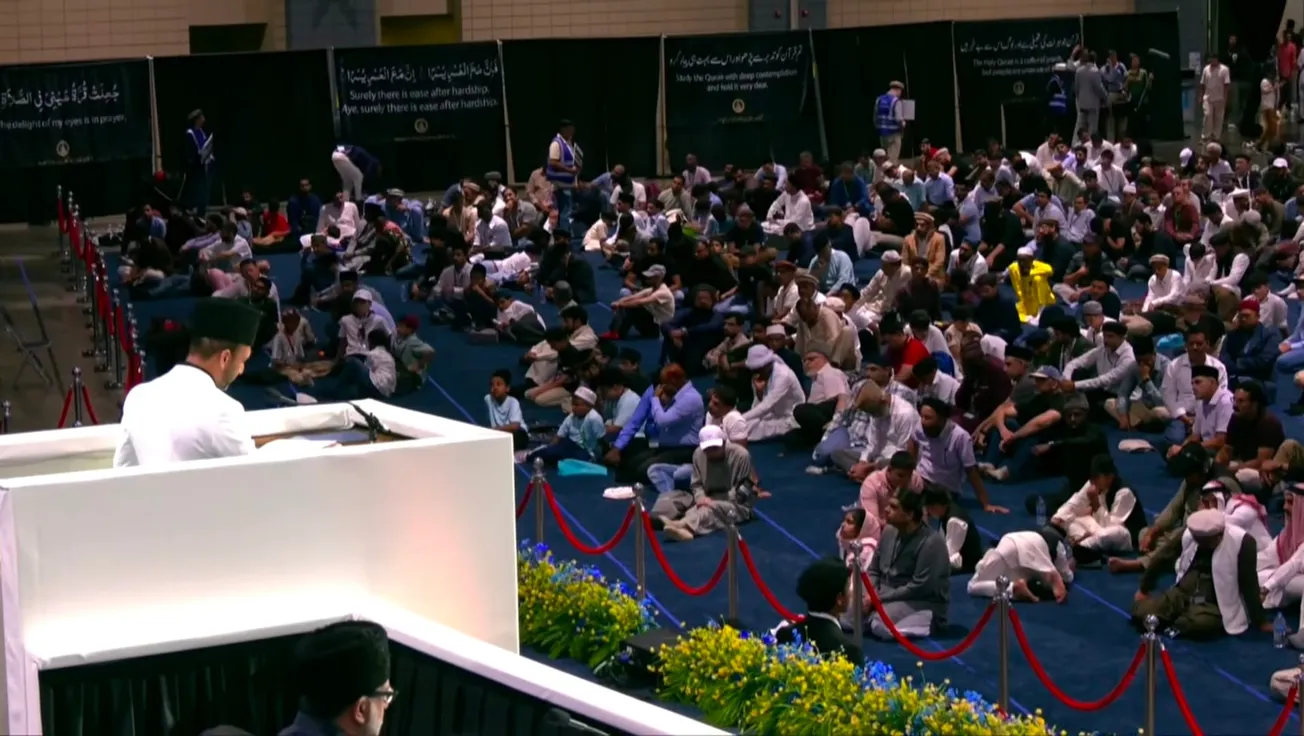
Urdu, Arabic and Islamic imagery intermingled with red, white and blue branding at the 76th annual Ahmadiyya Muslim Jalsa Salana convention this weekend at the Greater Richmond Convention Center, coinciding with the 250th anniversary of the founding of the United States.
The ideas of the nation’s founding principles of freedom, justice and religious diversity were the highlighted concepts of the keynote speech at the conference with nearly 10,000 people in attendance.
“The command of the Quran and the promise of America meet on the very same ground that every human being carries a dignity that is divine in origin and absolute important,” said Qasim Rashid in his keynote address on Saturday. “There is no peace without justice and there is no justice without that dignity. And here is the remarkable thing, America's all highest institutions already recognize this unity between the Islamic and the American view of justice. This is not my interpretation; this is historical affirmation.”
Rashid elaborated on connections between the founding ideas of the people who penned the U.S. Constitution, the country’s esteemed law schools, the nation’s highest courts and Islam.
Rashid, a University of Richmond Law School graduate who practices civil rights law in Illinois, titled his address ‘Peace Through Justice – Restoring the Promise of America’ bringing in many themes of America’s founding and justice.
Rashid emphasized the common ground between Islamic teachings and America’s highest ideals, saying: “The command of the Quran and the promise of America meet on the very same ground: that every human being carries a dignity that is divine in origin and absolute in worth.”
He also spoke plainly about current important issues and challenges facing Muslims in the U.S.
“Now despite these affirmations literally carved in stone, there are people in this country working with cruelty to convince you of the opposite. A dozen or so state legislatures have passed the so-called ‘Anti Sharia laws’ built on the false premise that Islamic teaching and American law are somehow enemies, but the Quran and the Constitution turn out to be reflections,” said Rashid in his keynote connecting America’s Founding Fathers’ writings, specifically Thomas Jefferson’s defense of religious liberty.
“When someone tells you Islam has no place in America, you may tell them respectfully that the father of the First Amendment already disagreed – in Richmond, Virginia no less.”
He also encouraged the crowd to take a stand regarding injustices around the globe.

Supporting secular government
Jalsa Salana is an Urdu phrase that translates to annual gathering. The sect was initiated in 1891 by Mirza Ghulam Ahmad and is now led by another worldwide spiritual successor, the Caliph.
In the United States, a Silver Spring, Maryland mosque serves as a headquarters of the sect, which upholds its founder’s beliefs of discourse through “Jihad of the Pen,” and reforms of behavior of fanatical Muslims, said Amjad Mahmood Khan, the Ahmadiyya community national secretary for public affairs.
Ahmadiyya ideas are not always considered mainstream, which often has marginalized the community, which has faced discrimination from other Muslims.
Rashid said his comments highlighted the Ahmadiyya Muslim Community’s focus on establishing justice and peace through dialogue, service of humanity, countering disinformation and misinformation and Islam’s teaching of absolute justice including secular governance, a separation of religion and state.
“We vehemently oppose theocracy,” Rashid said noting oppression has been codified against the Ahmadiyya community. “There’s a critical need to separate religion and state, because that's the only way you have justice. When people can be a Muslim, Christian, atheist, Jewish or Hindu or not, without any kind of compulsion or oppression, this is for us a core tenet of Islamic teachings, that justice must reign supreme. And that only happens if you have separation of [government and] religion.”
The gathering focused on spirituality, increasing religious knowledge and promoting brotherly love among members, according to the sects’ website. Sessions were separated by gender in the Islamic tradition. General sessions were shown live in the women’s area, for viewing and participation in the same main programming as it occurred.
Women, who play substantial leadership roles, also held their own concurrent session featuring women speakers and programming specifically organized for that audience.
This year, the Jalsa Salana focused on connections, learning, prayer and service as well as a focus on America’s 250th anniversary with a ‘Call for Justice and Religious Freedom.’


(At left) Attendees view an exhibit at the Ahmadiyya Muslim Community meeting at the Richmond Convention Center this past weekend. (At right) Henrico County residents who are members of the Ahmadiyya Muslim Community Wajahat Mobeen, Umer Sindhu and Rashid Nasir. (Dina Weinstein/Henrico Citizen)
Faith to face challenges
Unique from Shi’ite and Sunni sects, its late 19th century founding in Qadian, India lead followers to believe that Mirza Ghulam Ahmad is the prophesied messianic figure, sent to restore Islam's true, peaceful teachings. The movement is distinct in its strong advocacy against violent jihad, advocating for a "jihad of the pen," promoting understanding and defending the faith through peaceful means.
Because the Ahmadiyya Muslim Community has faced discrimination in Pakistan, religious freedom was a distinct focus of the keynote address, with additional speakers from the United States Commission on International Religious Freedom and the Everett Center for Global Religious Freedom at Dallas Baptist University who noted that Thomas Jefferson owned a copy of the Quran.
“Islam pleads for the secular type of government more than any religion and more than any political system, the very essence of secularism is an absolute justice must, because regardless of the differences of fake religion, color, creed and group, this, in essence is the true definition of secularism and this is exactly what the public wants us to do in the matters of the state,” Rashid said in his keynote address.

According to the Pew Research Center, Muslims make up only about 1% of the adult population in the United States. With tens of millions of members worldwide, which is just 1% of the world's Muslim population, there are about 20,000 Ahmadiyya Muslims in the U.S.
An exhibit at the convention traced the sect’s connection to the U.S. back over a century when the founder made headlines besting a critical Christian religious leader in a prayer duel by living longer and predicting the American religious leader’s demise. A leader emigrated to the U.S. from India in 1920 expanding religious observances here.
The exhibit traced Islam’s growth in the U.S. along with challenges.
The Council on American-Islamic Relations’ 2026 Civil Rights Report “The Right To Be Different” reported 8,683 complaints of discrimination targeting Muslims nationwide in 2025, ranging from civil rights violations to hate crimes. That is its highest ever number of discriminatory incidents directed at Muslims in the U.S.
Umer Sindhu, who lives in Henrico and works in real estate, volunteered at the Jalsa Salana so that attendees could soak up sessions focused on raising youth to foster compassion and courage, the importance of marriage and lessons from their prophet Muhammad’s life.
Sindhu attends the Masjid Anwar in North Chesterfield where the sign out front states “Muslims who believe in the Messiah.” Another banner on a gate features a photo of Mirza Ghulam Ahmad and states “The Messiah Has Come” along with “Love For All, Hatred For None.”
As a youth leader at the mosque, Sindhu, who experienced prejudice as a teen growing up in Pakistan for being a member of the Ahmadiyya Muslim sect, tells teens he mentors who feel prejudice here because of their religion to be strong.
“We can tell we are not the extremists,” Sindhu said. “Every group or religion have a bad group. It does not mean all. We try to tell the youth, instead of have a fight with them, instead of have an argument, I will show you with the love.”
As the Saturday night evening meal finished at the Jalsa Salana, attendees were called to evening prayer as fireworks celebrating the country’s 250th anniversary lit up the sky nearby.
Dina Weinstein is the Citizen’s community vitality reporter and a Report for America corps member, covering housing, health and transportation. Support her work and articles like this one by making a contribution to the Citizen.