Emergency responders urge drivers to ‘Move Over’ for lights, sirens and crashes on Virginia's highways
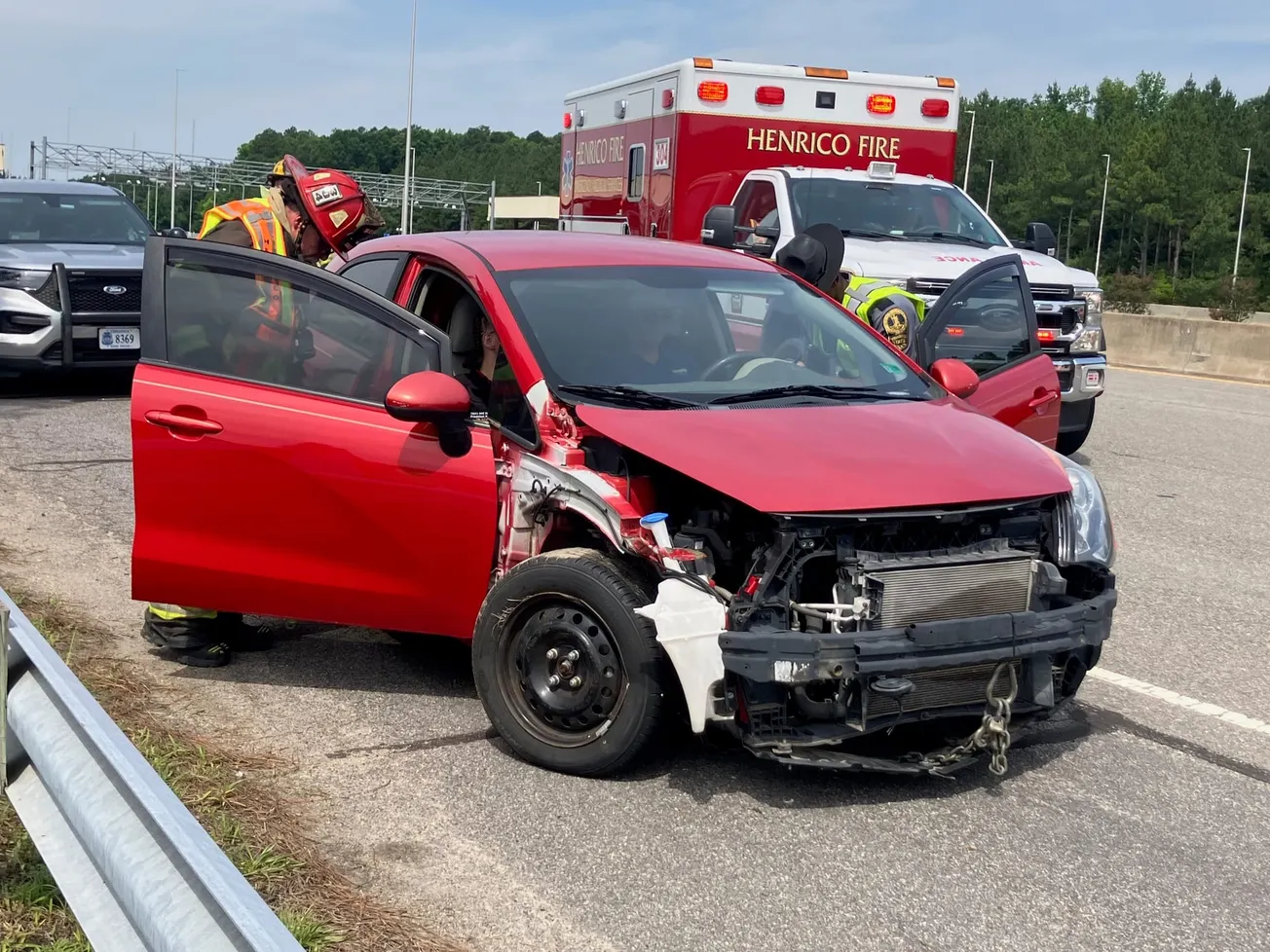
On a recent Thursday morning, a driver crashed a car into a guardrail on the 895 Pocahontas Parkway in the eastern part of Henrico County. Emergency personnel determined the cause of the crash was due to the driver getting distracted by a call on a cell phone.
The driver and the passenger were seen by emergency medical personnel at the scene of the crash and taken to an area hospital to treat their injuries.
The car was hauled off to a shop by a tow truck for extensive and expensive repairs.
The driver and a passenger suffered injuries resulting in mounting medical bills.
As other drivers whizzed by the crash scene, they craned their necks to see the damaged car.
For the emergency professionals who brought a tow truck, a fire truck, ambulance and fire tanker truck, acting as a crash cushion, there are many dangers on the road. Other drivers are a one of those problems.
“The biggest concern is not just the crash itself, but it's that other incident that may occur around us, if not into us. And how we protect and block ourselves is the key. Part of that is bringing that barrier,” said Henrico County Fire Captain Scott J. Archibeque after the driver and passenger were loaded into the ambulance.
“We have nice equipment that's probably a million dollars plus. We just totaled one fire truck a few weeks ago on the interstate. The goal is not to total that. The goal is to protect us, to protect everyone around.”
A fatal time of year
Archibeque was giving the gathered crowd a play-by-play description of what the emergency personnel were doing, because the crash by the Pocahontas Parkway headquarters building was actually staged to draw attention to the dangers for first responders as a part of Global Road Safety Week and the Move Over campaign, which aims to make drivers more aware about the need to let emergency vehicles safely pass.
Virginia's Move Over law requires drivers who see flashing lights ahead—whether it’s red, blue, amber, or a hazard lights to move over or slow down.
The mock crash demonstration also highlighted the coordinated emergency response that follows with staff from the International Bridge, Tunnel and Turnpike Association; Virginia State Police; Henrico Fire and EMS; AAA Mid-Atlantic; and the Drive Smart Virginia organization.
A hotspot for crashes on the Pocahontas Parkway is the attenuator coming off Chippenham Parkway. Drivers who realize that they do not want to be on the toll road sometimes try to get off, smashing into the bullnose-like construction, which costs about $15,000 to replace.


Emergency responders and road safety advocates at a mock crash demonstration on the Pocahontas Parkway. (Patty Kruszewski/Henrico Citizen)
AAA data shows this July 4 holiday weekend will see 72.2 million people nation-wide and 2.13 million in Virginia taking to the roads, with 1.89 million of those travelers in automobiles. About 95,000 will choose to travel via bus or train, and others will take to the sky.
"It's summertime, so that means kids are out of school, families are going on vacations," said Virginia State Trooper Tracy Dewvaul. "Lots more drivers creates traffic. It means less awareness, more traffic law infractions. That can potentially mean that we have to step up our enforcement. We'll probably respond to more calls for service in the day than we would if it was winter. It means accidents due to driver inattention. Heavy traffic flows means less awareness, and drivers following too closely. That's the most common ticket we write for crashes is following too closely just because people tend to not pay attention or they don’t see the brake lights."
Dewvaul and other first responders at the mock crash want drivers to eliminate distractions to keep themselves, their passengers and those around them safe.

Virginia Department of Motor Vehicles data showed 1,987 car crashes on Henrico’s roads this year.
Distraction is one major cause of those crashes. First-responders and driving experts at the staged crash said young and old drivers have their weak traits that can put them in danger. Many older drivers find car onboard electronics distracting.
“Limit those distractions. If you're using that GPS, set it up before you pull out of the driveway,” Dewvaul said. “Put it in a non-distracting way. Let it guide you down the roadway, focusing on the road, not being distracted by music, by pets, other passengers, onboard electronics, or cell phones. Focus on being a good and courteous driver out there. Maintaining the speed limit.”
Investigations reveal that cell-phone usage often is the cause of crashes.
“The two main causes of crashes have always been speed and distracted driving. Eliminate those distractions. It is a primary violation to have a hands-free device in your hand or have a cell phone device in your hand. There are only a limited number of exemptions,” State police First Sergeant JD Miles said. “Try to limit those distractions if at all possible. Keep your eyes on the road.”
Driving for the conditions is important, too. If it starts to rain, roads are going to be slick. Drivers should increase their following distance even more, officials said.
“Don't let stop-and-go traffic turn you into an aggressive driver that can create other unintended consequences on the roadway,” Dewvaul said. “And never drive impaired.”

Emergency responders at a mock crash demonstration on the Pocahontas Parkway to draw attention to move-over laws. (Patty Kruszewski/Henrico Citizen)
Move-over laws
Move-over laws encourage drivers to give first responders unobstructed access to get to car crashes on highways.
“I’m running lights and sirens for a reason,” said Dewvaul, who has had close calls with drivers who veer into his path. “If you see any emergency vehicle with lights on it coming, get out of the way.”
People sometimes tend to forget which way they're supposed to go, Dewvaul said.
“I have been going down 288 pretty fast and a car was in the right lane. They were doing exactly what I needed to, staying out of my way. They heard lights and sirens and then they proceeded to cut me off and I almost went into the back of them probably doing a hundred miles an hour,“ said Dewvaul.
For people calling in crashes, knowing the mile marker or location so “safety central” can give state or county police the correct location as well as routing is important, since access points to highways and interstates are very limited.
At crashes, the first officer to arrive assesses the situation. When a crash necessitates extreme support, such as when a car is caught under the guard rail that must be cut, another truck and crew is needed.
“We just keep adding folks until we can solve the problem, we can give the roadway back to y'all and the troopers and whoever else is going to work the crash,” Archibeque said.
Police are in danger on the road as they assess the victims and the car to see if their fuel is leaking or any other hazards exist. Authorities may need to shut down a few lanes or an entire highway.
They rely on that person's version of events, crash damage and debris fields, taking it all into account as they conduct a crash investigation.
“The priority becomes taking care of the car, stabilizing it, making sure it doesn't move. They're trying to determine how severe and which patient goes first. The sickest patient goes first. If they're equal, they can take them both,” Archibeque said.
Crashes can cost the drivers and the emergency department millions of dollars. Specialized towing companies contracted with VDOT focus on specific zones throughout the region to clear commercial vehicles such as buses, boats, aircraft, vehicle fires, overturned campers that can weigh 60,000 pounds.
Those tow truck drivers also face dangers. Many AAA trucks now are topped with digital signage that tell motorists to slow down and move over.
At the event, Brad Hughes took photos. He’s an officer who was hit by a distracted driver on a highway in 2014 as he was helping a disabled driver and lost his legs as a result,.
“I know how it is to go through this pain, and what it's like to be a survivor, having to deal with the PTSD of going out here and watching this,” Hughes said.
He teams up with Virginia Commonwealth University’s Project Impact to educate drivers of all ages of how dangerous things are when you're on the roadway.
“Your life is more important than the distractions,” Hughes said. “You can change your life in three seconds. You can also take somebody else's life.”
Dina Weinstein is the Citizen’s community vitality reporter and a Report for America corps member, covering housing, health and transportation. Support her work and articles like this one by making a contribution to the Citizen.