Skip to content
Image: Virginia Passenger Rail Authority

Editor's note: The original version of this article incorrectly indicated that Virginia Railway Express Service to and through Washington, D.C. would not be affected. In fact, as now correctly indicated in the article below, VRE service also will be impacted and its trains will run to L'Enfant Station, just south of Union Station, Oct. 16-26. The Citizen regrets the error. 


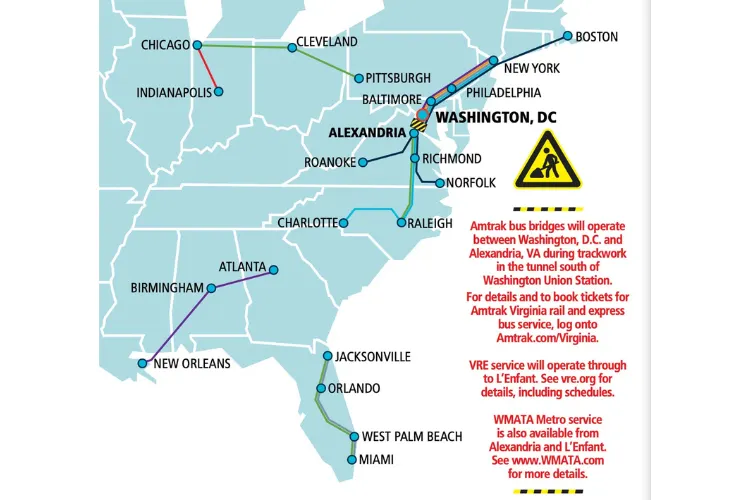
From Oct. 16 to 26, planned infrastructure upgrades south of Washington, D.C.’s Union Station will result in schedule adjustments impacting service to and from Virginia.

That will mean no northbound trains can enter Union Station in D.C. Southbound trains will also not be able to depart from Union Station during the construction.

All northbound regional trains from Virginia, including Amtrak's Carolinian, will stop in Alexandria, and then buses will take travelers to Union Station to continue north if that's where they're going. Alexandria will be the northernmost stop for southbound regional trains.

During the Oct. 16 to 26 work window, track switches, tunnel infrastructure and electrical systems are being improved or replaced.

The outage will begin after the close of service Oct. 16 and conclude before service resumes on the morning of Oct. 26.

Tracks under Union Station that will be replaced in October from the 16th to the 26th, making passenger trains from the south, including Virginia, stop in Alexandria. (Courtesy Amtrak)

“At Union Station, when you go under the first street tunnel, you have a number of tracks that have to go down to two tracks, much like on a highway,” said DJ Stadtler, Virginia Passenger Rail Authority's executive director.

“There are a number of switches, and they take you from one track to another, that are all in a same tight area. It's called an ‘A-interlocking.’ It has not been replaced for a long time. A lot of the switches are still the old-fashioned air switches that run by air. Amtrak is going to replace that whole interlocking on those switches with electronics.They’re really taking the track out, putting brand new track switches in, so it's safer, more or less, prepared for the future.”

Amtrak is calling the construction a “Pause for Progress.”

Image: Virginia Passenger Rail Authority

The work will cause reduced service, train cancellations, route modifications and travel disruptions south of Washington, D.C.

For Virginia train travel, that means the Northeast Regional north of D.C. will operate as usual between Union Station, New York's Penn Station and Boston’s South Station.

South of D.C., the Northeast Regional will operate one roundtrip between Norfolk and Alexandria. There will continue to be one roundtrip between Roanoke and Alexandria.

The Northeast Regional service south of DC is VPRA's Amtrak Virginia service.  It changes names because the service in Virginia is state-supported by the Commonwealth. Service north of DC is funded by Amtrak. VPRA has been referring to these routes as Northeast Regional/Amtrak Virginia service for clarity.

The northbound trains stopping at Alexandria train station will mean travelers going to the Nation’s Capital will need to use other means to access their final destinations.

Washington, D.C. is easily accessible via Amtrak’s Alexandra Station at 110 Callahan Drive. Travelers simply need to walk 0.2 miles to the adjacent King St-Old Town Metrorail Station and take the Yellow or Blue Line, which runs every eight to 15 minutes and reaches downtown D.C. in approximately 20 minutes.

Additionally, for those continuing their train journey north, Amtrak Virginia will provide three roundtrip buses or a “Bus Bridge,” that will be timed to connect with trains between Alexandria and D.C.

Amtrak Virginia will also provide express bus service consisting of:

• 1 roundtrip: Roanoke, Lynchburg, Washington, D.C.

• 1 roundtrip: Charlottesville, Washington, D.C.

• 2 roundtrips: Virginia Beach, Norfolk, Newport News, Williamsburg, Washington, D.C.

• 1 roundtrip: Norfolk, Newport News, Williamsburg, Washington, D.C.

• 2 roundtrips: Richmond Staples Mill, Washington, D.C.

• 1 roundtrip: Richmond Main Street Station, Washington, D.C.

"During Amtrak’s “Pause for Progress” Oct. 16-26 construction period, buses operating between Washington, D.C. and Williamsburg/Norfolk will serve Virginia Beach (on some trips), Norfolk, Newport News, and Williamsburg before continuing to Washington," Beth K. Toll, Amtrak senior public relations manager wrote in an email. "Richmond is not a stop on those routes. However, Amtrak will offer separate express bus service between Richmond and Washington, D.C."

Image credit: Amtrak

The Carolinian train route will be operating between New York and Washington, D.C., and also between Alexandria and Charlotte. Travelers will take a bus connection between Washington's Union Station and Alexandria.

The Virginia Railway Express also will be affected by the October construction interruption, since it uses the same tracks that Amtrak operates on. But it will run trains to L'Enfant Station, just south of Union Station and will run on a modified schedule during those nine days of construction in October.

Five long distance train routes – the Cardinal, the Floridian, the Silver Meteor, the Palmetto and the Crescent – will be interrupted or changed during the Oct. 16 to 26 timeframe.

VPRA will also use Amtrak’s service disruption to maximize the work that can be completed on VPRA’s projects, including the Long Bridge Project and Alexandria Fourth Track project.

The Virginia Railway Express (VRE) will run a modified schedule the week of Oct. 19 to 23 to accommodate Amtrak’s infrastructure rehabilitation project temporarily eliminating access to Union Station. VRE trains will service all stations up to L'Enfant Station with some reduction in frequency. Schedule details are being finalized, and updates will be shared via VRE's Train Talk and VRE.org/schedule.

Amtrak officials have communicated that through Pause for Progress construction, train travelers will gain safer, more reliable rail service, fewer delays over time and a stronger, more dependable network.


Dina Weinstein is the Citizen’s community vitality reporter and a Report for America corps member, covering housing, health and transportation. Support her work and articles like this one by making a contribution to the Citizen.

Comments