Henrico parents make urgent plea to school board: limit technology use in schools
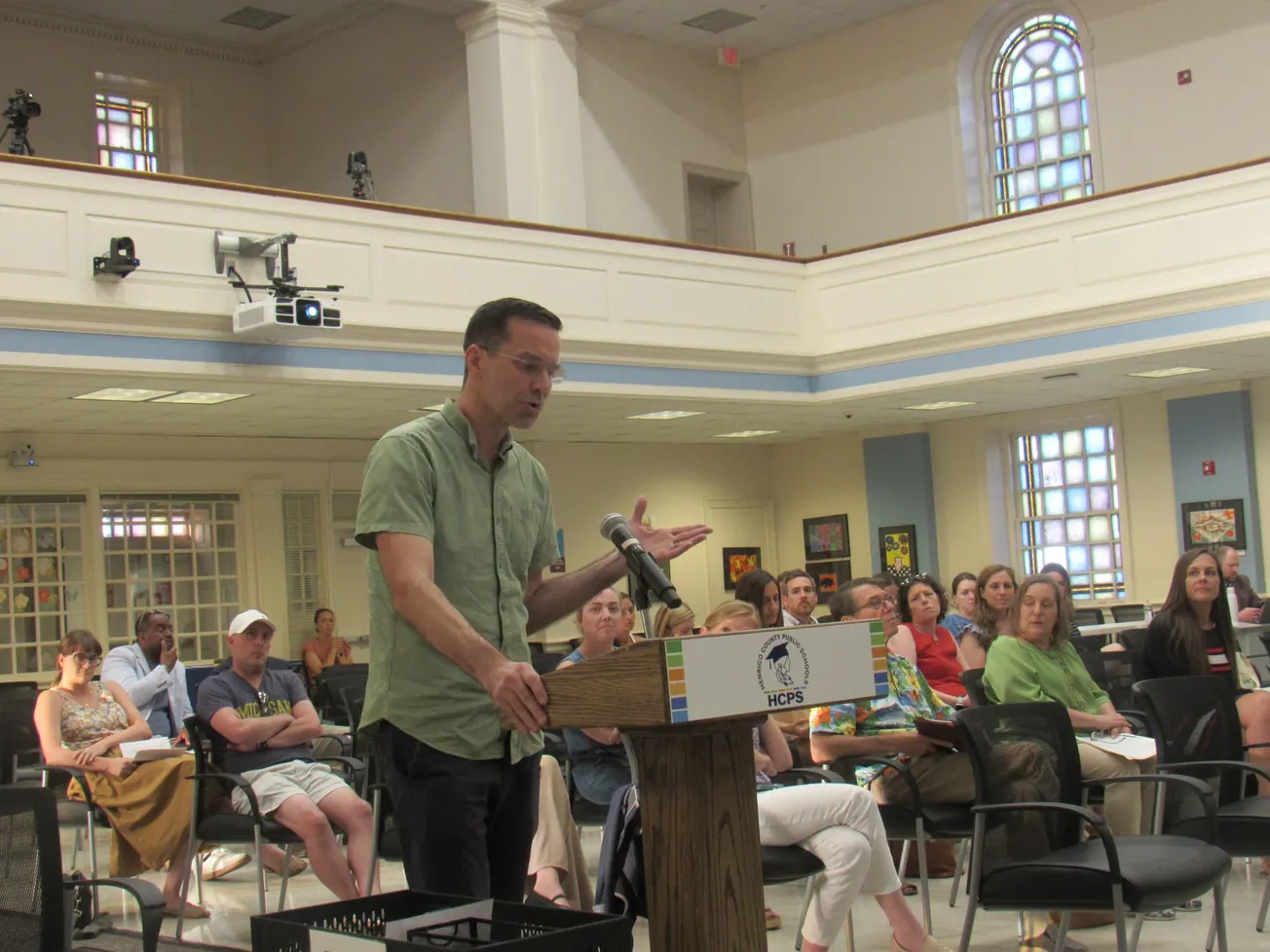
More than a dozen parents and community members spoke out at the June 11 Henrico School Board meeting, urging Henrico Schools officials to reconsider its one-to-one device ratio for students and set stricter limits on screen time in schools.
The division currently provides iPads to students starting in pre-kindergarten and kindergarten, then switches to laptops in first grade, which students have through 12th grade. Beginning in sixth grade, students take their laptops home with them to complete online homework.
Some parents say that especially since COVID, when virtual learning was necessary, HCPS has become over-reliant on laptops and other devices, using technology as a “crutch” rather than a supplemental tool for learning.
Pocahontas Middle School PTA president Gracie Herbert, who has one student at Pocahontas and another at Mills E. Godwin High, said that both of her children have ADHD and both are struggling in school. Every day when they come home, Herbert requires both of them to write a paragraph before being able to play video games – a task that is surprisingly difficult for a middle-schooler and high-schooler.
“They can’t spell. I have a rising seventh-grader that spelled ‘write’ as ‘wrte’ this week. I’m embarrassed for him because he never has to write in school,” Herbert said. “I get emails weekly about my kids playing games, being on YouTube on their school computer. And they’re not supposed to have YouTube, but they figure out how to get it on there.”
Elementary school parent Michelle Alder said her rising fourth-grader is on his Chromebook all day at school and then begs to log back in when he comes home. Not only would her son use the computer for school work but also during downtime at school, which she believes has led to his lower academic scores.
“During indoor recess, he would play Minecraft – during recess. It seems like the device has become his teacher instead of a tool,” Alder said. “His written comprehension has struggled, his math has gone down, and now my first-grader’s handwriting is way better than my fourth-grader’s handwriting – because he doesn’t write anything.”
School board to 'consider' grade-level screen time limits
HCPS has a practice of having elementary-schoolers use educational technology for 15 to 20 minutes once or twice a week, according to HCPS Director of Innovative Kourtney Bostain, but does not have screen time limits for secondary schools. HCPS believes that technology should “support instruction, not replace it,” she said, and that the majority of technology use should involve students actively learning.
But parent Jane Dai, who has a rising first-grader at Pemberton Elementary, said that those elementary screen limits are often not actually put in practice. When enrolling her son in kindergarten, Dai met with Pemberton’s principal, who assured her that students used technology 20 minutes a week for math and 20 minutes a week for reading – but her first-grader is on a screen for much longer.
“What we found out throughout the school year was that there was also screen time for listening to stories on individual tablets with headphones, so-called ‘brain breaks’ where videos with songs or stories were played on the smart board, and music class often included YouTube videos – these are just a few examples,” said Dai. “The school ran a denim clothing drive for charity, and the reward for the class with the most donations was extra tech time.”
Parents also said that students are easily able to get around the division’s internet security software, “Securly,” to access all sorts of unallowed sites – TV streaming sites, social media, even pornography.
Godwin High parent Angela Clinton said that a months-long systemwide security breach earlier this year allowed her daughter and many other students to get around Securly and access all sorts of banned sites. Even after the breach was fixed, HCPS did not properly notify families about what happened, she said.
“If my child was skipping class for months, the school would have a duty to inform me. Yet thousands of students were effectively skipping class and parents weren’t informed,” Clinton said. “We rightfully cared about months of learning time due to COVID, why not the months of lost learning time due to laptop use?”
In April, HCPS announced that it would be implementing a new internet monitoring system this upcoming school year – “Securly Classroom” – that allows teachers to see what their students are doing on their screens in real time and even control students’ screens. The new system will be a “powerful tool” for teachers to help reduce distractions in the classroom, said HCPS Director of Technology Brain Maddox.
But some parents are worried that expanding Securly platforms would only be “doubling down” on technology use instead of stepping back, requiring teachers to become computer “security guards” and take away from teaching time.
“My son’s school was part of the Securly Classroom pilot program, and I would say its roll out did not inspire confidence,” said parent Kimberly Fehrs, who has an elementary-schooler and a middle-schooler. “Teachers were doing less teaching and more monitoring, like a police guard checking all screens for violators. . . It is a band aid fix that ultimately does not get to the root of the problem.”
In addition to multiple in-person speakers, the school board’s online public forum saw 16 pages of comments from other parents expressing similar concerns about technology overuse. Parents also cited a local petition with nearly 1,000 signatures that calls for HCPS to eliminate devices for younger elementary school students and set enforceable screen time limits by grade level.
School board member Marcie Shea (Three Chopt District) said that the board has been informally discussing technology use in schools “for some time” and plans to put together a technology guidance document this summer with the input of parents, students, and staff. HCPS officials will consider implementing grade-level expectations around screen time, she said.
“This remains unfinished,” she said. “This remains continuous work.”