Skip to content
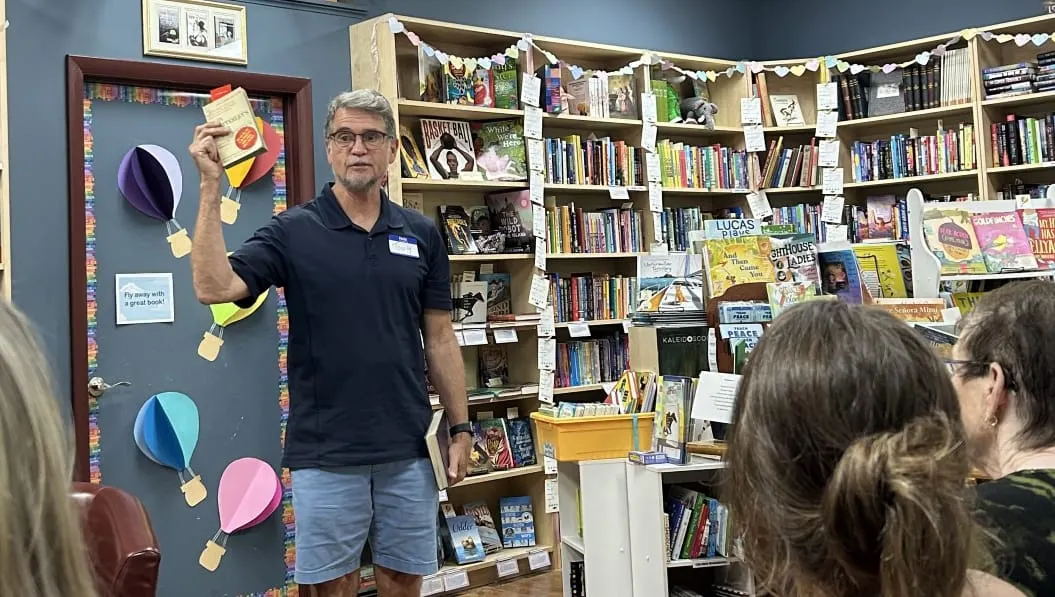
Local author Tony Gentry read a selection from D.H. Lawrence's “Lady Chatterley's Lover" during a banned book event July 14, 2026 at Book People's Henrico location. (Suzanne Boothby for the Henrico Citizen)

About 30 book lovers gathered at Book People’s Ridgefield Parkway store in Henrico's Far West End July 14 with banned books in hand for an evening that blended community read-in with a larger conversation about censorship and the freedom to read.

The event, a fundraiser in partnership with James River Writers benefiting Authors Against Book Bans, brought New York Times bestselling author Sara Raasch and Newbery Medalist Meg Medina to the Gleneagles shopping center store for readings, conversation and a little activism.

Medina, a former National Ambassador for Young People's Literature, opened the evening by welcoming everyone and talking about the communal read-in, during which attendees could crack open their own banned books with no interruptions.

Medina held up her own well-worn copy of “Fahrenheit 451,” Ray Bradbury’s classic about book burning, which she said she hadn't read since college.

True to bookstore hospitality, Medina made sure attendees knew where to find dessert, cheese and crackers, and a dedicated gluten-free table.

Attendees also found a green raffle ticket and a postcard tucked into their event envelopes for contacting elected representatives about pending legislation.

“I'm going to fire you up this evening,” Medina told the room, “and we're going to talk about some of the legislation that is making its way through our government, and that needs our attention and our voice right away.”

Local writer Tony Gentry kicked off the reading portion with a selection from D.H. Lawrence's “Lady Chatterley's Lover,” which he described to the crowd as one of the original banned books and, he noted, something of a template for modern romance novels.

The book, which follows an affair between an upper-class woman and a working-class man and was among the first to suggest women might take pleasure from sex, wasn’t published in full until 1959 in New York and 1960 in London. Its British release triggered a landmark obscenity trial, Regina v. Penguin Books Ltd., that turned on whether the novel’s use of previously taboo sexual language could be legally justified.

A sampling of the merchandise that was available at the Book People event July 14, 2026. (Suzanne Boothby for the Henrico Citizen)

Amidst a national wave, 'the freedom to read'

Following the read-in, Raasch and Medina sat down for a conversation about the role readers and writers play in defending what Medina called “the freedom to read.”

“Talking about and supporting banned books and independent bookstores is more important than ever, and we’re always delighted to be in community with Meg Medina,” said Katharine Herndon, executive director of James River Writers, one of the event’s sponsors.

Many organizations now track banned books, and since 2021 PEN America, the free-expression organization has documented nearly 23,000 book bans in American public schools – a scale of censorship the organization says is unmatched in the lifetime of any living American.

The bans disproportionately target books about race and racism, titles by or about people of color, and books with LGBTQ+ characters or themes, along with older readers' titles touching on sexual content or sexual violence.

From fall 2021 to spring 2025, some of the most frequently banned titles came from celebrated authors including Toni Morrison, Margaret Atwood, and Judy Blume. John Green’s “Looking for Alaska” topped the list, followed by Jodi Picoult’s “Nineteen Minutes,” a novel centered on a school shooting.

In the 2024–2025 school year alone, PEN America recorded 6,870 instances of book bans affecting nearly 4,000 unique titles. Among the 15 most-banned books that year: Anthony Burgess’s “A Clockwork Orange,” two entries in Sarah J. Maas’s “A Court of Thorns and Roses” series, and “Nineteen Minutes.”

Those figures likely understate the true scope of censorship, participants noted. One attendee, a retired school librarian, described how school libraries sometimes quietly self-censor to avoid conflict before a formal challenge is ever filed, removing or declining to purchase a title rather than risk a fight.

Medina also spoke to what she called soft censorship, when books are quietly pulled from schools and libraries nationwide, usually over content addressing race, LGBTQ+ identities, mental health, sexuality or social justice.

Many of these bans, she said, come from advocacy groups and legislation targeting “inappropriate” material, often under the guise of protecting children, even though the books in question provide essential historical, identity and human rights perspectives.

Henrico has removed library books before, but the state has no official record of it.

Even as Henrico County residents gathered Tuesday night to discuss book censorship, county records show at least three library books have been pulled from Henrico high schools in recent years, despite Henrico not appearing on the state’s official list of divisions that have removed books at all.

In October 2021, Henrico County Public Schools removed eight copies of “Out of Darkness” by Ashley Hope Pérez from high school libraries after a parent told the School Board the young-adult novel, which centers on a 1930s interracial relationship in East Texas and touches on racism and sexual abuse, contained "pornography." The book, winner of the 2016 Michael L. Printz Award, was pulled so the district’s Instructional Materials Review Committee could evaluate it.

Shortly thereafter, Henrico removed "I Am a Gay Wizard" from one high school library after a parent challenged a scene depicting two male characters, arguing it “could drive premature sexualization.” In May 2022, an elementary school parent submitted a formal complaint about the book “A Good Kind of Trouble.”

Both books later were returned to school libraries after the review process. Henrico Schools spokesperson Eileen Cox said at the time that pulling both books was standard procedure while a review committee considered them.

The National Coalition Against Censorship pushed back, arguing that removing a book before a review is complete “gives privilege to the person complaining over the professional who put the book there in the first place.”

The group has also documented a national pattern in which most challenges target books by or about people of color and LGBTQ people, a pattern Henrico's two removals fit.

New York Times bestselling author Sara Raasch and Newbery Medalist Meg Medina at the Book People event July 14, 2026. (Suzanne Boothby for the Henrico Citizen)

Henrico isn’t in the state’s count

In April and May 2025, the General Assembly's research arm, the Joint Legislative Audit and Review Commission, surveyed all 131 Virginia school divisions about library book removals dating back to July 2020. Ninety-four divisions responded. Henrico wasn't one of them.

JLARC's report, released in July 2025, found that 32 divisions had removed 223 unique titles a combined 344 times since mid-2020. Hanover County alone accounted for more than a third of that activity, removing 125 books, which was the most of any division in the state. Chesterfield reported removing one title; Richmond reported none.

Cox told VPM News that neither the district's chief academic officer nor its library services specialist had any record of receiving it, speculating a spam filter caught it or staff overlooked it.

JLARC's appendix lists “Out of Darkness” as removed by two Virginia divisions, but because Henrico didn’t respond, its own well-documented 2021 removal of that same title isn't reflected in the state's official tally at all.

Ahead of Tuesday’s event, Medina spoke about why she continues to take on book bans even after her term as National Ambassador for Young People's Literature ended.

Asked what it means to her – a former National Ambassador for Young People's Literature and a Newbery Medalist – to fight book bans, Medina spotlighted two focal points related to youngsters.

“One is the decline in reading as a daily part of life,” she said. “The second is the rising attacks on young people's right to read.”

Her goal, she said, is to keep kids connected to reading not just as entertainment but to grow more deeply in their thinking about themselves and the world. Now past her official ambassador duties, she said she has “wider leeway to discuss issues that can cause discussion and controversy,” while still carrying the public trust the role built.

Medina's books, including "Merci Suárez Changes Gears" and "Yaqui Delgado Wants to Kick Your Ass," have faced challenges (the latter first being targeted in Cumberland County, Virginia, when she was disinvited from a school anti-bullying event.)

“The title is provocative, to be sure, but it is also a phrase that is very tame compared to what kids experience at the hands of real bullies,” she said.

The novel has since been banned in Florida and, she said, “possibly other places — it's hard to tell and keep track.”

She described a mix of feelings: embarrassment that someone considered her work “bad for children” despite a career spent trying to improve kids' lives; frustration that adults were blocking a book that could open important conversations; and sadness “that bans are only increasing, particularly to students who are especially vulnerable, such as LGBTQ youth.”

The act of reading banned books aloud, together, is a meaningful form of protest in itself, Medina said, because it “is a respite, in my view. Tonight's event is meant to remind people that reading freely is a cornerstone of our country's beliefs. Book bans ultimately hurt all of us because they erode our basic principle of freedom of expression and freedom of choice.

“I hope that our attendees tonight realize that we cannot stay on the sidelines and pretend that book bans don't impact us. They absolutely do.”

For attendees who already feel marginalized by efforts to limit books about their experiences, she added, “I hope they can see firsthand that they have a community of people right here in Henrico — along with national organizations like Authors Against Book Bans — who value books and the freedom to read them as we wish.”

Learn more about Authors Against Book Bans here.

Comments