Funding for new I-64/North Gayton Road 'diverging diamond' sets in motion multi-year project to alleviate Short Pump congestion
Long-sought relief for commuters in the Short Pump region is getting closer.
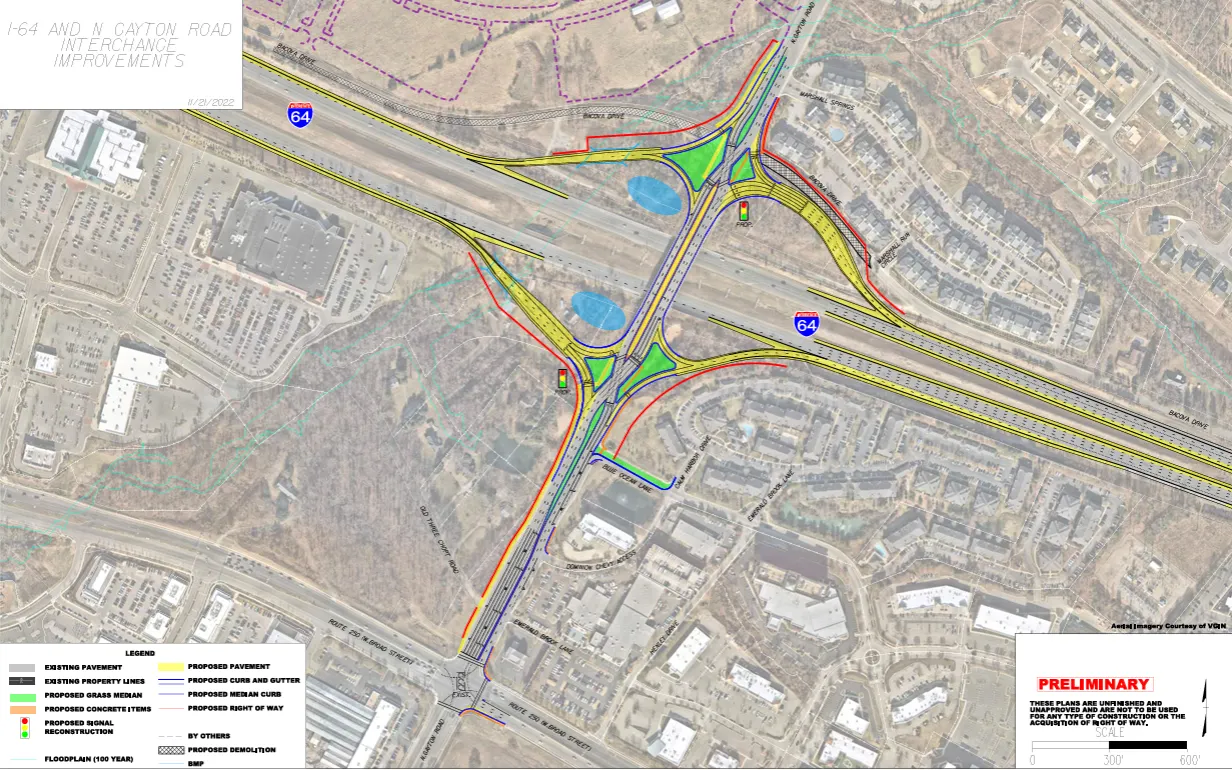
The Central Virginia Transportation Authority's board voted at separate meetings in July and August to approve about $63 million in funding for the I-64/North Gayton Road interchange project, which will provide a new exit along I-64 to alleviate traffic along the West Broad Street corridor in the region.
That money means that the project is now fully funded at $157.4 million ($63.2 million in CVTA regional dollars, as well as $94.2 million in local, state and federal transportation contributions).
After the Commonwealth Transportation Board awards a design build contract, construction is set to begin in the spring of 2028, with completion expected by the summer of 2031. The project will be designed and administered by the Virginia Department of Transportation.
The North Gayton Road interchange will offer another way for commuters to reach deeper parts of Short Pump, thereby reducing the congestion at what is arguably the county's primary traffic pain point: the West Broad Street corridor near the I-64 exit adjacent to West Broad Village.
Most commuters seeking to get from I-64 to retail spots along West Broad Street in the Short Pump area or who want to connect to John Rolfe Parkway, Pump Road, Lauderdale Drive or other popular thoroughfares do so by exiting there and then heading west along West Broad Street. During rush-hour commutes, that creates frequent gridlock to Short Pump Town Center and beyond.

Diverging diamond planned
As part of the North Gayton interchange project, officials will construct a rare diverging diamond design, in which commuters on North Gayton Road will travel on the left side of the road instead of the right side while traveling on the bridge over I-64.
The design (which is currently in place at an I-64 interchange in Zion Crossroads in Louisa County and another at I-95 and Courthouse Road in Stafford County) will temporarily shift North Gayton Road traffic to the left side of the roadway as it crosses I-64, allowing motorists turning left onto interstate ramps to do so without crossing opposing traffic. The configuration has been shown to reduce conflict points and improve traffic flow, according to officials.
The North Gayton Road bridge already includes sidewalks, but it will be repurposed within its existing width to provide a shared-use path as well, according to Henrico County public works staff, along the southbound side of North Gayton Road.


6 other related projects also planned in region
Henrico officials for years have been trying to alleviate traffic at bottleneck intersections in the Short Pump area.
The I-64 interchange at North Gayton Road project focuses on improving traffic operations and reducing recurring congestion and is part of a larger effort – the Short Pump Area Improvements suite of seven projects, which are at various stages of development and funding.
In coordination with the Richmond Regional Transportation Planning Organization, Henrico has applied for SMART SCALE Round 7 funding, for another distinct project in Short Pump in that grouping – the I‑64 at West Broad Street interchange, according to Henrico Department of Public Works Division Director of Transportation Development Sharon Smidler.
In that immediate area, officials have several ultimate goals:
• construction of a partial cloverleaf interchange that removes the on-ramp from eastbound West Broad Street to westbound I-64;
• construction of dual westbound right-turn lanes at that intersection with westbound I-64 ramps and contraflow left-turn lanes;
• conversion of the westbound West Broad Street right-turn lane at Tom Leonard Drive to a shared through/right lane and installation of a through-cut;
• restricting vehicles on the westbound off-ramp from I-64 to eastbound US 250 from turning left at Dominion Boulevard.

A 2020 study conducted by Henrico County Public Works concluded that the interstate, interchanges, and arterial network in the Short Pump area (which includes sections of I-64, I-295, US 250, and Route 288) posed operational and safety challenges and provided limited capacity.
Anticipating significant growth in the Short Pump area, adding to traffic and other challenges, Henrico County developed (with VDOT) several improvement plans in that area.
But the report said the suggested improvements were not enough to provide relief to the congestion and safety issues on the interstate and area roads. There also have been multiple fatalities at the targeted intersections.
Multiple studies concluded that because of increased population growth and development, there was a need for improvements to the existing interchanges, interstate and an arterial network, along with new roadway connections and new limited access point connections.
The 2020 study stated an additional interstate connection at North Gayton Road would reduce demand at critical, over-capacity interchange ramps and on key sections of major arterials.
In 2023 the Federal Highway Administration conditionally approved the county’s plans to build an interchange at I-64 and North Gayton Road. County officials had been working on the project for about eight years at that point.
Nelson wants to see 'all kinds of travel' in Central Virginia
Created in 2020 to help address the region’s transportation needs for which funding was not readily available, the CVTA is funded through a 0.7% sales and use tax and a gas tax of 7.6 and 7.7 cents per gallon for gasoline and diesel fuels, respectively, in nine Metro Richmond localities, including Henrico.
In partnership with those nine localities and state agencies, CVTA officials fund multimodal transportation projects and expand infrastructure, prioritizing and funding transportation projects that are deemed critical to the region.
Financial documents from the July CVTA meeting show that Henrico has received $28 million dollars from CVTA to date this year for transportation projects and about $187 million in total from the agency for regional transportation projects since its inception.
The CVTA’s Fiscal Year review showed Henrico County has received funds for 80 of the 208 local funded projects since CVTA’s inception in 2020 – or 38% of all CVTA-funded projects. Many are multi-year-projects, with funding received from additional sources, like VDOT and US DOT.
A review of tax collections and disbursements, along with regional projects, showed that 19 of the 72 regional CVTA projects were based in Henrico County, including the $66 million Pulse bus Westward extension, which has received $7 million in CVTA funds.
Other regional transportation projects that have received CVTA funds in Henrico include:
• Route 5/New Osborne Turnpike improvements;
• Route 60/33/Beulah Road roundabout;
• Woodman Road improvements from Mountain to Hungary Road;
• Staples Mill Road improvements;
• Brook Road changes;
• the Fall Line Trail;
• the GreenCity Connector trail and bridge;
• West Broad Street intersection improvements at Parham Road.
During CVTA's July meeting, representatives from mobility groups asked for more allocations for bicycle, pedestrian and transit.
Henrico Board of Supervisors member Tyrone Nelson, who represents Varina, also rolled off as chair that month.
He reflected how the CVTA has allocated millions of dollars for bicycle, pedestrian and transit projects, and in his time as chair has established itself as a formidable funding organization promoting significant transportation projects that have made an impact on the region.
“We're a billion-dollar organization, a lot of money flows through the CVTA. Thirty percent of funds this round did go to pedestrian projects. It's not all highways and roads,” Nelson said.
Nelson continues to represent Henrico on the CVTA board and said he looks forwarding to seeing Henrico and the entire region benefit from large CVTA-funded projects, including an interstate expansion in Chesterfield County, the north Gayton Road interchange in Short Pump and developments at Richmond International Airport.
“I want to see us continue to make the Central Virginia region a place where you can find all kinds of travel, whether you’re in a car, walking biking, flying or you’re on the train, moving the people around the region is important and CVTA is squarely a part of it,” Nelson said.
Dina Weinstein is the Citizen’s community vitality reporter and a Report for America corps member, covering housing, health and transportation. Support her work and articles like this one by making a contribution to the Citizen.