Skip to content

At Henrico roundtable, county and state leaders address harms of vaping, possible enforcement solutions
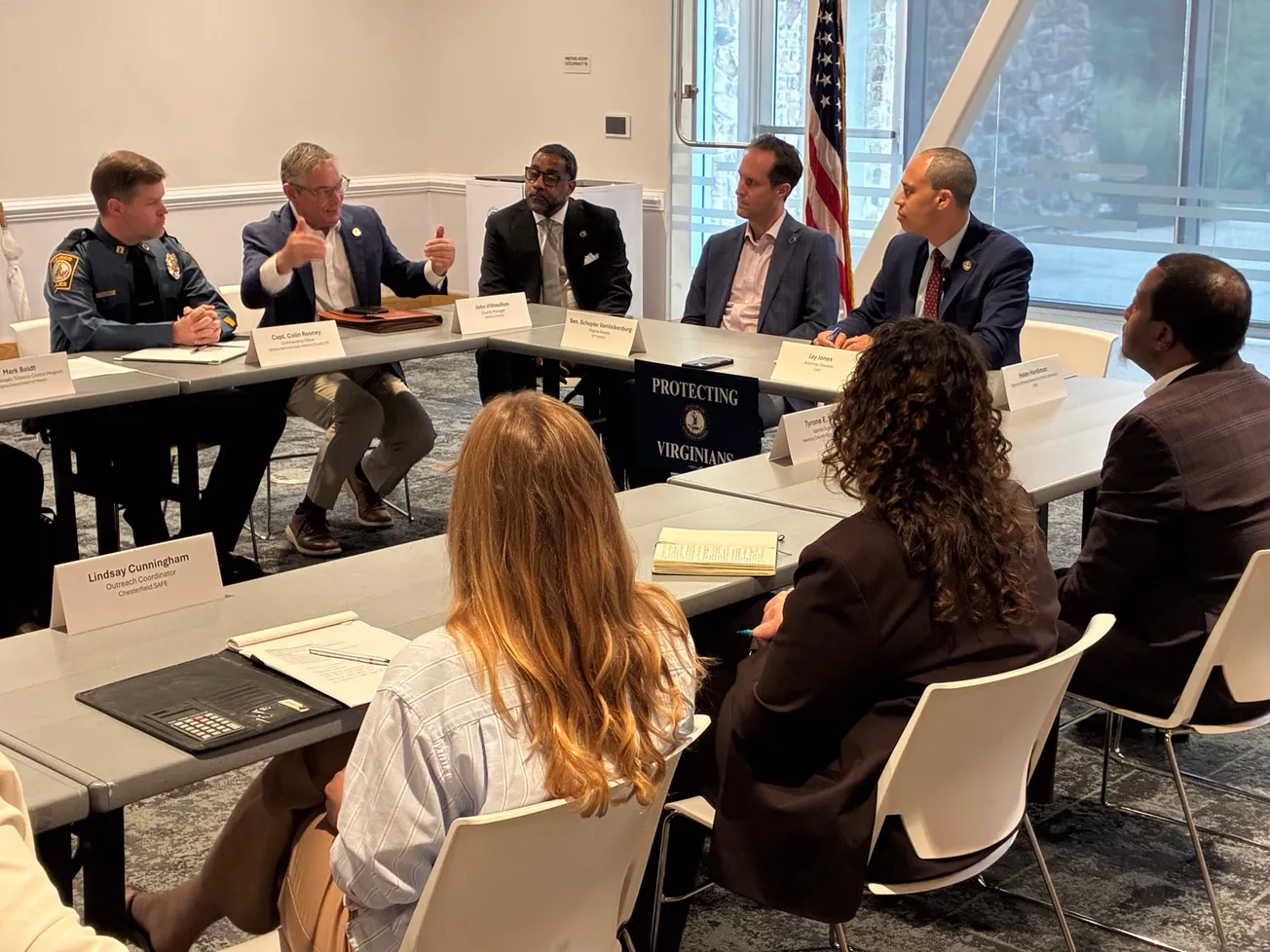
Henrico County Manager John Vitoulkas (second from left) makes a point at a recent vape enforcement roundtable headed by Virginia Attorney General Jay Jones (wearing a red tie) Aug. 4 at the Varina Area Library. Henrico County officials present at the event included Captain Colin Rooney, HCPS commanding officer school services (left); Roscoe Cooper, Fairfield District supervisor (center); State Senator Schuyler VanValkenburg; and Tyrone Nelson, Varina District supervisor (far right). (Dina Weinstein/Henrico Citizen)

Henrico educators and health experts told government officials this week that he use of vaping products is widespread and the impact is harmful.

During a meeting of community and government leaders Aug. 4 at Varina Area Library, convened by Virginia Attorney General Jay Jones, State Senator Schuyler VanValkenburg (D-Henrico) said sees the impact of vaping in and outside of his Glen Allen High School civics classroom.

“In the schools, it’s undeniable that it has become a massive problem with kids,” said VanValkenburg. “It's ubiquitous, the stories about what kids do, they sit on the floor in a bathroom at lunch [to vape]. It's crazy stories. The addiction problem is real. You see these kids that are hitting these things all day long. It's an illegal product that's addictive. They're intaking it so much more than they would in a cigarette, which is already addictive. It's a real problem.”

Students who vape are less likely to be in class, because they're trying to get out of class to vape, he added. Vaping also impacts students’ attention span and their academic performance, he said, because students are less likely to be productive academically if they’re addicted to a drug or a tobacco product.

VanValkenburg co-sponsored the Vape Enforcement Act (Senate Bill 620/House Bill 308) passed by the Virginia General Assembly this year. The law shifts retail tobacco and liquid nicotine licensing to the Virginia Alcoholic Beverage Control Authority, mandates compliance checks to curb underage sales, and restricts sales to products on a state registry.

Despite the known harm, dozens of vaping shops have popped up in Henrico County in close proximity to schools in recent years, targeting minors through catchy colors and products that connect to pop culture, even though the sale, possession and use of vapes are illegal for anyone under 21 in Virginia.

The proliferation of the shops prompted the county's board of supervisors to adopt tougher restrictions on them in December 2025, creating new rules that require vape shops to obtain provisional use permits in order to locate in the county. The regulations also ban any such shops from locating within 1,000 feet of a school or 2,000 feet from religious institutions, childcare centers, public parks and other smoke shops.

Health concerns about vaping

The battery-powered devices that heat a liquid to make a mist a user breathes into his or her lungs impacts students’ ability to focus as well as their health, according to experts. Vapes (a short form for "vaporizer") simulates smoking without burning tobacco.

But serious health problems can arise from vaping.

In various Virginia jurisdictions, 20% to 70% of students vape as young as in third grade, according to Michelle Peace, a Virginia Commonwealth University professor in the Department of Forensic Science. Her forensic toxicology research lab studies vapes, which are also known as electronic cigarettes, and evaluates the adulteration of cannabidiol (or CBD) products, which have created a rash of poisonings nationwide.

One of the primary concerns for teens who are still developing is the heavy metals found in vapes, since the coil in the vape is a metal, and the e-liquid is manufactured in metal vats. Heavy metals leach during the manufacturing process. When the coil is heated, heavy metal pops from the coil and is inhaled.

“It's been demonstrated that people who vape have higher concentrations of heavy metals in their blood,” Peace said. “Heavy metal can have a tendency to interfere with brain function and heart function. There are solvents in the vapes that are very caustic and dangerous to lung tissue. The chemicals that are the flavoring agents are known toxins, irritants and carcinogens in lung tissue.”

That creates lung damage. Peace tracks clinical reports that people are having cardiovascular events from vaping. A VCU study showed young people who vaped are physiologically 13 years older than their non-vaping peers. Despite this scientific evidence and data, the industry continues to say vaping is safer and less addictive than smoking.

The recent vape enforcement roundtable organized recently by Virginia Attorney General Jay Jones in Varina was attended by legislators and leaders in the field of law enforcement, government, education and health. (Dina Weinstein/Henrico Citizen)

Virginia vaping regulations

Virginia requires all liquid nicotine and nicotine vapor products to be registered on an official state directory managed by the Office of the Attorney General. Unlisted products are banned from retail sale, with stores facing fines of $1,000 per product per day. The state also enforces a strict minimum age of 21 for purchase of vapes and performs active compliance checks.

Retailers may only sell items certified and listed on the Liquid Nicotine & Nicotine Vape Product Directory. Sellers must maintain appropriate state liquid nicotine licenses and pay applicable state vape taxes.

At the vape enforcement roundtable hosted by Jones this week, VanValkenburg and Peace elaborated on the problems, challenges posed by vape vendors and the underage users.

They also presented some potential solutions and ideas for collaboration with other local legislators, educators, health officials and law enforcement. The event followed Jones’ announcement late last month of the formation of his office’s Regulated Products Enforcement Unit.

The roundtable focused on what is and what is not working in the area of enforcement of regulated products and where the OAG can bolster enforcement efforts and regulatory compliance.

The Regulated Products Enforcement Unit program works alongside the ABC to keep illegal products off the shelves and get them out of the hands of kids.

“These emerging substances are issues, we're not going to solve them alone,” Jones said at the roundtable. “We will continue to rely on community members to implement these solutions, to find ways to improve our communities. What is beneficial is when we listen to folks from different parts of this Commonwealth, we find new ideas, we find new solutions, and then take those to other places and hopefully have an opportunity to scale those and make progress in a statewide.”

Jones asked the experts to speak about how vaping culture impacts schools, homes and communities and what powerful tools could stop the dissemination of the addictive and harmful devices.

Officials at the roundtable explained that they see vaping products marketed directly to youngsters through dangerous social media challenges. Henrico law enforcement officials have worked with school administrators to confiscate vapes, but students often become aware and stash the devices in bushes outside schools to pick up when the school day is done, according to officials.

The Henrico Police Organized Crime Unit has conducted undercover underage purchases and charged the businesses that are found in violation of the law. 

“We’ve done a good job of educating these shops about what products are permitted under state law, what products are not, and the liability of selling those products that are not,” said Captain Colin Rooney, Henrico County Public Schools' commanding officer for school services. “We are trying to educate the public that while you walk into a brick and mortar store, you might be purchasing a personal product that's actually not what you intend to purchase. You don't know where that's actually coming from. There are certain parts that are actually allowed for code. There's many that aren't. These brick-and-mortar stores continue to sell them. We try to get those products off the shelves.”

Virginia Attorney General Jay Jones (at the head of the table) converses with participants at a recent vape enforcement roundtable in Varina attended by legislators and leaders in the field of law enforcement, government, education and health. Michelle Peace, a Virginia Commonwealth University professor in the Department of Forensic Science, sitting in the foreground, listens. (Dina Weinstein/Henrico Citizen)

Henrico's efforts to minimize vape shops

Henrico County has made proactive moves to restrict vape shops while recognizing there are legal vape products. There are already approximately 75 vape shops in Henrico, according to leaders at the roundtable. They expressed concern with illegal, imported substances that are predominantly tailored towards children.

The new restrictions implemented by the board of supervisors late last year provided “a way of helping us minimize the number of vape shops,” said Varina District Supervisor Tyrone Nelson.

Henrico officials have sent letters to vape shop owners in the county explaining the regulations they have to follow, but Henrico County manager John Vitoulkas said it's almost impossible to follow the regulations because there are colored vapes that are not on the FDA approved list.

“What we need is a way to be able to go into these stores and say, ‘This is an illegal product. You have a fine of, I think it's $2,500 per product, per day,’ that adds up. That could be significant,” Vitoulkas said.

Peace, who goes undercover purchases to test products, said the fines hardly impact vape store owners, who see them as just the cost of doing business on a daily basis, sinces their profit margins are so high.

Henrico Deputy Commonwealth's Attorney Michael Feinmel told Jones that his office is frustrated with the whack-a-mole experience for law enforcement, along with the lack of clarity about fines paid.

“When I looked at the new laws that were passed, what excited me the most were the record keeping requirements and the class two misdemeanors that were created there,” Feinmel said.

“My difficulty is most of the verbiage in the code section gives the enforcement authority to the ABC board and to special agents. I sat down with the assistant chief and other members of our team and said, ‘They've got to keep three years of records. It's a Class Two misdemeanor. I can prosecute that case.’ If you walk in there and they don't have the records, and/or the records are fraudulent or they don't adequately back up what they're supposed to represent, that's an easy case. We can go back to the ABC board and say, ‘Take the license away because they're not adequately keeping the records,’ but all the enforcement is given to ABC board and none of it is given to the local police.”

Jones said future legislation would address closing gaps in record keeping, enforcement and communication between local and state government.

For next steps, Virginia Department of Health Tobacco Control Program Manager Mark Boldt urged messaging of the regulations and harms of vaping specifically to 13 to 17-year-olds in language that is distinct from messages to young adults.

A discussion of other states’ successes in vaping enforcement brought other ideas to the forefront.

Jones said he looks to Henrico County as a jurisdiction providing solutions that his team can take on the road to help other Virginia counties.

“This is not limited to Central Virginia. It's certainly something we have heard from parents all across Virginia,” Jones said.


Dina Weinstein is the Citizen’s community vitality reporter and a Report for America corps member, covering housing, health and transportation. Support her work and articles like this one by making a contribution to the Citizen.

Comments