Va. lawmakers OK governor’s tweaks to major energy bills, reject health and labor bill amendments
Paid Family and Medical Leave is a step closer to becoming law, while rejected amendments on other bills mean Spanberger must now choose to sign or veto
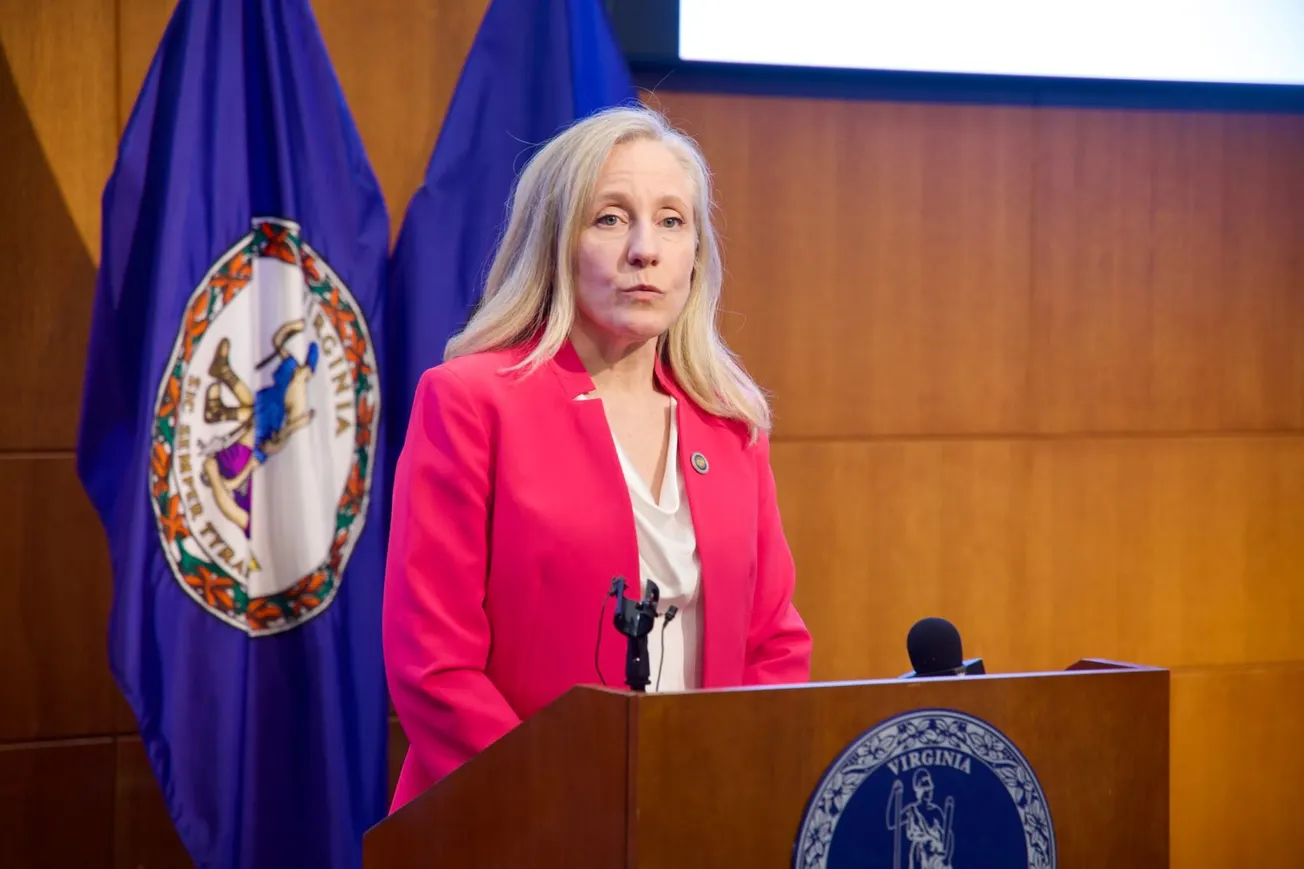
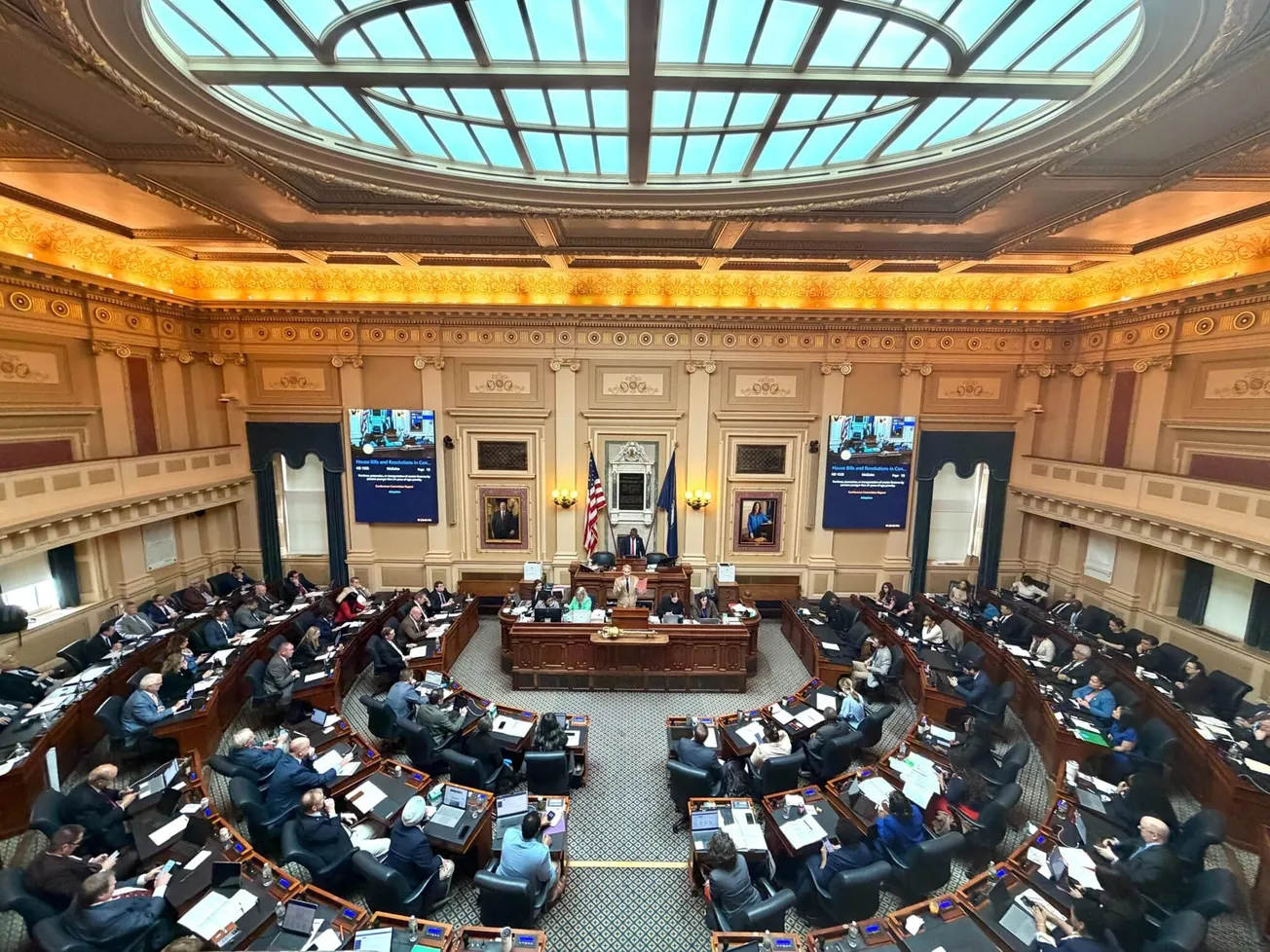
Virginia lawmakers met Wednesday to weigh Gov. Abigail Spanberger’s amendments to dozens of bills passed this year, reflecting both shared goals and differing views on some of the most consequential legislative proposals, despite Democratic control of both chambers and the governor’s mansion.
Spanberger’s changes to measures designed to rein in residential power bills by levying more distribution costs onto data centers and to establish a paid family and medical leave insurance plan by next year were accepted by the Senate and House.
But lawmakers rejected her tweaks to bills that would limit how much profit the state’s largest utility can make on certain projects, cap the cost of power line burial, establish a board to limit prescription drug costs, and expand paid sick leave benefits and collective bargaining rights.
Here’s how the process shook out, and details on what happens next.
Mixed reactions to energy cost shift, power line burial bill amendments
Lawmakers took up two bills regarding utility costs that received heavy edits from Spanberger. Each chamber accepted only a portion of the amendments.
The governor handed down sweeping changes to Senate Bill 253 by Sen. Louise Lucas, D-Portsmouth, and House Bill 1393 by Del. Destiny LeVere Bolling, D-Henrico, which aimed to transfer costs of new distribution infrastructure for data centers and capacity auction prices onto the high-load energy users, including data centers and large-scale manufacturers.
The two bills have some slight differences – but both extend the weatherization and bill assistance programs, which were untouched by the proposed amendments.
Spanberger removed the portion of both bills that shift the cost of purchasing additional power through the regional grid operator PJM, which the utility has said is necessary to meet demand on the hottest and coldest days.
She suggested replacement language to allow the State Corporation Commission to determine whether data centers and other high-load customers are paying “their fair share” and ensure costs aren’t unfairly passed down to customers. These recommendations were accepted.
Lawmakers said that this cost shift would save the average residential customer $5.52 a month. But under the original bills, those savings would only be realized if the SCC found that the cost shift was reasonable to be placed onto the high-load facilities, which would not be guaranteed.
The original bill text allowed for high-load customers that are already under construction by July of this year to opt out of the high-load facility rate class to avoid some of these new costs. Spanberger’s amendments removed that opt out and that amendment was accepted.
The bills also extended to 2038 Dominion’s Strategic Undergrounding Program (SUP), which maintains a monthly cost on customers bills so that the utility can bury distribution lines in the most outage-prone areas. The governor’s tweaks to these parts of the bills met resistance at the Capitol.
The cost of the SUP program, started in 2014, has totaled $1.4 billion to bury 2,900 miles of power lines. It comes out to a customer cost of $4.88 a month. The bills as passed by lawmakers would raise the price per mile cap from $750,000 to $900,000 and limit the investment in the program to 4% of the distribution rate base.
Spanberger’s amendments to the SUP program would give the State Corporation Commission more authority to reject more projects if they find them to be unreasonable, even if they are under the $900,000 price cap. The amendments also lowered the percentage of investment down to 2%. Lawmakers rejected these amendments.
Spanberger’s amendments added in a new provision to the bill that limits the return on equity, or how much of a profit that Dominion can make back on projects, to 9.3%. With the governor’s changes, anything over that percentage would be credited back to customers on their monthly bills. In the latest rate case in front of the SCC, the SCC allowed Dominion a 9.8% return.
Environmental advocacy group Clean Virginia supported the governor’s amendments and estimated it would spur $267 million in savings over five years. However, lawmakers rejected this addition to the bills.
When asked about the reasoning behind her amendments to the two bills, Spanberger pointed to on-going negotiations with the data center industry over the potential removal of the sales and use exemption for their equipment and software upgrades, deliberations that the state’s budget now hinges on.
“There are efforts afoot in the General Assembly, as it relates to the budget, to ensure that data centers are paying their fair share, as I think everyone broadly agrees is necessary,” Spanberger told reporters last week. ”And so that will continue to play out in those negotiations.”
Paid Family Medical Leave on track for Spanberger’s signature
State lawmakers have tried for years to establish a Paid Family and Medical Leave program. In her first State of the Commonwealth speech as Virginia’s new governor, Spanberger promised that if it made it to her desk, she would sign it.
Though she did not sign it outright earlier this month, she proposed minor tweaks that left the essence of the measure intact. Lawmakers accepted those on Wednesday, sending the bill a step closer to becoming law.
SB 2 by Sen. Jennifer Boysko, D-Fairfax, and HB 1207 by Del. Brianna Sewell, D-Prince William, would allow for workers to take up to 12 weeks off when caring for family members who are ill, going through long-term care for their own injuries or illness, or when having a child.
Federal law requires employers with 50 or more workers to allow for up to 12 weeks of leave, but does not require that workers who use the leave be paid. With Virginia’s pending law, workers can tap into a partially-state-funded program for up to 80% of their pay. It will entail some initial state funding to set up, but would eventually become jointly funded as most employers and employees pay into it over time.
The pending new law also allows for four weeks of “safe leave” for survivors of domestic violence, sexual assault or harassment to sort through medical, legal or safety issues.
Courtenay Schwartz with the Virginia Sexual and Domestic Violence Action Alliance said that while she had wished for this demographic of workers to have more time off if they need it, she is grateful to see lawmakers and the governor supporting the issue.
Paid sick leave amendments rejected
Lawmakers rejected Spanberger’s changes to their paid sick leave legislation. HB 5 by Del. Kelly Convirs-Fowler, D-Virignia Beach, and SB 199 by Sen. Barbara Favola, D-Arlington, would ensure employers allow workers to take up to five days off per year for minor illness recovery.
The state already allows this type of leave for home health workers and if the bill is signed, will expand this to other workers around the state. A point of contention emerged as airline pilots and other flight crew were excluded in Spanberger’s amendment.
In a statement ahead of the reconvened session, Air Line Pilots Association president Capt. Jason Ambrosi said that flight workers deserved to be included too.
“Paid sick leave is not a perk. It is a public health and aviation safety issue,” he wrote. “Crew members should not be pressured to fly while ill.”
Prescription Drug Affordability amendments rejected
A five-year journey to establish a Prescription Drug Affordability Board continues, as lawmakers rejected Spanberger’s amendments to it.
Now rebranded as the Affordable Medicine Act, the advisory board would help ensure that federal drug pricing caps are applied to state-regulated health insurance plans. Backed by both Presidents Donald Trump and Joe Biden, the federal government approved caps on 10 drugs at the beginning of this year for Medicare recipients and another 15 are expected to kick in next year.
Del. Karrie Delaney, D-Fairfax, who carried the House version of the bill, said that the state legislation is “simply extending that” to other insurance types. Sen. Creigh Deeds, D-Charlottesville, carried the Senate version, SB 271.
Spanberger’s amendment, however, would add a reenactment clause, which advocates for the bill said would have taken the teeth out of the measure.
Meanwhile, groups like Pharmaceutical Manufacturers of America and the Virginia Association of Health Plans have expressed support for Spanberger’s amendments.
Association CEO Doug Gray said the fiscal impact statement for the bill was published weeks after the bill was passed, because it was heavily workshopped so close to its passage. Meanwhile, PhRMA has noted complexities in pharmaceutical supply chains.
Ultimately lawmakers in support of the bill have emphasized how it can help curb drug prices, as more and more of their constituents have relayed feeling forced to choose between rent, groceries and medicine.
Collective bargaining amendments rejected
Lawmakers shot down Spanberger’s amendments to collective bargaining bills for public employees, which would have delayed the bills’ implementation for local governments until 2030.
HB 1263 by Del. Kathy Tran, D-Fairfax, and SB 378 by Sen. Scott Surovell, D-Fairfax, would repeal a prohibition on public employees being able to collectively bargain for things like workplace conditions, benefits or salaries. Both lawmakers carried the legislation in previous sessions but it was not successful under former Gov. Glenn Youngkin.
The Virginia Association of Counties have celebrated Spanberger’s amendments to delay the effectiveness of the law, while unions have continued to advocate for the bill to be signed without them.
Spanberger defended her amendments in recent weeks, emphasizing that she felt that state employees should exercise collective bargaining rights first, to ensure “that we have a process that works” and to give “ourselves time for any level of adjustments.” She said that could prime local public sector employees to successfully do so later.
Next steps
The amendments that lawmakers accepted to their bills will be incorporated before the measures become law. The ones that were rejected and sent back to Spanberger have an uncertain fate; she can choose to sign them as is, or veto them.
The governor will have 30 days to take action. Unless otherwise noted, the signed bills will transform into laws July 1.
Both chambers will return to the Capitol Thursday to begin finalizing the state budget.
Virginia Mercury is part of States Newsroom, a nonprofit news network supported by grants and a coalition of donors as a 501c(3) public charity. Virginia Mercury maintains editorial independence. Contact Editor Samantha Willis for questions: info@virginiamercury.com.