Skip to content

These Black maternal health groups laid groundwork for perinatal grants, then they were left out

The state-piloted program is supporting four organizations in an effort to boost maternal health outcomes and fill access gaps around Virginia
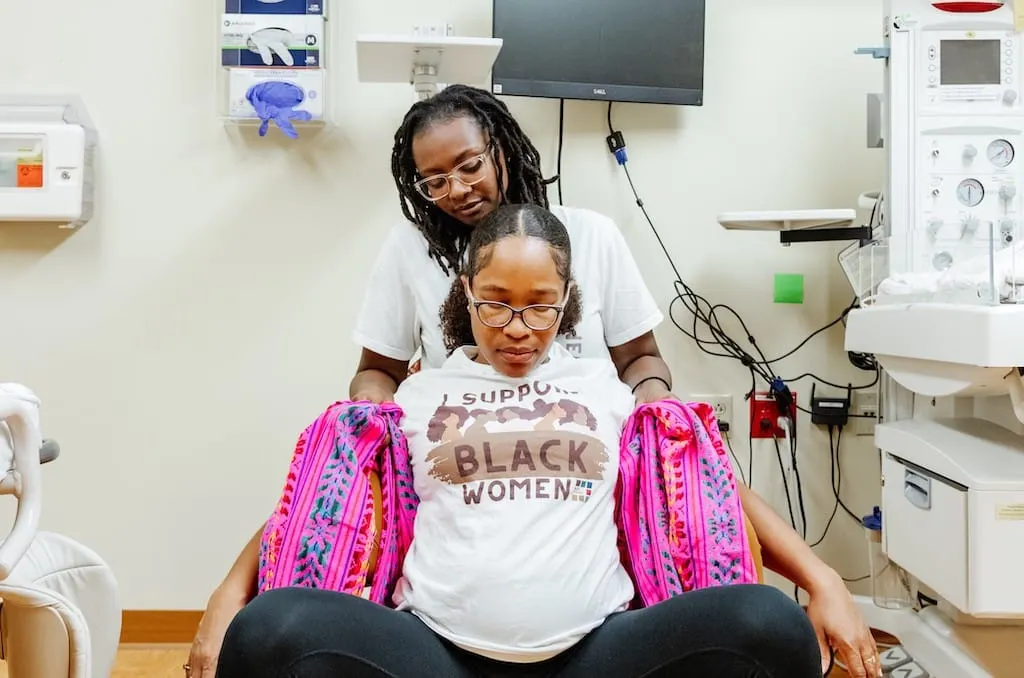
Dana Williams, top, and Khalyson McDuffie are doulas with Birth in Color, a Virginia group that offers doula services for pregnant patients of color and training for local maternal health care workers to combat racial bias. Here, they participate in a doula simulation training session. (Photo courtesy of Kenda Denia/Birth in Color)

Long before Virginia lawmakers and governors were using the word “Momnibus” and celebrating a series of bills aimed at bolstering maternal health, doula Kenda Denia and nurse Stephanie Spencer were tapped behind the scenes to lend their expertise. 

Now, the work they helped lead has garnered state dollars, legislative support and public praise, but their community-rooted organizations weren’t selected to reap any of the funds. 

The two women spearhead groups that serve parents and parents-to-be through various services, connecting them to resources and advocating for them to state lawmakers. Spencer’s Urban Baby Beginnings and Denia’s Birth In Color were two early pioneers of the concept of maternal health hubs in Virginia.

Last year they were instrumental in helping lawmakers secure $2.5 million in the state budget to support or expand community-based maternal care. The goal, Spencer and Denia said, was to support community-centered organizations working to improve outcomes for pregnant people, particularly Black parents-to-be. 

Studies show that Black parents experience disproportionately negative health outcomes, often due to provider bias. Black women are also more likely to die from complications, a fact confirmed by Virignia’s Maternal Mortality Review Team. 

Denia and Spencer served alongside a handful of representatives from various healthcare organizations, people with lived birthing experiences and various physicians to offer insights into how the fund should be shaped. 

After applications opened ran from October through December last year, Denia and Spencer’s were denied. 

More than 40 groups applied, a recent VDH release stated. A substance use recovery organization, an organization that supports families with special needs, a federally qualified health center, and a hospital in Southwest Virginia won the funds.

Community-based organizations have already built trust with parents, and established systems with care coordination, navigation and home visits or doula support, Spencer said. 

It’s why “funding community-led and rooted organizations” had been a “key takeaway from the workgroup,” she added. 

The budget language specified that the awards go to “community-based providers” to “improve perinatal outcomes and to reduce maternal and infant mortality in their communities.”

“While only four great projects were granted due to limited resources, the opportunities outlined by our applicants speak to future needs of our communities in caring for our families,” a VDH press release said. “Grantees were selected with consideration for regional representation.”

Three of the four grantees are along Route 81 in Southwest Virginia with the other grantee just east of Richmond in Williamsburg.

Maternal health deserts have sprung up in Southwest Virginia and South Side Virginia in recent years. Though Spencer and Denia’s organizations originated in Central Virginia and Hampton Roads-originating, they extend into parts of Southwest Virginia. 

Spencer is glad to see the funding off the ground and know that grantees will be putting it to work soon. But to be denied a slice of the pie after helping create it has been frustrating to her and Denia, she said. 

A ‘reset’ of trust

Birth In Color founder Kenda Denia moderates a panel during the 2026 Black Maternal Health Summit her organization hosted on April 17, 2026. (Photo by Charlotte Rene Woods/Virginia Mercury)

The news comes at a time where several nonprofit organizations or free clinics in the state have relayed their eroding trust in VDH.

The state health department has been trying to internally heal after years of staffing turnover, burnout and financial mismanagement. More recently a billing error for rebates with a pharmaceutical company has disrupted services that community-based organizations provide for low-income people living with HIV.

Add in the slight Denia and Spencer feel, and it doesn’t help matters, Denia said.  

“You have to think about all the free work Stephanie (Spencer) and I have done,” she added. “Panel discussions, workgroups and connections to communities.” 

Her words were even more pointed when she quizzed Virginia Health and Human Resources Secretary Marvin Figueroa at a Black Maternal Health Summit last month. 

“We gave collateral information that VDH did not have, yet our organizations did not get support for our hubs,” she told him. “How do you think community organizations are supposed to be at the table if we don’t feel trust?”

Figueroa responded that VDH, which he oversees as a member of Gov. Abigail Spanberger’s cabinet, needs to have a “reset” with community organizations. 

Some of the trust was broken, he noted, before he and VDH Commissioner Cameron Webb stepped into their new roles a little more than 100 days ago. Still, Figueroa isn’t ducking accountability.

“I am committed to making sure it happens,” he said. “It’s good to hold our feet to the fire.”

“Re-establishing trust doesn’t happen overnight,” VDH communications director Maria Reppas acknowledged in an email. “It requires showing up, listening, and following through over time. While we may not always agree, we are committed to ensuring every voice is heard and every perspective is respected and considered in our work.” 

Spencer said her organization will apply again in potential future rounds. Denia, however, said it might be best to advocate for future funding to flow through an agency other than VDH. Originally, she had suggested it go through the Virginia Neonatal Perinatal Collaborative, an entity already entrenched in the maternal healthcare space. 

How awarded funds will be spent

In the meantime, the four beneficiaries of the pilot program will soon put their money to work. 

Williamsburg-based Child Development Resources provides wraparound services to children with developmental delays or special needs, as well as underserved families. They offer various services for expecting parents and childcare providers and conduct training for early childhood professionals. 

The staff also speak multiple languages to better connect with the diverse communities in the area that includes immigrants whose first language is not English. 

“Most of our work is about going into people’s homes and working with them there,” said Carla Javier, director of children’s services. “That requires a lot of humility and a lot of trust-building. You build these kinds of programs by one parent telling another parent.” 

While the organization initially began with a focus on children with disabilities, Javier noted how it has grown over the years to support a range of families and professionals that serve them. 

The VDH grant, she said, will help take its maternal health work to a new level. They plan to hire doulas and a family resource specialist that can be an intermediary between the organization and a local hospital. 

While much of the clients are attained by word of mouth, the organization has also formed a relationship with the Sentara Regional Medical Center in Williamsburg. As the primary birthing center in the area, Javier said it’s a relationship that can support referrals and connections to resources for families.

For Harrisonburg-based community-based organization Strength In Peers, the funds will bolster a partnership they have formed with a regional Sentara health center for its perinatal hub. Sentara is a nonprofit health system with hospitals or health centers scattered around parts of Virginia. 

While Strength in Peers’ specialty is serving people who are overcoming substance use disorders, executive director Nicky Fadley said that the health hub project “will not be limited to parents in recovery.”

Services the funding will support include case management, peer support, health education and doula support.

Fadley emphasized that the money will also help them address maternal healthcare access issues for people in the region without a primary healthcare provider and who struggle with mental health challenges. It may also help them reach people who may have limited English language proficiency. 

In addition to its broader maternal health offerings, Fadley noted how the organization also has a dedicated substance use recovery program for pregnant people as well as a recovery residence program for parents who are in recovery. 

Johnston Memorial Hospital in Abingdon, which is under the Ballad Health umbrella, was another of the four grant recipients. It’s unclear how the hospital plans to use the funds or if it will partner with any community-based organizations, as Ballad representatives did not follow through on an interview request by the time of this publication. 

Rockbridge Area Health Center in Lexington is also a grantee. The facility did not respond to inquiry by the time of this publication, so further hub establishment details are not clear at this time. 

Federally Qualified Health Centers like Rockbridge Area Health Center tend to serve uninsured and Medicaid patients. They offer sliding scale payment methods to support those who struggle most to afford care. 

Such centers are also bracing for federal funding losses, as a reconciliation bill Congress passed last summer will make thousands of Virginians vulnerable to losing their health insurance early next year. Congress’ failure to renew Affordable Care Act subsidies has already contributed to 33,000 Virginians dropping that form of health insurance. 

 State lawmakers have earmarked a slate of public health funding priorities ahead of finalizing the state budget this year, but continuing the perinatal health hub pilot was not one of them. 

Former Gov. Glenn Youngkin removed it in his outgoing “caboose” budget late last year and state lawmakers have kept it out for now. Denia said she would like to see the matter revived in the future, albeit without VDH having control of the purse strings. 

In the meantime, VDH is keen to glean insight from the pilot program’s four grantees. 

“VDH is looking forward to working with each pilot site, learning from their experiences and identifying strategies that can be expanded and scaled in communities across Virginia,” Reppas said.


Virginia Mercury is part of States Newsroom, a nonprofit news network supported by grants and a coalition of donors as a 501c(3) public charity. Virginia Mercury maintains editorial independence. Contact Editor Samantha Willis for questions: info@virginiamercury.com.

Comments