Is Henrico’s air safe to breathe? DEQ, Lung Association clock ozone levels
The late spring’s sun and warm temperature beckon residents outdoors but, beware: there’s a danger that is not visible.
The past two weeks in Henrico have witnessed six yellow level ozone days, with each of those days showing ozone as the primary pollutant according to the Virginia Department of Environmental Quality’s ozone forecasting reporting.
Ozone is a pollutant that is created in the atmosphere. It is not directly emitted by any source, but it requires emissions from other entities such as cars, other facilities, gasoline vehicles and other chemicals that emit nitrogen oxides, as well as volatile organic compounds. VOCs react in the atmosphere with light and requires the sunlight, and that creates ozone.
According to the federal Environmental Protection Agency, ozone is a powerful oxidant that acts like a lung irritant, causing immediate breathing issues such as coughing, wheezing, chest pain, and increased asthma attacks. Long-term exposure can cause permanent lung damage, reduced fertility, and increased respiratory or cardiovascular mortality. Children, seniors, and outdoor workers are most at risk.
Ozone increases in the warm, stagnant summer days when there is a lot of sunlight, few clouds and little wind.
“The winds would help disperse the pollutants, versus the stagnant air. It lets things build up and generate more ozone,” said Kristen Stumpf, air quality modeler in the Office of Air Quality Assessments at the Virginia DEQ. “We see the higher values later in the day until the sun starts setting. And then we have ozone production that slows down until the sun goes down.”
Ozone can impact certain vulnerable people's health – typically people with existing lung conditions, as well as the elderly and the young, because of their air intake. With higher levels of ozone, it can make it harder for people to breathe.
The ozone forecasting season runs from the spring through September, with the DEQ sending the information out through an email multiple times each week. The EPA website airnow.gov shows ozone at a national scale.
“We forecast for the next day so people can be aware if tomorrow is going to be a poor air quality day. That way they can adjust their activities to either earlier in the morning, later in the evening or change it completely to make sure they're not out increasing their respirations during the highest levels of ozone,” Stumpf said.
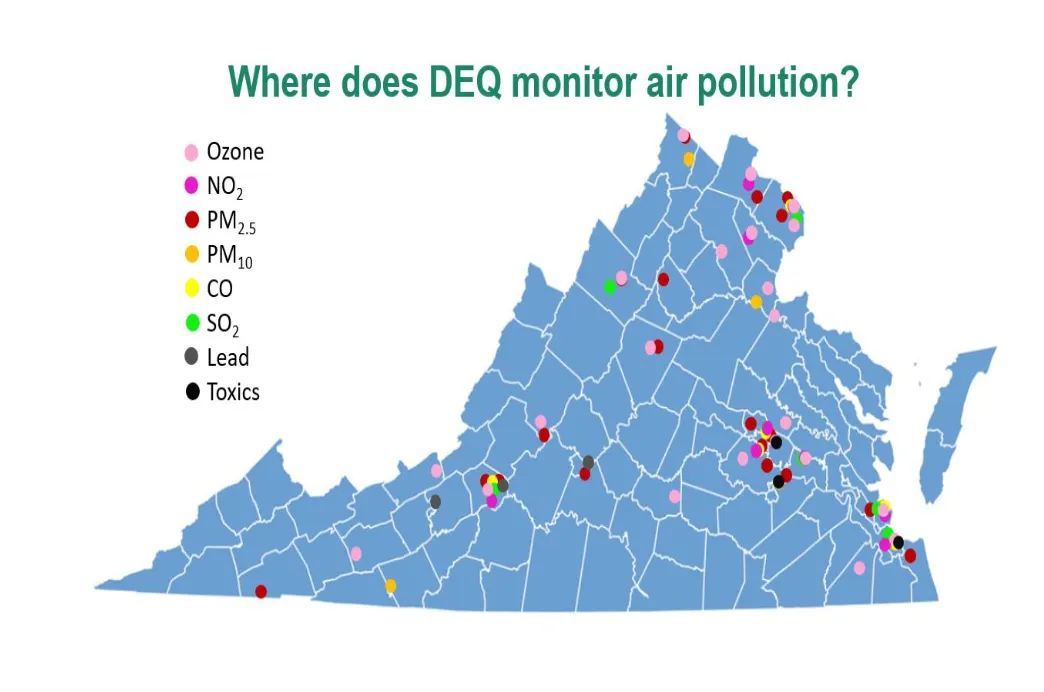
Varied regions of Virginia have varied ozone levels, depending on population and general emissions. The majority of DEQ’s monitors are focused on the higher metropolitan metro areas forecasting for the regions of Washington, D.C./Northern Virginia; Winchester; Richmond; Hampton Roads; and Roanoke.
Air quality is monitored in multiple sites in and around Henrico County including Bryan Park, the DEQ Piedmont Regional Office in Glen Allen and the Henrico Police Athletic League.
Video courtesy of the American Lung Association
Tied to emissions, DEQ scientists have seen ozone levels decrease through the years as emissions have decreased.
The air quality is broken down by color, indicating concern as levels increase. Green is good, yellow is moderate, and orange is where it starts to get unhealthy for sensitive groups.
“That's our first of major threshold for poor air quality as a code orange day. That's for those sensitive groups, those that already have existing breathing or lung conditions such as elderly and young children,” Stumpf said.
After orange, comes code red which Stumpf said is rare here.
“People may start seeing a little bit more trouble breathing or more asthma incidences. Those have gotten a lot less frequent,” Stumpf said.
The Virginia DEQ has records that go back to 1995 showing a significant improvement in air quality statewide, with a lot fewer high ozone days in recent years.
“I can see for the Richmond area, in 1998 Richmond had 69 days that were over the current ozone standard, which is the code orange level. And then in the most recent years, going back to 2013, the maximum was four days in 2016. Other than that, it's been zero, one, two or three over the years,” Stumpf said.

During the past two weeks, the DEQ has logged a mix of yellow and green days.
“It's not necessarily bad air quality to see code yellow,” Stumpf said.
After last weekend’s cold front with a little bit of rain, the clean air helped to keep the area in the good green level for a day or two until pollutants got reestablished in the area and ozone went back up.
The I-95 corridor can tend to have a little bit higher ozone, as can the D.C. to New York area as it is more populated, Stumpf said.
“As you go south, it's less,” she said. “The population is a little more spread out, whereas, California and a few cities throughout the country have higher ozone levels.”

Air quality health concerns
On Earth Day (April 22), the American Lung Association released its “State of the Air” report using data from official air quality findings, rating ozone levels, particle pollution and populations at risk.
In the report, Henrico County received a "B" grade for the level of high ozone days, clocking two orange days. In the area of particle pollution Henrico earned a "C," with three orange days. Henrico’s population at risk includes 5,132 children and 28,882 adults with asthma, according to the report.
Composed of three oxygen atoms, ozone is described by the American Lung Association as being "good up high, but bad nearby."
The ozone layer found high in the upper atmosphere shields us from much of the sun's ultraviolet radiation. However, ozone air pollution at ground level, where we can breathe, causes serious health problems. Ozone aggressively attacks lung tissue by reacting chemically with it.
The Air Quality Plan of the regional planning organization PlanRVA, presents a menu of 22 measures for reducing greenhouse gases and air pollution, across six sectors of the economy. With a commitment to innovation and sustained investment, the Richmond region could theoretically reduce emissions by 96% by 2050, according to the organization.
High air pollution levels can impair breathing, cause lung damage, coughing and eye irritation and put extra strain on the heart. Air pollution also can aggravate asthma, bronchitis or emphysema.
Paying attention to the forecasts is important if you have any existing lung conditions, officials said. The DEQ also forecasts for particulate matter – very small particles in the atmosphere that have an impact on the heart and lungs.
“People may want to pay attention to both of those depending on their personal health concerns, keeping an eye on the forecast and understanding or knowing when the poor air quality is expected, and adjusting plans and schedules as necessary to protect themselves,” Stumpf said.
In its “State of the Air” report, the American Lung Association called on the EPA to not weaken, delay or revoke key health protections that will leave children in the U.S. more exposed and more vulnerable to the consequences of many different pollutants, including ozone and particle pollution.
Dina Weinstein is the Citizen’s community vitality reporter and a Report for America corps member, covering housing, health and transportation. Support her work and articles like this one by making a contribution to the Citizen.