Planned Saturday protest seeks end to ongoing deportation flights at RIC

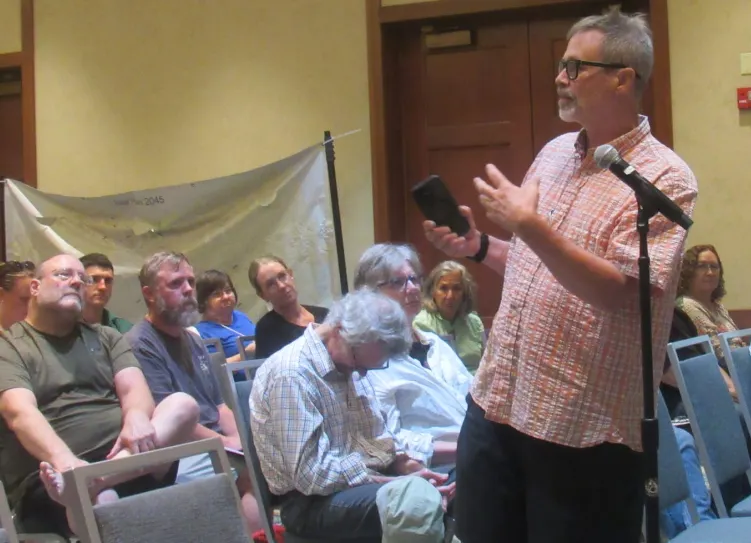
This year, on his way to the library or the gym, Varina resident Paul Fleisher witnessed unmarked airplanes as well as planes with company logos that aren’t featured as commercial carriers at Richmond International Airport, parked on the quiet, far eastern end of the facility behind a chain-linked fence.
White school buses were there to meet the ABX Air, Global X, Eastern Air Express and Allegiant flights where shackled people ascended a movable walkway onto the planes.
The remote activity became clear.
These operations were ICE detainee-transfer flights carrying people out of state, far from family and legal representation, to detention hubs in Louisiana, Texas or California, where some ultimately may be placed aboard removal flights to other countries.
In some cases, deportees from airports throughout the United States are being jailed indefinitely in prisons in their countries of origin or flown to other countries where they are not citizens, according to cases documented by Human Rights First.
“It reminded me of internment of Japanese Americans during World War Two. I compare it to the Holocaust and the entire slave trade. These people could be considered to be kidnapping victims,” Fleisher said.
Much of the detainee movement occurs outside ordinary public view.
“The entire business of how they are treating our immigrant neighbors is horrific. Families are being separated. People are being shuffled so they can’t get legal representation. I’m disgusted by the way my own country is treating our immigrant folks.”
Fleisher is not alone in his concerns.
On Saturday, Fleisher and other activists who are a part of RVA Indivisible, RVA ICE-Scream, the First Unitarian Universalist Church and other groups are gathering at a busy intersection by RIC to act as a witness to the deportation flights and to “demand an end to these cruel and unlawful deportations.”
First Unitarian Universalist Church, RVA Indivisible, RVA ICE-Scream, and Indivisible Central Virginia are co-sponsoring a protest objecting to ICE deportations Sept. 19 at the airport at the corner of Williamsburg Road and Airport Drive in Henrico.
One person who plans to attend commented they see RIC as complicit in the growing number of flights.
“DHS is disappearing our neighbors. Don’t let them use our airport to do it,” the commenter wrote online.



Some of the photos Varina resident Paul Fleisher took of deportation flights at the Richmond International Airport he witnessed this year on the far remote east side of the airport. He is one of the people who will gather this Saturday to protest the deportations. “The entire business of how they are treating our immigrant neighbors is horrific. Families are being separated. People are being shuffled so they can’t get legal representation. I’m disgusted by the way my own country is treating our immigrant folks.”
Grave human rights abuses
While detentions and deportations in the Richmond area and throughout Virginia have not been marked by the widely viewed violence and resistance as in Chicago’s Operation Midway Blitz and Minneapolis’ Metro Surge, they have been significant.
The Deportation Data Project counted 20,240 people arrested by ICE in Virginia since January 2023, whether or not the arrest resulted in a decision to detain that person. Nationwide, DDP has counted 896,393 ICE arrests between October 2022 and August 2026.
Dataset graphs show a significant spike in ICE action in Virginia, as in the rest of the country.
From October 2022 through December 2024, ICE averaged about 150 arrests per month in Virginia, according to Deportation Data Project. Since January 2025, the monthly average has risen to roughly five times that level.
In July alone, there were 49,571 ICE arrests nationwide, which exceeds the December 2025 number of 40,177. In Virginia that number was 805, which was 200 fewer people apprehended than the previous month.
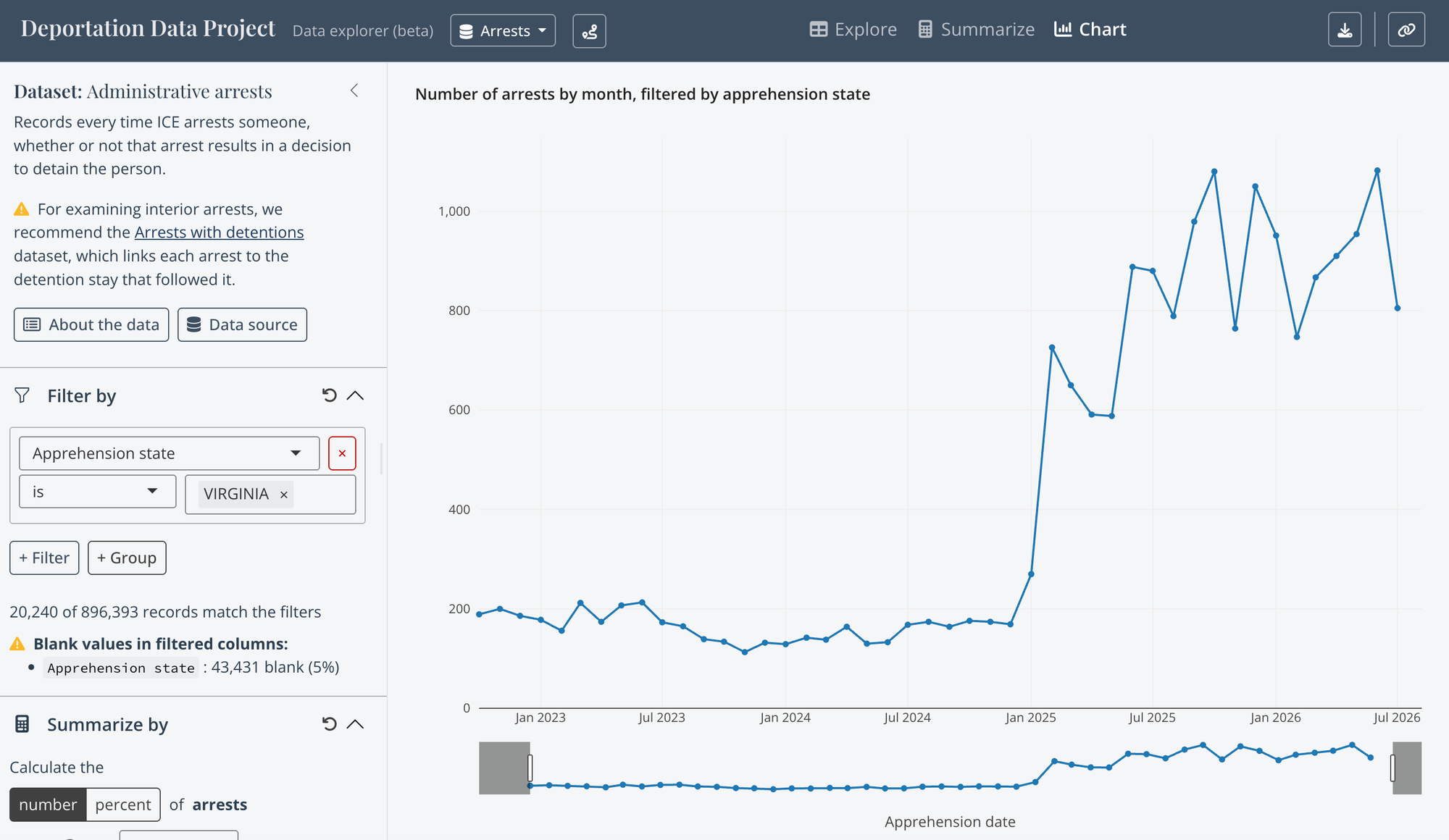
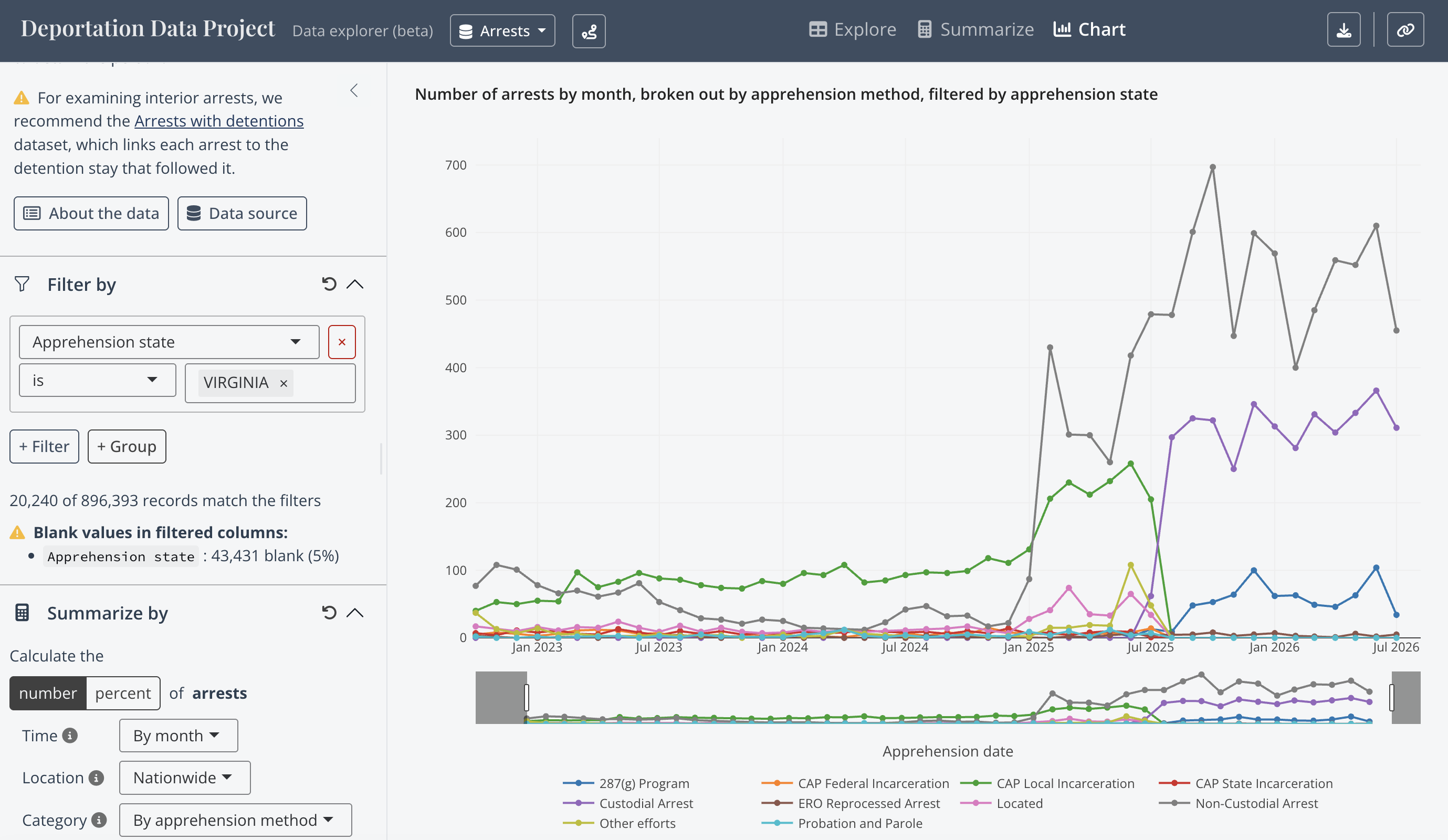
Deportation Data Project data showing ICE arrests in Virginia.
According to the Human Rights First nonprofit ICE deportation tracker’s latest report, Richmond International Airport has played a key role in deportation shuffle flights to deportation hubs in Louisiana.
The flights Fleisher sees come and go with regularity.
This year, RIC has received 132 domestic shuffle flights transporting shackled detainees out of Virginia. HRF’s new ICE Flight Monitor interactive dashboard shows how regularly the domestic transfer flights arrive and depart from RIC thrice weekly, often with detainees from preceding segments held in shackles for extended hours.
HRF counts Richmond as one of the five U.S. cities seeing more than 50% more shuffle flights than the previous month, with 27 in August, 25 flights in July and 16 flights in June. From January to May 2026, there were either 12 or 13 ICE deportation flights at the airport.
These flights previously were met right in front of the Fixed Base Operator terminal of Richmond Jet Center, but an employee of the business said the flights were moved away from the terminal because of what the employee described as the “sensitive” nature of the operation.
HRF counted a total of 128 deportation flights out of Richmond airport in 2025, more than two-and-a-half times the number of flights in 2024 (50).
The local deportation shuffle flight operation, while considered “sparse” in the scheme of flights at RIC, is a part of federal priorities to “pursue an unprecedented mass deportation agenda” as described extensively in HRF. To date, HRF has tracked nearly 64,000 flights since 2020.
This August, HRF calculated a total of 1,267 domestic shuffle flights nationwide – a 58% increase from the same month last year.
Federal funding for immigration enforcement has increased substantially under the Trump administration. The 2025 reconciliation law provided nearly $75 billion in additional funding to U.S. Immigration and Customs Enforcement, including $45 billion to expand immigration detention capacity.
In 2026, Congress approved another roughly $70 billion through the Secure America Act for immigration and border enforcement across ICE, U.S. Customs and Border Protection and the Department of Homeland Security. That measure included approximately $38 billion for ICE and $26 billion for CBP, with additional funding provided to DHS for related enforcement activities.
ICE reported 442,637 removals and returns during fiscal year 2025, substantially exceeding the 175,000 target identified in its congressional budget documents. Because the federal fiscal year ran from Oct. 1, 2024 through Sept. 30, 2025, however, that total spans two presidential administrations, including the final months of the Biden administration and more than eight months of the Trump administration.
For fiscal years 2026 and 2027, ICE has established a much higher target of 1 million returns and removals annually. The agency defines its removal statistics to include formal removals as well as certain returns, including voluntary returns and voluntary departures, while its detention figures measure initial bookings into ICE facilities. The increased removal target is part of the Trump administration's broader expansion of immigration enforcement.
In its report, Human Rights First characterizes a number of ICE tactics as unlawful and cruel.
Human Rights First has raised concerns that ICE’s rapidly expanding detention and transfer system can make it more difficult for detainees to remain in contact with family members and attorneys and to pursue their immigration cases.
The organization also has documented cases in which the federal government has sought to deport people to third countries where they are not citizens, sometimes despite claims that they could face persecution, torture or other serious harm. Advocates have argued that rapid transfers between detention facilities and removals with limited notice can interfere with detainees’ ability to obtain legal assistance or seek habeas corpus relief – the legal process through which a person can challenge the lawfulness of detention.
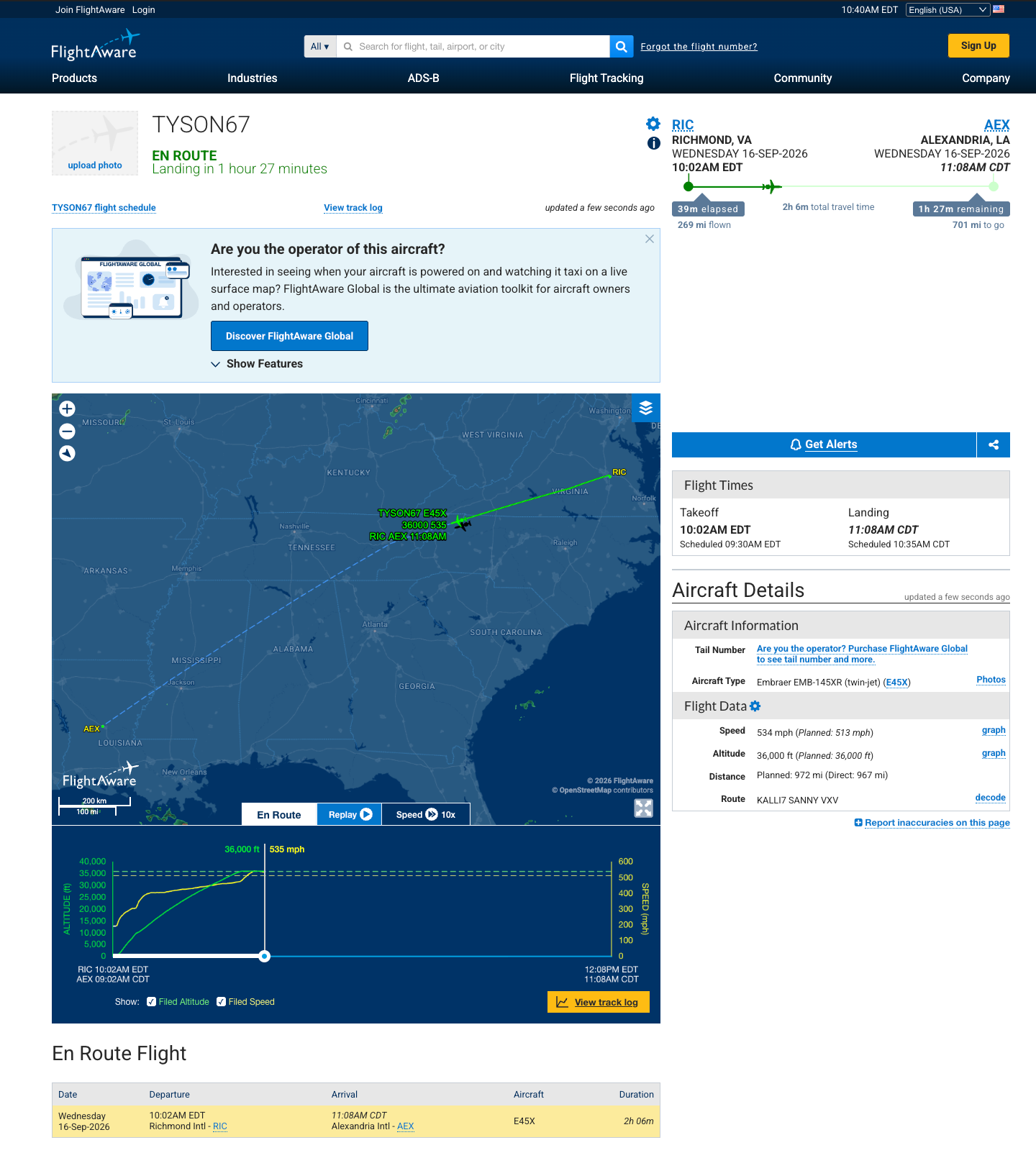
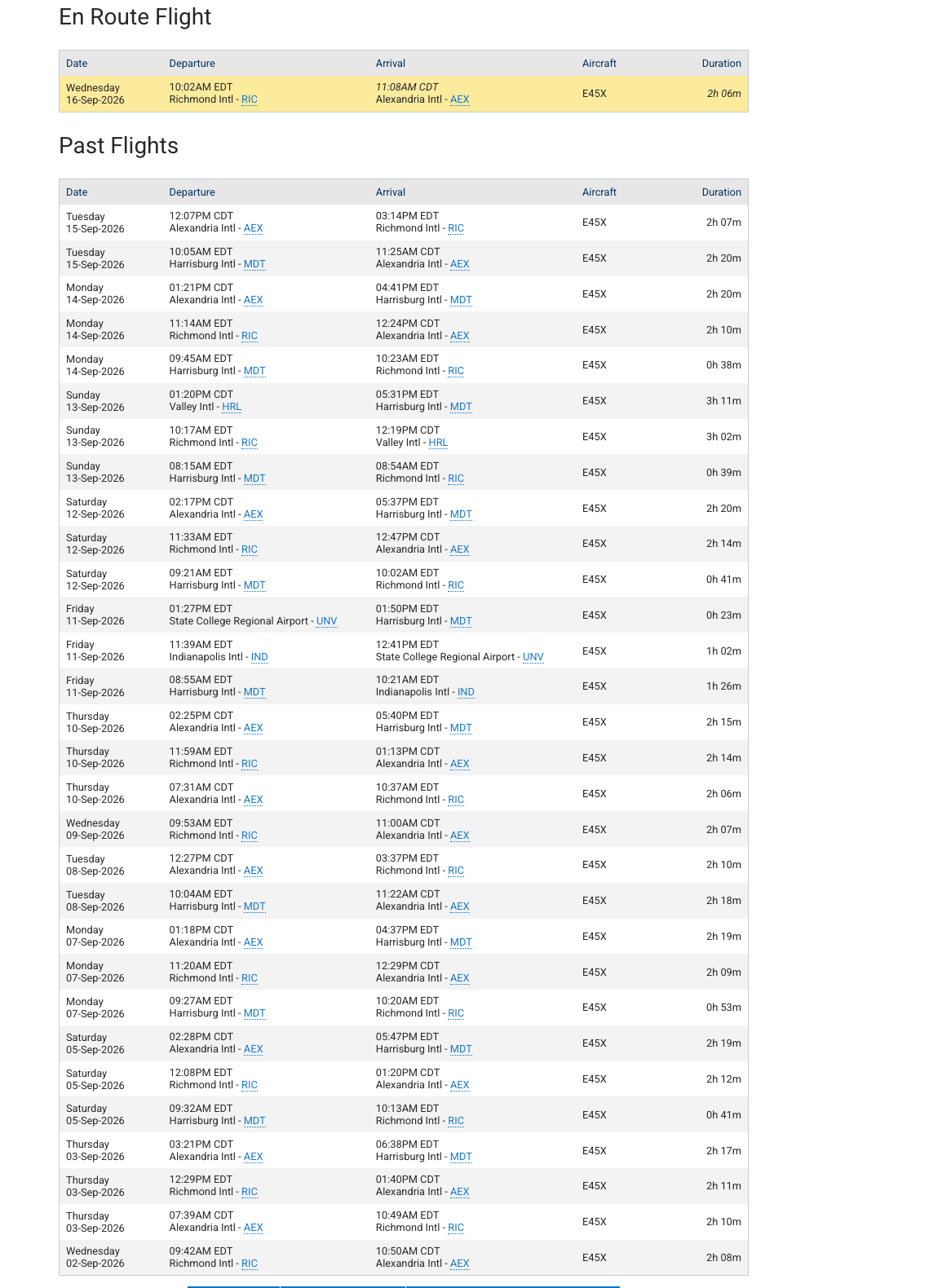
A screenshot from FlightAware on Wednesday showed a deportation shuffle flight from Richmond International Airport on its way to a detention hub in Alexandria, Louisiana (left) and the history of its route. TYSON is a call sign frequently associated by flight trackers with charter aircraft operating ICE flights; the call sign itself does not identify the flight publicly as an ICE operation.
'Silence equals consent'
Many, like Fleisher do not see the point of targeting immigrants they describe as law-abiding, who they say have come here to work – some of whom already had cases in the immigration system.
“Our country’s economy relies on what these people do. Our economy relies on the taxes they generate. They get no benefit,” Fleisher opined. “I’m disgusted by the way my own country is treating our immigrant folks.”
Fleisher said he contacted the 14-member Capital Region Airport Commission and was told that because RIC accepts federal grants and operates as a commercial airport, it is obligated to accept legal flights.
“They can’t just deny landing rights just because they don’t like what they are doing,” Fleisher said.
Fleisher wants to address the Capital Region Airport Commission at one of its monthly meetings, but though those meetings are open to the public, Fleisher said he was told that CRAC's regular meetings do not include a general public-comment period.
“As a public body using our public funds, it ought to have a time for public comment,” Fleisher said.
A year ago, when the deportation flights came to light through reporting in the Citizen, their presence was news to CRAC members. The commission is composed of representatives appointed by Henrico, Chesterfield and Hanover counties and the City of Richmond.
“Silence equals consent,” Fleisher said. “I don’t consent, and I have been pretty vocal about that and condemning the Trump administration. I have no intention to be quiet.”
Requests to ICE for information about the organization behind the Richmond International Airport deportation flights, as well as the backgrounds of the people being transported on them, their charges and their ultimate destinations, went unanswered.
But officials from ICE and the Department of Homeland Security have publicly defended the administration’s increased immigration enforcement as an effort to enforce federal immigration laws, remove people who are subject to removal and protect public safety.
ICE officials have said that detention is used to ensure some people appear for immigration proceedings, facilitate removals and address cases in which criminal histories may present public-safety risks. The agency also uses alternatives to detention for some people who remain in their communities while their cases proceed.
Administration officials have frequently emphasized arrests of immigrants with criminal records, but ICE enforcement is not limited to people convicted of crimes: people may be placed in removal proceedings based on alleged violations of immigration law, such as entering the country without authorization or overstaying a visa.
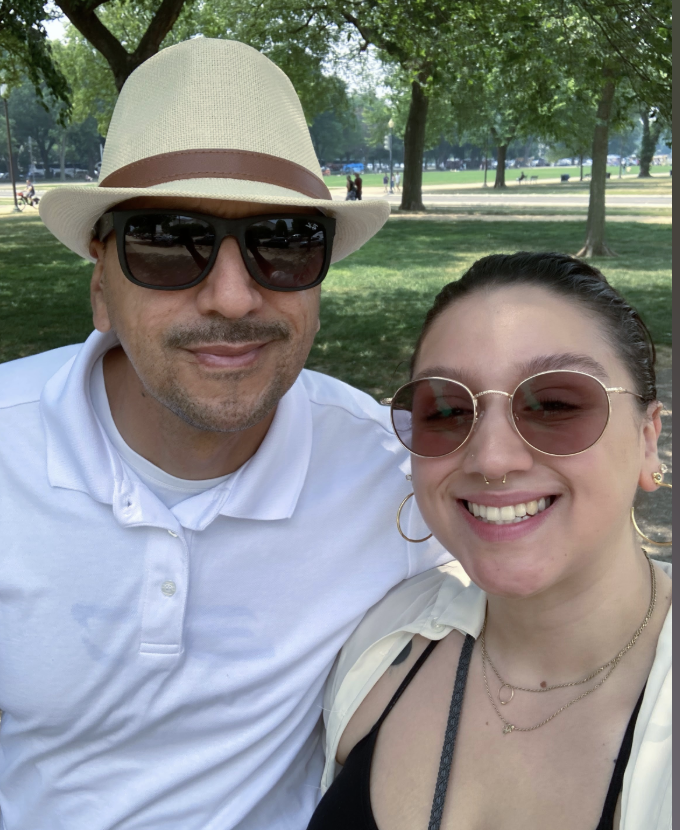

Rosa Lobo and her father, Gabriel, (left) as posted on her GoFundMe page to raise funds for legal assistance. At right, Rosa last fall said of experiencing and navigating her father's deportation and detainment in the U.S. and El Salvador: "I'm so tired. I feel like there's nothing in my control.” (Dina Weinstein/Henrico Citizen)
For daughter trying to locate father, 'I feel like there's nothing in my control'
Last fall when Henrico resident Rosa Lobo received a call from her father, she didn’t initially answer because she had started her workday. But the call proved urgent.
He, along with his whole work crew, had been picked up by ICE around Washington, D.C. Born in El Salvador, Rosa’s father did not have a permit to work and live here. He was brought here as a child and has lived here since.
She described her father as someone who felt American.
“He has an accent, but he speaks English pretty well,” said Lobo, who was born in Southwest Virginia. “He speaks Spanish, which is his first language. He's a very silly, goofy guy when you meet him, but he's not stupid. He knows what's going on. He knows what people think about him. He watches the news, he's very studious. He's very religious. He'll read his Bible every night before he goes to bed. He is good at defusing situations.”
Then Gabriel Lobo was in detention at an ICE center in Chantilly, Virginia.
After that, he was transferred to the Farmville ICE Detention Center, where Rosa went to visit him.
She set up a GoFundMe to raise funds for legal support which grew donations due to her connections in the Richmond area as a graduate of a local prestigious university and an impactful nonprofit. She credits the Richmond Legal Aid Justice Center, Richmond Legal Fund and the Amica Center with supporting her and her father as much as they could.
She is just one of dozens of other area residents who have created GoFundMe fundraising campaigns to pay for legal support in a federal immigration system in which people generally do not have a right to government-appointed counsel. Thousands across the country have used the platform to garner help for their family members.
Seeing her normally tidy father shackled and disheveled shook Rosa to her core.
Soon, her father was gone, flown out in the middle of the night to a Louisiana detention center.
In Louisiana, he was again in the middle of the night loaded onto a plane – this time flown to El Salvador, where she said he ended up in CECOT (Centro de Confinamiento del Terrorismo), a maximum-security prison built by the Salvadoran government as part of its campaign against gangs.
Rosa worried as communication stopped.
The experience has taken a toll on Rosa's mental health. The tense situation and fear during this administration remind her of her mother's experiences growing up in Southwest Virginia watching the Klan march in her town.
"We think about these things as being so far away and so out of reach. But, it's recent history. It's things that my parents remember and things that are happening actively to me, to people younger than me," Rosa said.
“I'm so tired, and I feel like there's nothing in my control.”
Her family hired lawyers in El Salvador to free her father, but he was caught in a prison system from which he could not secure his release (though she said he had committed no crime there), due to that country’s “state of exception.”
That, according to human-rights organizations, has permitted authorities in the nation to detain people for extended periods based on suspected gang affiliation with severely limited due-process protections.
“I've had to swallow the fact that there's a high possibility I'm never going to see my dad again,” Rosa said. “Even if he lives. There's a 0% chance that he's going to be able to come back to the United States. Whether or not I would be able to travel to El Salvador is up in the air as well.
“It's a good chance that I'm not going to see him again, be it because he's detained indefinitely because he needs to keep a low profile and stay in El Salvador, or be it because he is fully disappeared and possibly killed. I don't know. It's truly a hopeless situation at this point.”
The mental toll on Rosa has been significant. While worrying if her father is being treated inhumanely, she forces herself to eat, sleep and work, finding solace with activism with the Democratic Socialists.
“I've tried reaching out to my elected officials, not about my case in particular, but about the subject as a whole, signing petitions, sending letters, about something has to be done about ICE. Something has to be done about this mass disappearing of people in the United States. But every response, it's always, like the automatic ones you get from their desk, ‘Thank you for reaching out to your representative. So-and-so in the office saw your letter and this is what they had to say.’ And it's always ‘We'll get around to it.’”
In the spring, Rosa’s GoFundMe update showed her father’s status as still jailed in El Salvador without charges being pressed.
“These days, the only evidence I have that my father is even alive is that someone spends the money my uncle sends in for his food,” wrote Rosa, noting that any legal process there could take years.
She still does not know what he was charged with in the U.S.
Mugshots bear witness
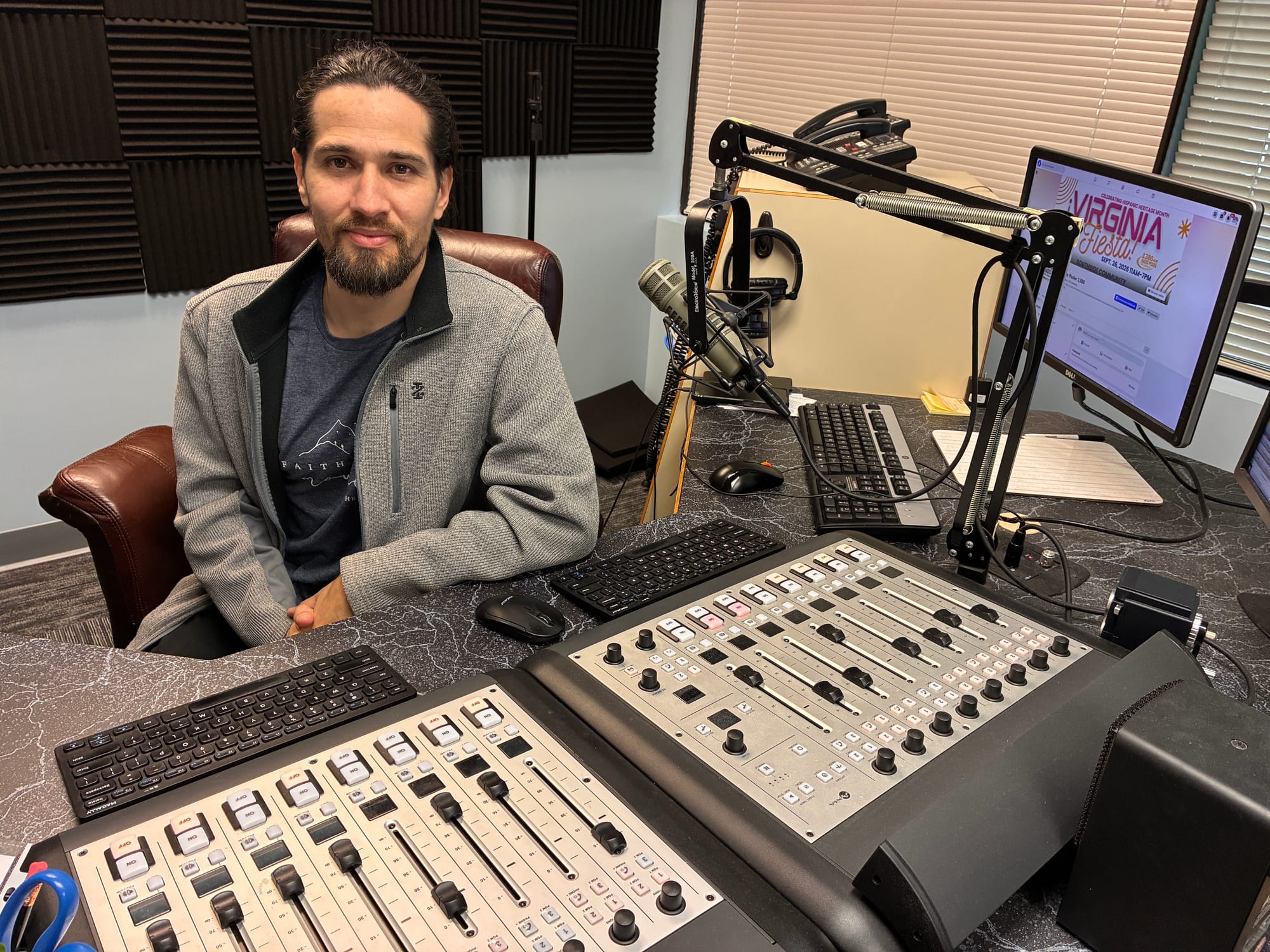
Radio Poder Spanish-language morning-show radio host Oscar Contreras prays for and with his listeners daily from a quiet radio station office in a nondescript Henrico office park building.
But during the past two years, the station’s social media page took a diversion from uplifting community events and educational opportunities with inspiring Biblical verses.
As ICE apprehensions began to increase, his listeners started calling him for help.
“People were calling me saying 'My family member was taken. I don't know where he is,'” Contreras said. “It was kind of like kidnapping.”
So, Contreras, who was born in Guatemala and is a U.S. citizen, began searching.
Mugshot websites helped him find people who had been detained – photos of Latinos and Latinas in workwear of those who toil outside in landscaping, house painting, roofing and in kitchens photographed at their worst moment.
“When I find out that this page, you could find the people and let the family members know, I was able to help the families find the people because I have their birthdays,” Contreras said.
“I said, ‘I don't think people know this. I didn't know this.’ I didn’t know there were so many detentions. I thought like one here, one there, because you would expect things to be on video, but it was happening. I thought, ‘What do I do with this information?’”
A short hesitation of posting photos meant to embarrass the person who allegedly committed a violation is now a visual witness to Virginia’s role in a nationwide mass deportation effort.
Contreras offers to remove photos if the people or families contact him. He also posts from the bustednewspapers.com website: "The people registered are representative of that entry, not of their guilt or innocence. Every person arrested is presumed innocent until proven guilty."
He has sifted through the mugshots of those detained at Riverside Regional Jail and now Chesapeake City Jail stating: “Several people detained by ICE are registered in prisons before being taken to Detention Centers. Usually the information says: Arrested by ICE but we are publishing the people with Latin American names because this prison is used by ICE. (NOT ALL WERE REGISTERED BY ICE, BUT IT IS DIFFICULT TO SAY AT LEAST THAT THEY SPECIFY)”
He saw sadness, confusion and uncertainty in their faces.
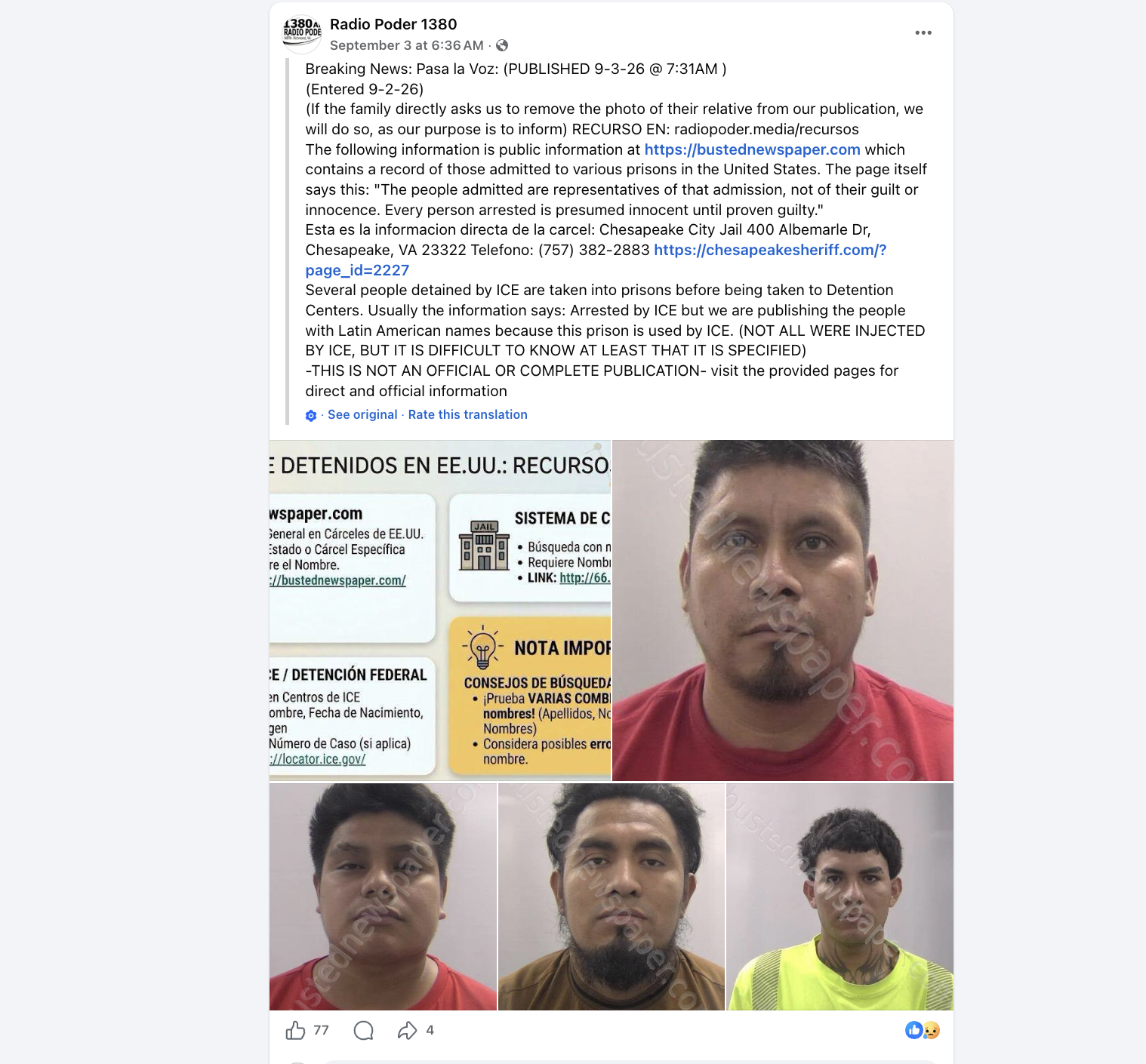
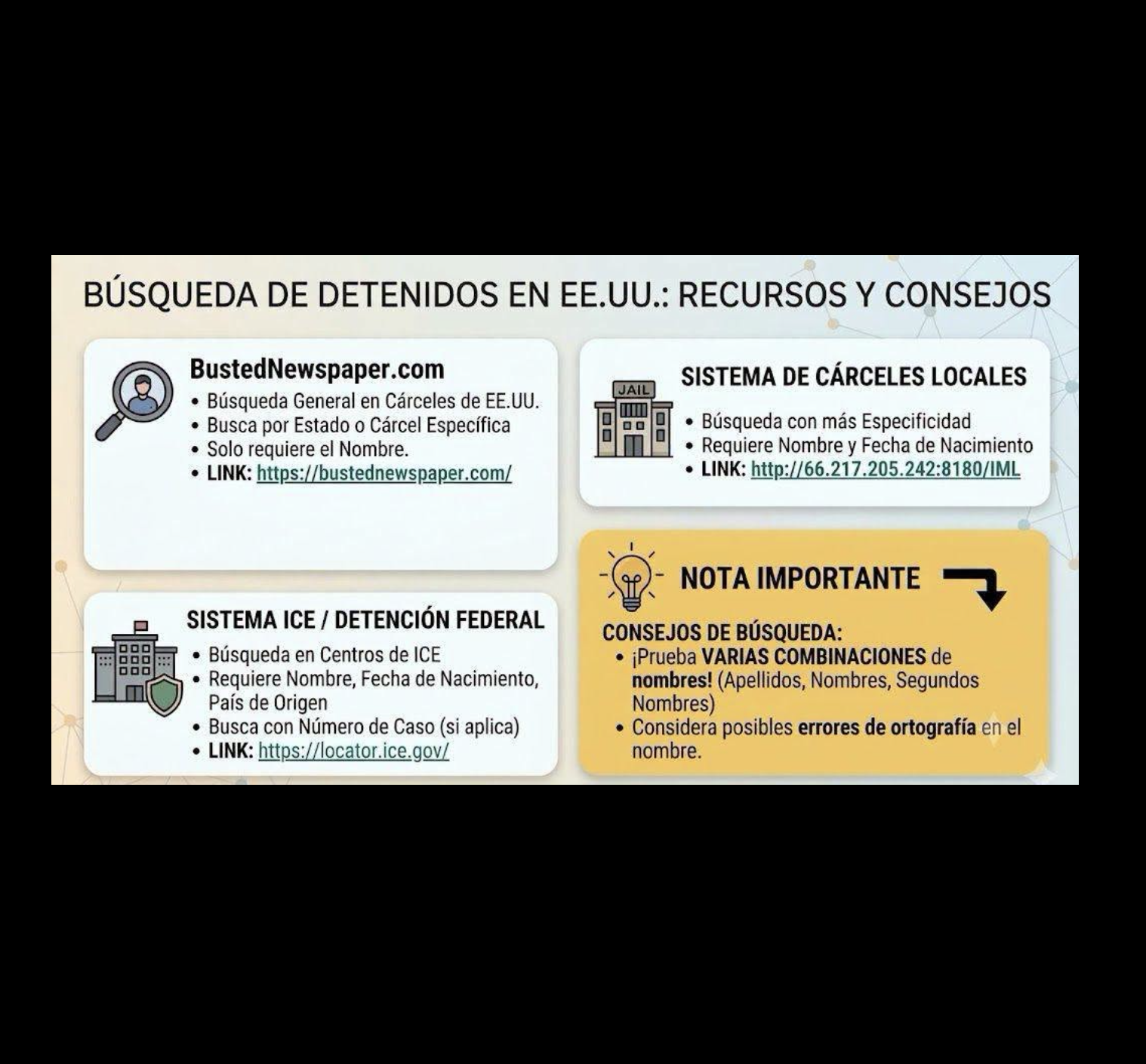
Screenshot of a Radio Poder social media post with mugshots of people detained by ICE at the Chesapeake City Jail and an informative graphic to help people navigate the legal and U.S. immigration system to keep track of their family members.
Stories Contreras hears are heartbreaking:
• a family member searching for four members of her family who were apprehended as they were out fishing.
• a pregnant mother who was left with four other children, asking for assistance.
• a woman whose husband was caught by ICE who had to abandon his work truck in a random neighborhood asked for help searching for their property.
• a child of a deported parent who refused to go to school after being bullied. Contreras set up a meeting with the school to get home instruction for the student.
“Children have to go to school after their parents were taken. It's a lot to carry. People may say, ‘They're criminal.’ Okay, fine. But it doesn't diminish the suffering of the people,” Contreras said. (A Brookings Institution analysis estimated that about 145,000 U.S. citizen children had experienced the detention of a parent between January 2025 and April 2026.)
• a woman whose mugshot Contreras posted later called asking him to take it down after she was released from detention telling of torturous conditions.
“I asked, can you share your story?” Contreras said. “She was telling me, 'I'm traumatized by it.' It was extremely cold and one of the detentions that she was in, the bathrooms had plugged up, and because of it, the women were doing their business on the floor because there were no restrooms. They were moved four or five times, not just plane flights. She said there was a group of women where they would come to them and say, ‘Okay, you're gonna be transported,’ and then we just put them in the van, take them, and at the end of the day, they were being brought back.”
The woman told Contreras that the experience continues to disrupt her sleep and makes it difficult for her to leave her home.
Reactions to the mugshots on Radio Poder’s social media have varied. Some people have said “Great this is what I wanted.”
One commenter lamented: “How sad because most are not doing anything wrong, just looking for a living for their families.”
Contreras’ connection to churches resulted in meetings of congregations that wanted to become more informed about the impact of deportations on immigrant communities and to help those who are detained and those left behind.
“The result has been in large and small ways,” Contreras said. “In small ways, I can tell people that I'm praying for them, and listen to them. And the big way, there are churches and organizations that are working together and connecting to see how they can help the immigrant community. I think that's a good thing that came from this initiative of like, ‘Hey, something's happening, and people have to come together.’”
With the awareness of the ICE activity, lawyers on Radio Poder have encouraged adults to get their power of attorney documents in order to protect their children.
Contreras thinks Virginia’s elected leaders need to publicly acknowledge the high numbers of detainments and deportations and the impact on the community.
“I think that would be a huge start,” Contreras said. “If someone like our governor or our federal officials would say, ‘Yes, this is happening,’ then at least you know that they know, and then, hopefully, they'll do something about it. And you can be like, ‘Well, you know all the details, you know, so stop it.’”
Dina Weinstein is the Citizen’s community vitality reporter and a Report for America corps member, covering housing, health and transportation. Support her work and articles like this one by making a contribution to the Citizen.