
Parents fear a technology overload in schools. State leaders are beginning to step in.
Central Virginia parents and teachers say they are confronting a “digital tsunami” when it comes to their students’ education.
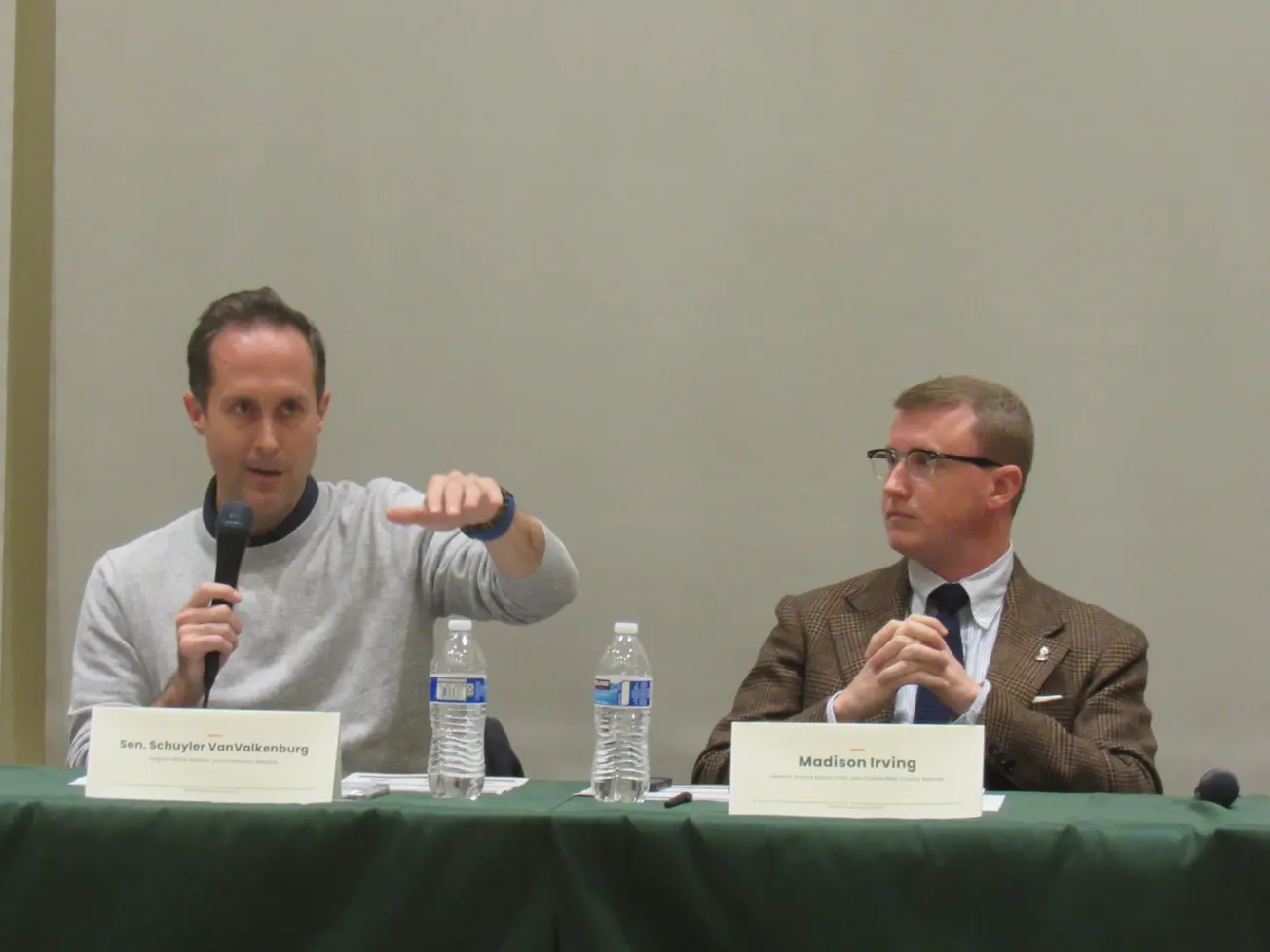
At a Nov. 17 town hall in Chesterfield, families from the Richmond region spoke with panelists, including state senator Schuyler VanValkenburg (D-Henrico) and Henrico School Board Chair Madison Irving, about the consequences of overexposing children to screens and how schools should balance innovative technology with the old-school pen-and-paper method.
Many parents in attendance primarily were concerned with how excessive screen time during school could produce endless distractions, create a need for constant stimulation, and ultimately lead to worse academic performance. Henrico parent Ryland Potter said she has already requested a “technology reduction” for her elementary- and middle-school students during their class time.
But other parents were hesitant to fully eliminate screen time for their children. Chesterfield parent Jasmine Bai, whose child will be a kindergartener next year, said she worried that her child would “fall behind” if other kids were able to use new technology and learn new skills.
The town hall was headed by former Henrico teacher and Chesterfield parent Amber Rhodes, who leads the regional chapter of The Balance Project and emphasized that the non-profit’s message was not “anti-technology” but instead encouraging technology use in the right ways.
Panelist W. Monty Jones, an education professor at Virginia Commonwealth University who has a Ph.D. in instructional technology, said that parents should be less concerned about the amount of technology used in school and more focused on whether it is used appropriately.
“We are all talking about screen time, screen time, screen time. . . Well, all screen time is not the same” he said. “There’s lots of different screens, and kids can do really amazing things with them and they can do really bad things with them. In the hands of a good educator, this can be very, very powerful. I don’t think it’s a maximum or minimum, I think we try to use it to its highest effect.”
But other panelists said that without any moderation, high levels of screen time can developmentally lead to issues with concentration and completing slower tasks, as well as anxiety and depression symptoms.
“They're showing consistent correlation in research with concentration difficulties, poor executive functioning, and lower academic performance,” said licensed professional counselor Angela Petry. “High exposure to screens contributes to internalizing issues such as anxiety and depression, and then externalizing behaviors like aggression and hyperactivity. So students already struggling with emotional regulation often turn to screens to cope. It’s a vicious cycle.”
Bills on screen time limits, return-to-textbooks pilot program
For state legislator VanValkenburg, who is also a social studies teacher at Glen Allen High School in Henrico, the answer is not more technology. Some school divisions have implemented programs to give teachers more oversight into students’ technology use – such as Henrico Schools with Securly Classroom, a software that allows teachers to see and control what happens on students’ screens. But VanValkenburg said that method is often not very effective.
“I’ll be honest, I’m not using Securly to check [my students’] AI use, because I just find that to be so cumbersome and overwhelming on my end. I’d rather their computers just be closed and then give them a sheet of paper,” he said. “Sometimes the simple answer is the best answer, on a policy level and a teacher level.”
VanValkenburg said that he and his colleagues have several pieces of legislation planned for the upcoming General Assembly session that tackle issues of school technology and screen time. One bill would require all school divisions to implement guidelines around purposeful use of technology – “a la what Henrico County has already started doing” with the newly-created digital wellness guide, VanValkenburg said. The state would also create a model policy that divisions could simply adopt.
Upcoming legislation would also set screen time limits in school for kindergarten through second grade, but include exemptions for required online state testing.
Another bill would create a pilot program among 10 school divisions where students would return to physical textbooks rather than use digital materials, but VanValkenburg said that the state would need funding and willing school divisions to implement the program.
For the past three years, VanValkenburg also has tried to pass legislation that would ban “infinite feeds” for minors on social media apps, a feature that allows users to endlessly scroll through new content. This year, VanValkenburg wants to at least ensure that the infinite feed algorithm is not the default for minors using social media.
“There is a pathway to creating a healthier ecosystem so that your kid is less likely to be on [screens] all day,” he said. “Because if we’re asking an individual or a parent to be Sisyphus, we’re not going to win.”
VanValkenburg also said that legislators would have a “broader conversation” on AI use. Students’ reliance on AI has gotten so bad in his classroom that VanValkenburg said he has resorted to assigning only reading for homework.
“If I give them any assignment that’s writing, at this point, it’s not going to be done by them. Not every kid, but a lot of kids are just going to put it into AI,” he said. “I remember last year, I gave them five questions that I was quizzing them on…and 90% of the kids put the five questions into AI. I didn’t even have to give them zeros, they gave themselves zeros because the AI answered it wrong.”
Some parents also said that teachers’ reliance on digital learning materials can make it harder for parents and other older adults to be involved in their students’ schoolwork and education.
“There is a disconnect between parental involvement and what they do in the classroom, homework and everything else,” said Willie Johnson, whose grandson is a high-schooler. “My grandson comes home with math problems. I can’t go online and figure out what they’re doing because I don’t know which ISN number they’re using for the textbook. . . the parents have to stay involved. If not, we’re going to get lost.”
Irving, who represents the Three Chopt District on the Henrico School Board and is also a high school teacher in Chesterfield, said that teachers must be willing to have one-on-one conversations with families about not only what is going on in the classroom, but also whether students are getting too much exposure to technology at home.
“I think it’s being fine with teachers having conversations with students and parents and saying, ‘Part of what makes this more difficult for me is if [this work] is not happening when they’re at home as well,’” he said. “I think it’s just having person-to-person conversations.”
Liana Hardy is the Citizen’s government and education reporter. Support her work and articles like this one by making a contribution to the Citizen.


