
Henricoans among nearly 200 at Capitol Bell Tower rally demanding Virginia leaders rein in data center growth
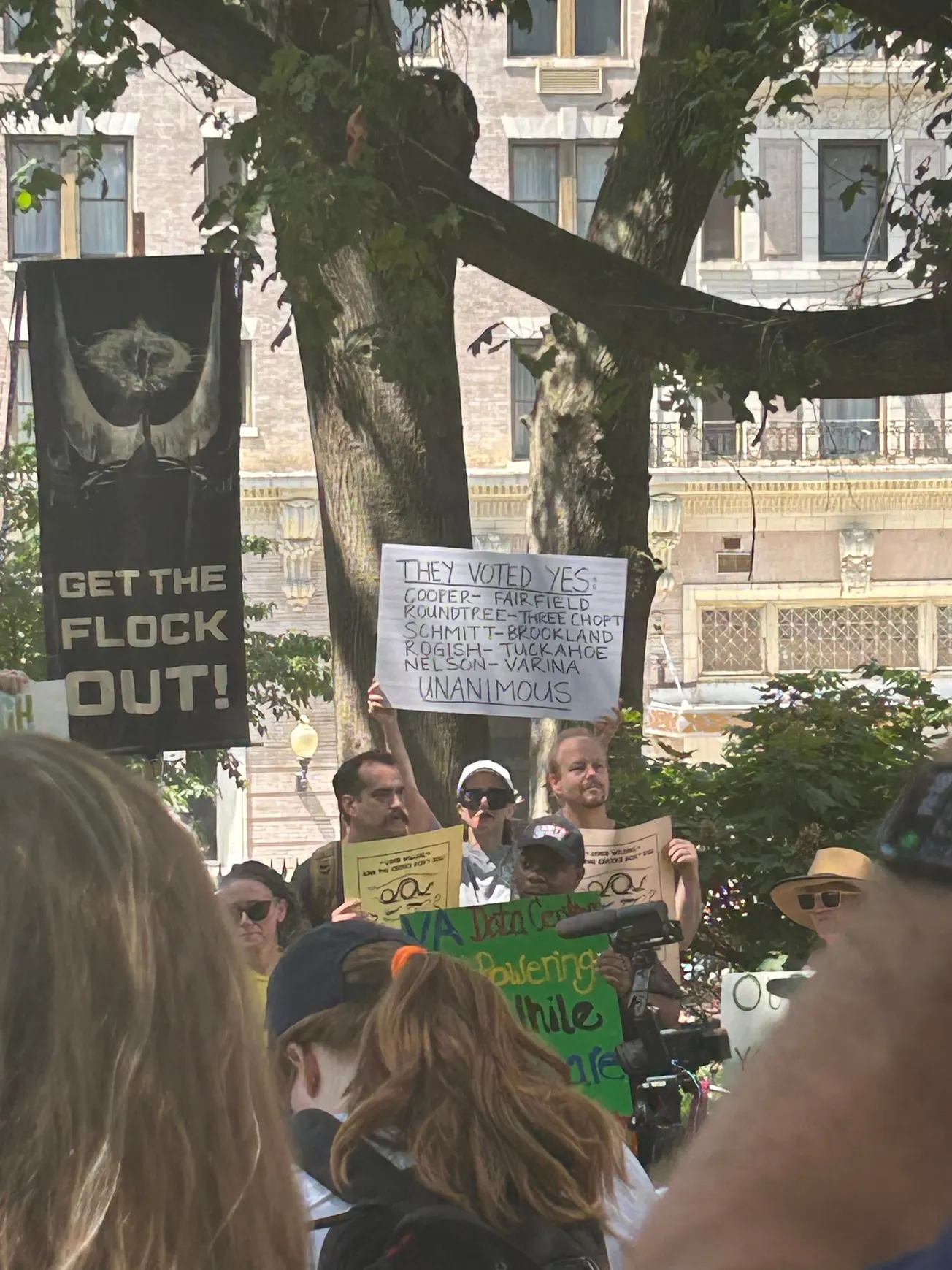
Nearly 200 people gathered at Richmond’s Bell Tower in the Virginia State Capitol Square July 11 for the “Enough Is Enough” rally, at which residents from Henrico, Hanover and neighboring counties told state leaders that rising electricity bills, pollution and unchecked data center development have pushed Virginia communities to a breaking point.
The rally, organized by a coalition of environmental, consumer and justice organizations, drew speakers from communities directly affected by data center construction across the state. Speakers called on Gov. Abigail Spanberger’s administration and the Virginia General Assembly to put protections in place for Virginia families before the industry expands further.
Monica Hutchinson, president of the Henrico County NAACP, outlined the NAACP’s “Stop Dirty Data Centers” campaign, which calls for full transparency in the permitting process, an end to what she described as rezoning decisions and deals made without community input, and legally binding, publicly disclosed agreements requiring tech companies to invest directly in the neighborhoods where they build.
“We must protect our frontline communities now, because every single month that they delay is another month that tech companies block in more destruction, more concrete, more corporate greed at the expense of Virginia neighborhoods, many of which are black communities,” Hutchinson said.
The NAACP has been working with communities across the country that stand to experience the negative impacts of data centers. Among the campaign’s demands: that data center operators pay for grid upgrades tied to their projects, bring their own clean energy rather than draining existing power resources, and be barred from building on protected land.
She tied the fight to environmental justice more broadly, saying Black communities have long dealt with pollution burdens from ethylene oxide to coal ash that predate the current data center boom, and that Henrico residents deserve access to the technology sector’s job pipeline, not just entry-level positions.
“We demand that they put our families over their data,” Hutchinson said. “That they put our schools over their profits, because enough is enough.”
Beatrix Jackson, a Varina resident and member of the Henrico County Public Schools Equity and Diversity Advisory Committee, described how a proposed data center off Darbytown Road prompted her to get involved in local zoning fights.

Jackson has been active in the “Say No” grassroots campaign against data center development in the area, which residents credit with helping scale back a rezoning proposal and canceling a planned 1 million-square-foot facility in the county.
Jackson said her family moved to Varina, in part, for its rural quiet after her husband's military service, and that the cumulative effect of data center infrastructure, not just individual project approvals, deserves more scrutiny from local and state officials.
“My husband is a combat veteran, and after years of serving this country, what he and our family found was something priceless in Varina,” she said. “It was peace. We chose to live in Varina because it still feels like a place where children play outside, where you can wake up to birds instead of machinery, where neighborhoods exist alongside wetlands, forests, farmlands, and schools. It’s a place where our family has been able to breathe, heal, and build a life.”
Jackson called for green buffer standards that preserve mature tree cover, independent studies of traffic and infrastructure impacts before projects are approved, and community benefit agreements that spell out facility ownership, profit-sharing and long-term accountability — even after a property changes hands.
“We experience the roads, the substations, the transmission lines, the industrial cooling equipment, the water demand, the light pollution, the continuous mechanical noise, the changing landscape, the loss of forests, and open space” Jackson said, arguing that data centers should be evaluated for their combined impact on a community rather than parcel by parcel.
She directly addressed Spanberger, saying she hopes her administration will help make Virginia “the national model for responsible technology development,” and pushed back on the idea that raising concerns about data centers means opposing technology itself.
“You can support the internet,” she said. “You can support use of AI. You can support economic development, and you can believe in innovation, and still insist on clean air, and still insist on protected water, and still insist on quiet neighborhoods.”
Both Hutchinson and Jackson pointed to Henrico’s own response to rising electricity demand.
Hutchinson pointed out Henrico’s 25% electricity rate increase for local government and schools, and how the county has asked employees to turn off lights and close window blinds to conserve power. Jackson noted that county employees have been asked to be mindful of their energy use as demand climbs.
The cost of data center growth is already landing on residents and public institutions, according to both speakers, ahead of any state action to address it.
Their claims track with statewide findings. A February 2026 study from George Mason University’s Center for Climate Change Communication, estimated that Virginia data centers already draw about 5,050 megawatts of power and account for 21% of Dominion Energy’s total sales, a share the researchers expect to double by 2040.
The state's own Joint Legislative Audit and Review Commission projects that rising data center demand could add $14 to $33 to a typical residential electric bill each month by 2040. The study’s authors also noted that Virginia currently has no requirement that data centers switch to backup power during periods of peak grid strain, and that utility rates are revised only once every one to two years — a lag they argue hasn’t kept pace with how quickly costs are climbing.
Among their recommendations: a dedicated rate class for data centers, so the financial burden of their growth doesn't fall on households and public institutions like Henrico’s schools.
Virginia has almost 400 data centers already in use with about 300 more planned, according to data from Pew Research.
Sponsors and community partners for Saturday’s rally included People Over Data Centers, Virginia League of Conservation Voters, Climate Action Virginia, Sierra Club Virginia Chapter, Chesapeake Climate Action Network, Data Center Defiance, Virginia State Conference NAACP, Freedom Virginia, 50501 Virginia, Indivisible, Block Valley Link, and Studio Two Three.