Henrico breaks ground on $300M water line, Richmond-Henrico Turnpike improvements

Henrico County officials broke ground Oct. 28 on the first section of a $300 million-plus water transmission line designed in part to prevent a repeat of the January 2025 water crisis, while also launching a project to widen a portion of Richmond-Henrico Turnpike.
The two projects, which officials celebrated during a ceremony at Richmond Raceway, are designed to improve water reliability, roadway safety and transportation options in Eastern Henrico.
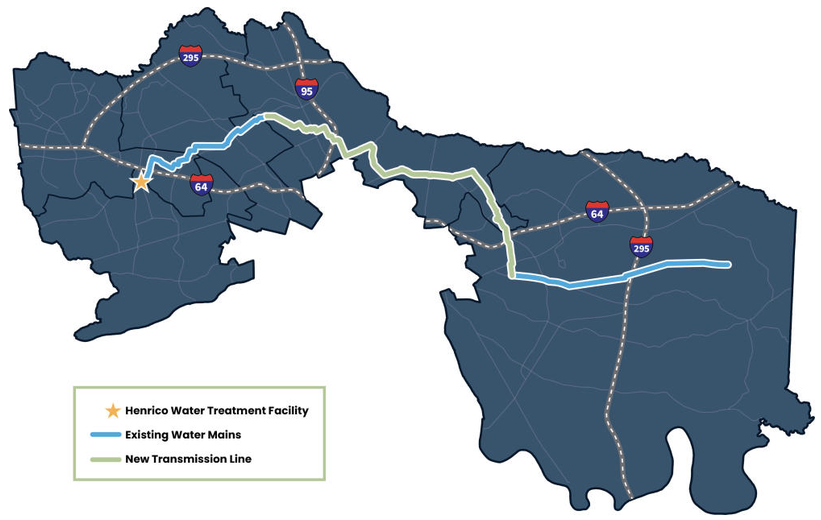
The larger of the two projects is the Eastern Henrico Water Transmission Line, a roughly 13-mile pipeline that will allow Henrico to supply water from its own treatment plant in Western Henrico to customers throughout the county, including those in the eastern portion.
The project is expected to be completed and operational by 2031, with construction on the remaining sections scheduled to begin in 2028. County officials said the design process is approximately halfway finished and should be completed in 2027.
Sign up for updates about the water transmission line project by clicking below.
The new line is intended to address a significant weakness in Henrico's water distribution system that became apparent during the January 2025 water crisis, when a mechanical failure at Richmond's water treatment plant left thousands of customers in Eastern Henrico – who are served by the city's plant – without water for several days.
Although Henrico operates its own water treatment plant on Three Chopt Road, the county's existing distribution system was not designed to move enough water from that facility to serve customers in the eastern portion of the county during a major disruption.
"We tried to push water from our water treatment facility on Three Chopt Road to customers in the East End, but our efforts were largely frustrative," Henrico Public Utilities Director Bentley Chan said during the ceremony. "The pipes were simply too small."
The new transmission line, which will consist of approximately 13 miles of 42-inch water main, is designed to correct that problem by providing the county with greater flexibility to distribute water throughout its service area.
"This project gives us the ability to stand on our own," said Henrico Board of Supervisors Chair Roscoe Cooper III, who represents the Fairfield District.
Following the water crisis, Henrico hired a local engineering firm to evaluate its water distribution system, identify weaknesses and recommend improvements. The board of supervisors approved a course of action in September 2025 and awarded a design contract for the transmission line that December.
County officials accelerated planning for the project after the crisis exposed vulnerabilities in the interconnected water systems serving Richmond and Henrico.
Varina District Supervisor Tyrone Nelson, who personally experienced the outage, recalled discovering that his own home had lost water service.
"I can still remember like it was yesterday going to turn the water faucet on, no water, and then my phone blowing up with text messages and calls of persons doing the same – no water," Nelson said.
Many families and businesses in the Varina and Fairfield districts were affected by the disruption, which lasted nearly a week in some areas.
"The truth is, I don't ever want to deal with that again, and I'm certain that none of us want to be in that position again," Nelson said.
The county currently purchases water from Richmond to serve northern and eastern portions of Henrico under an agreement that extends through July 1, 2040. The new transmission line will provide an additional supply option during emergencies and reduce the county's dependence on Richmond's system, though it will not eliminate that arrangement.
"When it is finished, we will have the ability to better support and protect Eastern Henrico with water from our own treatment facility," Nelson said. "If another disruption occurs, we will have a critical additional option to help maintain service for our residents."
Although the full transmission line remains in design, Henrico is beginning construction on approximately one mile of the pipeline now to coordinate the work with improvements to Richmond-Henrico Turnpike. That initial section is expected to be completed in 2028.
Residents can follow the progress of the Eastern Henrico Water Transmission Line project and sign up for email or text updates through the county's project information page at publicinput.com/eastendwater.

Richmond-Henrico Turnpike widening targeted for 2028 completion
The roadway project will widen Richmond-Henrico Turnpike between East Laburnum Avenue and Hummingbird Lane from a two-lane, undivided roadway to a four-lane, divided roadway with a 16-foot raised median.
The improvements also will include a sidewalk along the western side of the road and a lighted shared-use path along the eastern side, providing improved pedestrian and bicycle access to nearby Laburnum Elementary School and Henrico High School.
New box culverts also will be installed to improve drainage and reduce damage to the roadway during storms.
The work represents the second phase of a larger effort to improve approximately 1.9 miles of Richmond-Henrico Turnpike between Laburnum Avenue and the CSX railroad crossing.
Voters approved $14 million in bond funding for the roadway improvements as part of Henrico's 2016 bond referendum. The project also is receiving state and federal transportation funding, and the northern section already has been completed.
In July, the Henrico Board of Supervisors awarded a $40.3-million construction contract to Abernathy Construction Corporation for the southern section. The work includes roadway widening, drainage improvements, stormwater facilities and the installation of water and sewer infrastructure, including the initial segment of the new Eastern Henrico transmission line.
The roadway improvements are expected to be completed in 2028.
Cooper said coordinating the roadway and water projects will reduce construction disruptions and avoid the need to excavate the newly improved road in the future.
"By coordinating the installation of this water main behind me with the turnpike widening, we can accomplish two major infrastructure improvements at the same time and reduce the impact on our residents," Cooper said.
"That means less disruption for residents and no need to come back later and dig up a road that has already been improved."
The combined work also reflects the county's broader efforts to improve infrastructure in Eastern Henrico, where the water crisis heightened concerns about the reliability of essential services.
Nelson said the county's response demonstrates its commitment to addressing those concerns rather than simply restoring the system to its previous condition.
"We cannot change yesterday. We cannot go back and change what happened in 2025," he said. "But we can definitely learn from it. We can act on it and we can build a stronger system for the future."