Henrico aims to tackle its serious speeding issue with new 'life-altering' program
Reckless driving doesn’t just result in tickets. Sometimes it results in funerals.
Kelly Florian’s 19-year-old son Josh has had many friends involved in serious car accidents. He has visited friends in the hospital and even attended several of his friends’ funerals. But still, Florian said her son had a voice in his head saying: “that won’t happen to me.”
“Like many teenagers, Josh thinks he’s invincible,” Florian said. “Somewhere along the way, he has convinced himself that he is in control of that vehicle, and that the terrible things that happen to other people would never happen to him.”
When Josh was charged with driving 98 miles-per-hour in a 55 mph speed limit zone, his fourth ticket since receiving his driver’s license, the judge recommended that he participate in Henrico’s new SAFE High-Speed Diversion Program. Florian said that she was somewhat hopeful, yet also resigned that the program would not have much of an impact.
But over the next four weeks, Florian said her son would return from every program class with raw emotions – deeply moved after hearing from speakers who had lost loved ones in car crashes, “scared straight” after a visit to the Henrico County Jail, and challenged after confronting his own mortality when program participants were asked to write their own obituaries.
“This was not the teenager who entered this program. This was a young man finally understanding the consequences,” Florian said. “As a parent, I can tell you that I have seen a genuine change in him. I believe this program interrupted a very dangerous path for him and [prevented] a permanent tragedy from happening.”


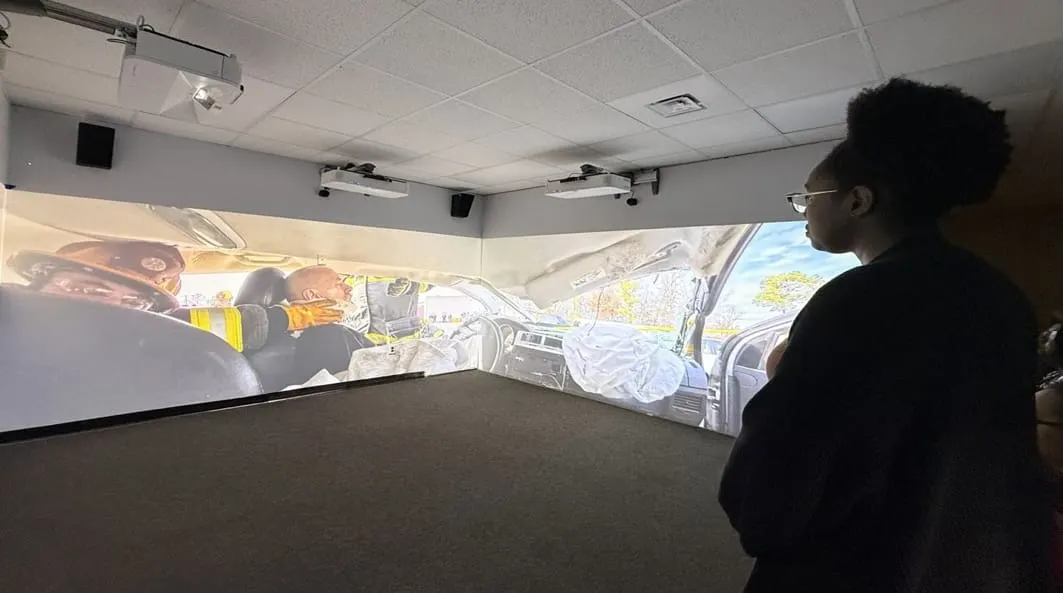
SAFE program participants examine car crash photos, learn CPR, listen to a panel of Henrico Police officers, and participate in a mock trial. (Courtesy Henrico County)
The SAFE Program, developed by county employee Brenda Chapman and launched earlier this year, is Henrico’s attempt to strategically curb its “systemic” speeding issue. Chapman, now the program manager, designed the curriculum to be comprehensive, emotionally challenging, and life-altering – forcing participants to recognize speeding as a tragedy en route rather than just a minor blunder.
During the course of 12 hours spread across four weeks, participants watch camera footage of devastating car crashes, write their own obituaries and plan their own funerals, hear directly from people who lost loved ones in a crash and from former reckless drivers and take a visit to the county jail and the hospital's intensive care unit.
In an immersive room with three floor-to-ceiling screens, participants watch footage of officers extracting victims from cars that are totaled and footage of doctors treating serious crash wounds in the hospital. Using dark sunglasses, headphones, and neck braces, participants are asked to do simple tasks such as grocery shopping to illustrate what life is like with a traumatic brain injury.
The program, which currently targets adults who were driving more than 90 mph or more than 20 mph over the posted speed limit, has enjoyed significant success: 96% of the 121 current graduates of the program have not received another traffic ticket.


Participants in the SAFE program wear equipment that mimics that feeling of a traumatic brain injury and complete simple tasks. (Courtesy Henrico County)
“A lifetime of poor decision making behind the wheel caught up to me, and I am so fortunate to have gotten this opportunity to address the old ways and turn myself into a safer driver,” said James Gill, a SAFE program graduate. “We do have a systemic issue, and I’m happy to say that I’ve gotten to partake in a solution to the problem.”
A reckless driving charge comes with the potential of up to a year of jail time, but Deputy Henrico Commonwealth’s Attorney Mike Feinmel said that participation in the SAFE program will more than likely prompt the judge to either reduce the length of the jail sentence or eliminate jail time, depending on the circumstances of each particular case.
“I have yet to see a SAFE participant come to court after graduating the program and not clearly demonstrate to the judge the impact that the class has had on his or her decision making and articulate a change in driving behavior,” said Feinmel.
The program is currently only available to adults at the cost of $150 for Henrico residents and $300 for non-residents (but at no cost for those with a court-appointed attorney), but Feinmel said the county is looking to expand the program to include juveniles as well as drivers who received speeding tickets for speeds less than 90 mph.
SAFE is one part of a multi-pronged approach to Henrico’s “serious speeding issue,” said Chapman, who remembers sitting in a Henrico courtroom and hearing 20 different reckless driving cases during the course of only one day.
The Henrico Board of Supervisors also is slated to vote on a proposal that would place speed cameras at all county high schools and two middle schools starting at the end of the year.
Liana Hardy is the Citizen’s government and education reporter. Support her work and articles like this one by making a contribution to the Citizen.