2 Henrico high schools redesign ninth-grade experience through partnership with Carnegie Foundation
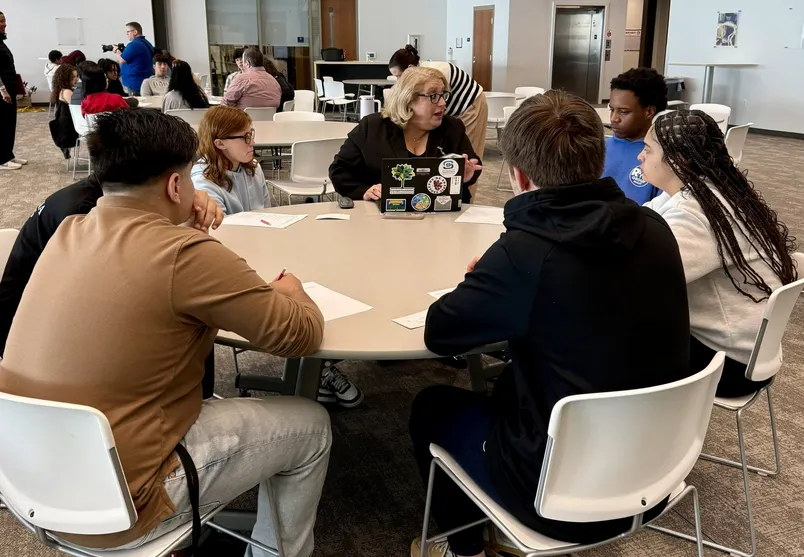
Through a partnership with the Carnegie Foundation for the Advancement of Teaching, two Henrico County high schools launched a pilot program this school year to redesign the ninth-grade experience for students.
As part of the nationwide “Future of High Schools Initiative Series,” Mills E. Godwin and J. R. Tucker high schools launched the program to focus on project-based, real-world learning. During the past year, principals Leigh Dunavant at Godwin and Art Raymond at Tucker spearheaded the effort to redesign the freshman experience around the Henrico Learner Profile’s durable skills framework, which is a comprehensive, community-developed model designed to prepare students to be life ready, cultivating essential skills and competencies beyond traditional academic knowledge.
“When we set out to do this, we really wanted to make sure that we created something that was special for our zone students, because we have a lot of centers at Tucker High School,” Raymond said. “For the students who are zoned here, we wanted to make sure that they had an opportunity. . . and to have that cohort experience like we have with Advanced College Academy for Social Sciences and IB center students.”
The principals created ninth-grade teacher teams at each school across different subject areas and gave them the flexibility to create cross-curricular lessons for cohorts of 88 to 100 students, outside the district’s standard evaluation cycle.
Their students spent the year working on projects with area business professionals to get exposure to real-world applications.
“Our goal for freshman cohorts is functioning, engaged students and happy teachers. So, we want teachers to be content and joyful with what they are doing with students, and we want them to have freedom,” Dunavant said.
To prepare, principals and teachers attended professional learning classes at the Carnegie Foundation and the University of Arizona’s “Next Education Workforce.” They visited schools in California, Arizona and Texas to see how they implemented similar programs.
“We need to show the relevance. Why are we learning this? You want students to start thinking about that sooner so they can develop more comprehensive viewpoints about things,” Raymond said.
Added Dunavant: “We have used career mentors, we have had field trips. We hope for the students to be prepared for internships, work-based learning, résumé, interviews, later in high school,” she said.
The process is designed to fold into Virginia's 3E framework that measures a student’s readiness for enrollment to higher education, employment for a career, or enlistment into the military.
On April 27, Dunavant presented with Henrico Schools Superintendent Amy Cashwell at the Virginia Association of School Superintendents conference in Roanoke, along with members of the Carnegie Foundation and HCPS specialists. She said superintendents are interested in seeing Henrico expand the program.
Dunavant noted that early data at Godwin looks promising, saying that among the cohort groups, student behavioral incidents and chronic absenteeism have dropped significantly. Student grades for classes outside of the cohort group have also shown significant improvement, she said.
Raymond observed that teacher satisfaction has also increased with this new model.
“I’m hearing teachers express more job fulfillment and just general joy about being at work and working with your colleagues,” he said.
At Tucker, the ninth-grade student cohort is wrapping up its learning this year with a capstone project focused on solving community-based problems. Godwin’s students are completing cumulative presentations built throughout the year.
Both schools plan to continue their ninth-grade cohorts next year and expand the pilot into 10th grade with a hope to scale up to 12th grade eventually.
More Henrico high schools will begin their own pilots next year and in the years to come.
“Henrico County is on the right track, because we have the direction through the strategic plan and the Henrico Learner Profile’s durable skills framework,” said Dunavant.
Raymond said it’s a new way of thinking.
“This is really a way to do school that is more fun and more engaging.”