'It’s our comeback year' – state, local leaders celebrate performance improvements throughout Henrico schools
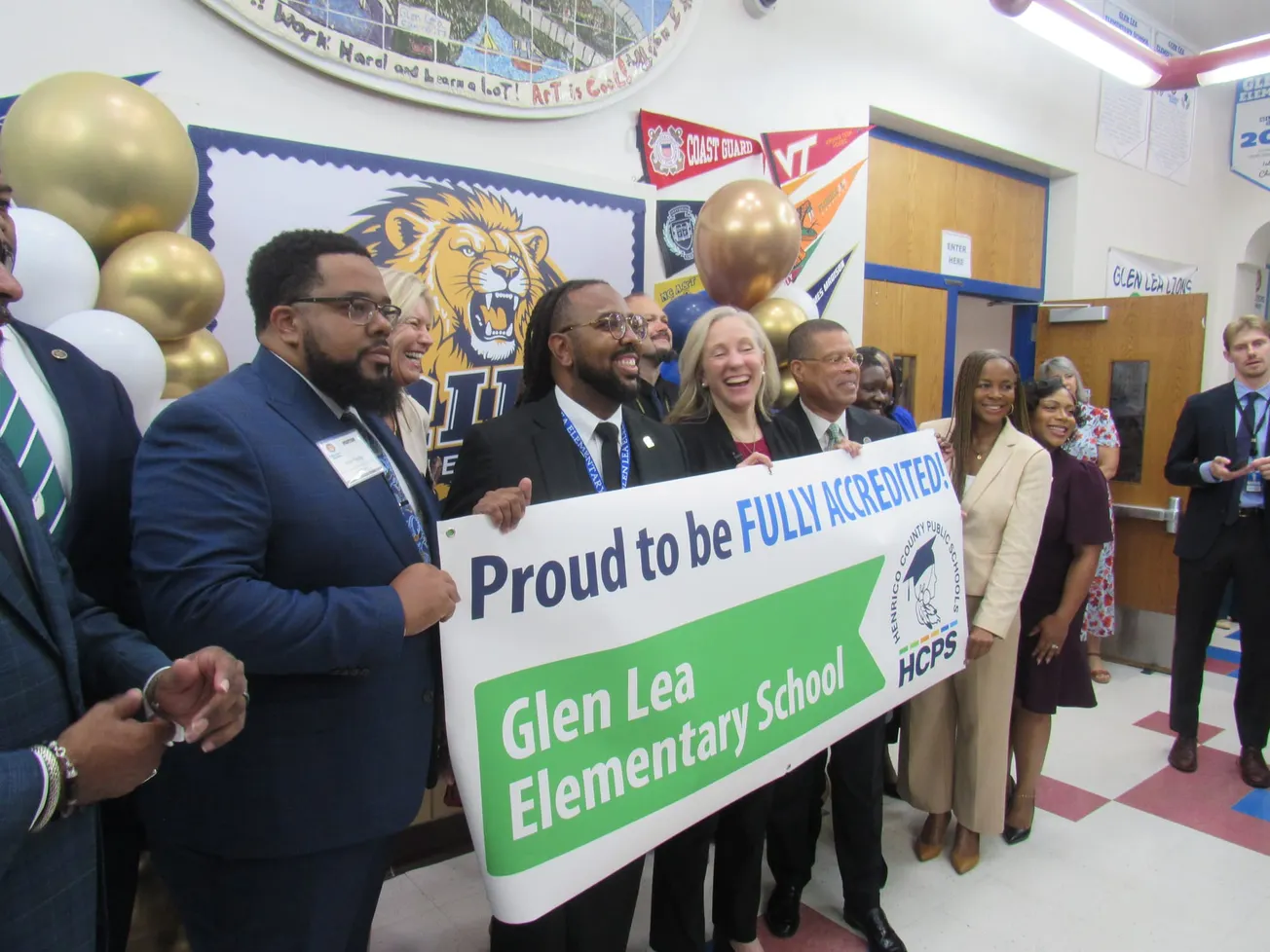
Excitement buzzed through the hallways of Glen Lea Elementary on the morning of Oct. 9, as Virginia Gov. Abigail Spanberger and other local officials congratulated staff on the school’s monumental rise in state ratings.
The Title I school saw its state school performance rating increase by 15 points this past year – the sixth-largest gain out of all Virginia elementary schools – moving from “Needs Intensive Support” to the “Approaching Expectations” category.
The success also extended to the entire school division; Henrico Schools saw nearly half of schools move up by one performance category, with an average increase of five points (schools are ranked using a 100-point scale). More than 60% of schools exceeded or met performance standards, with 28 schools earning the “Distinguished” rating as compared to 10 last year.
Virginia now evaluates public schools through two separate systems: the School Performance and Support Framework, which measures academic performance, and the state accreditation system, which evaluates whether schools meet state requirements. Introduced last year, the performance framework ranks schools on a 100-point scale, placing significant weight on reading and math achievement while also considering academic growth, chronic absenteeism, English learner progress and, for high schools, graduation and readiness measures.
Schools are assigned to one of four performance categories: “Distinguished,” “Meets Expectations” (previously “On Track”), “Approaching Expectations” (previously “Off Track”), or “Needs Intensive Support.”
The state also revised how it measures student academic growth this year, a change that contributed to improved performance ratings at some schools statewide.
Last year, more than half of schools in Henrico were ranked in the bottom two categories, with 14 schools labeled as “Needs Intensive Support.” Six schools, including Glen Lea Elementary, moved up from that category this year.

‘Our driving force is hope’
For Glen Lea, this past year has been “the year of the comeback,” said Principal James Gordon. When Gordon first took the position in 2021, in the throes of the COVID pandemic, Glen Lea had 11 teacher vacancies. Now – after conducting over 50 interviews since February – only four vacancies remain.
In 2025, Glen Lea also faced significant declines in state assessment scores; only one-third of students, or less, passed their reading, math, and science exams. But after acknowledging the real challenges, Gordon said that school leaders worked to bring scores back up the next year.
“We saw where our data was the previous year, and we took it from a positive and said, ‘It’s going to be the year of the comeback,’” Gordon said. “So each day, we move forward. We communicate. We work through disciplinary scenarios. Hope permeates our building. . . and this year, we’re here to dominate.”
“Glen Lea had the sixth-largest increase in the state. I mean, that’s over 1,000 schools,” said Henrico School Board member Ryan Young (Fairfield District). “And I recognize it because we were at the bottom last year. I don’t think anybody understood, there weren’t many schools underneath us.”
At Glen Lea, where over 80% of students are economically-disadvantaged, academic achievement can be affected by challenges such as vacancies, absenteeism, food insecurity, disciplinary concerns, and decreased parent engagement – issues that also impact other schools throughout HCPS.
“The Fairfield District has a high concentration of economic need. Some of our students are navigating trauma and barriers with consistent attendance,” said Young. “My principals can attest to being at bus stops in the morning and pizza parties on Fridays, trying to get people just to come to school.”


Virginia Gov. Abigail Spanberger visits a third grade class at Glen Lea Elementary. (Liana Hardy/Henrico Citizen)
But during the past year, the division has made progress in reducing a number of those barriers; teacher vacancies fell by 40% divisionwide, with schools in Eastern Henrico seeing the biggest changes. HCPS also saw modest gains in state Standards of Learning (SOL) scores, although the results still fell below state averages.
For many schools, current challenges are predicated on long histories of segregation and unequal educational resources, said Varina District school board representative Alicia Atkins. Fair Oaks Elementary, which earned full accreditation this year, began as a small four-room, all-Black schoolhouse in 1926. The school was funded by the Rosenwald program, which sought to bring educational opportunities to Black children amid segregation.
Varina High, which now has a predominantly Black student population, was once an all-white school. Its current campus opened in 1962, during the period when Henrico County was desegregating its public schools. In the years following COVID, the school reported the highest number of teacher vacancies in Henrico, with 22 vacancies in 2022.
This year, Varina High has reduced teacher vacancies to only four and has moved up in rankings to the “Distinguished” category.
“Students who were once among the first Black students entering Varina now have children and grandchildren who can walk through those doors and say, ‘I’m a part of a ‘Distinguished’ school,’” said Atkins. “When you know the history, this isn’t just a school receiving a designation.”
‘Let’s keep this momentum going’
The improvements are due in part to more targeted literacy and exceptional education supports, said HCPS Director of High School Education Thomas Ferrell, as well as increased school funding from the county.
Individual schools also saw progress from certain strategies. Maybeury Elementary Principal Danielle Sims said the addition of a school reading specialist was “pivotal” to help Maybeury jump from “Off Track” last year to “Distinguished” this year.
George H. Moody Middle also earned the “Distinguished” ranking this year, with principal Denise Doss crediting the success to three changes: expanding the International Baccalaureate program to all students, “radically transforming” exceptional education services to focus more on students’ Individualized Education Program goals, and launching a schoolwide mentorship program where every staff member was paired with a student.

Varina High Principal Cherita Sears also said expanding advanced coursework has made a big difference in the school, with 215 more students taking Advanced Placement exams this year. New schoolwide literacy strategies that focused on vocabulary instruction also helped Varina’s reading SOL pass rates increase from 73% to 87%, Sears said.
All Henrico schools earned full state accreditation this year, compared to 96% last year. The new accountability framework designates “school accreditation” based upon criteria such as building maintenance, staffing, and safety.
After inheriting the new school accountability system from former Gov. Glenn Youngkin, Spanberger said she intends to tweak the framework to make results more clear and digestible for educators and ensure results are released early in the school year.
“Our goal has been to improve upon the accountability system,” she said. “Last year, the results came out so late that it became so difficult for schools to really do much with the information. There was a lot of confusion about what the labels meant.”
Spanberger also said that the state will offer $26 million in grants to support schools with the highest needs.
This year is a “celebratory time” for Henrico, said school board members; schools such as Glen Lea, Varina, and Fair Oaks that have historically struggled with achievement gaps and poverty are now becoming “comeback stories” for the division.
“There have been challenges, disappointing results, and years when the numbers didn’t tell the story of what we really wanted to hear,” Atkins said. “But there’s been an effort to help students believe that academic achievement belongs to them, too. And to me, that’s what a comeback looks like.”
“[Principals] are beaming with success,” said Young. “Let’s keep this momentum going. Let’s continue to build bridges to excellence by connecting every school with the people, the resources, and the opportunities our schools need to thrive.”
Liana Hardy is the Citizen’s government and education reporter. Support her work and articles like this one by making a contribution to the Citizen.