Va. hemp growers worry about the future of their industry amid state and federal shifts
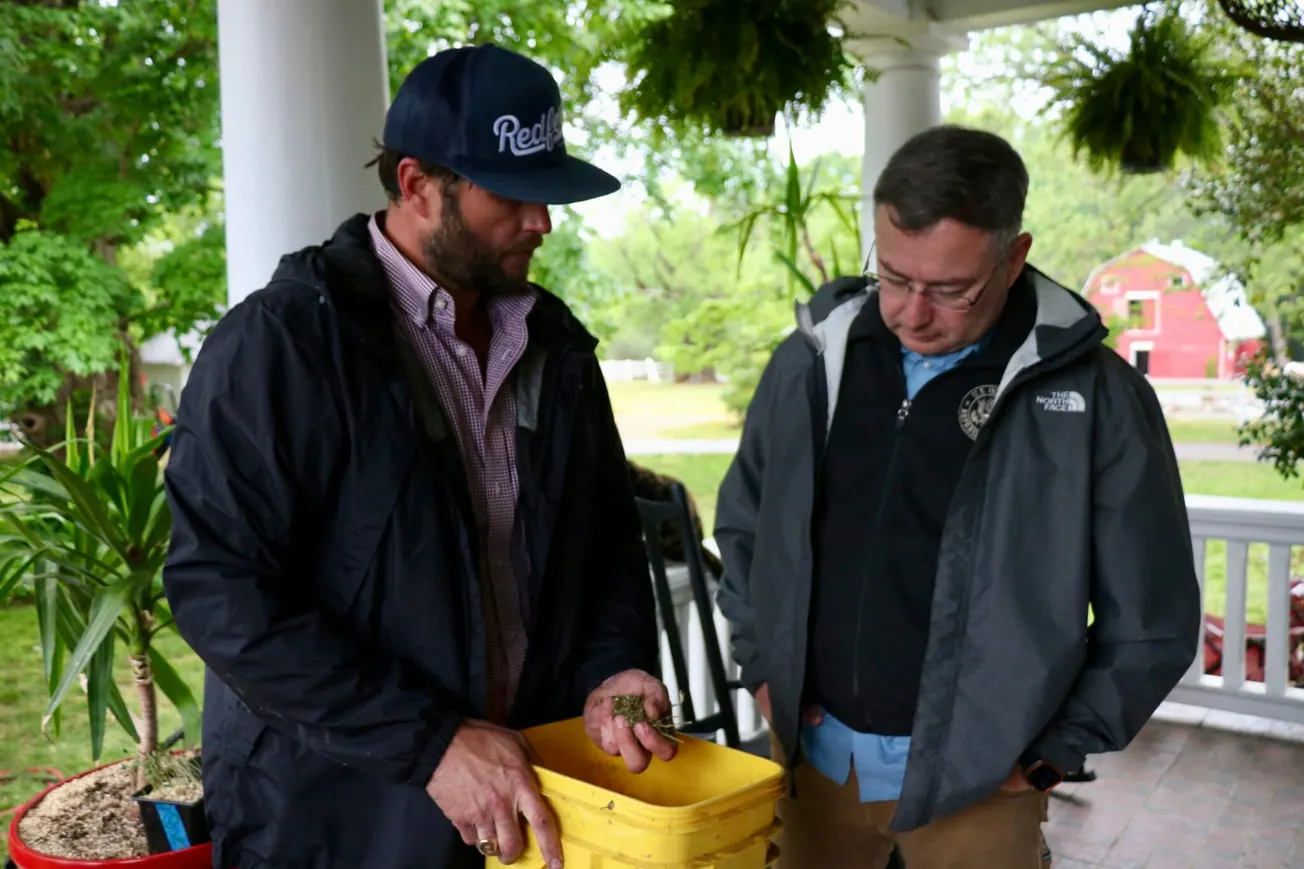
“We needed this rain,” farmer and entrepreneur Graham Redfern said from his front porch in Caroline County Wednesday as U.S. Rep. Eugene Vindman, who represents Virginia’s 7th District in Congress, approached.
The lawmaker was there to learn about the crops and products at Redfern Hemp Co., one of the state’s small businesses whose future hangs in the balance between soon-to-start federal restrictions on hemp THC products and Virginia’s not-yet-finalized retail cannabis market.
The rain was one certainty for Redfern, and a welcome one at the start of his planting season. But another, he said, is that most of his products will become illegal later this year, when the federal hemp crackdown kicks in.
“It’s scary,” Redfern said of thinking six months forward. He added that some of his staff members are thinking about looking for other jobs.
Redfern’s company, which employs 14 full-time staff and 5 part-time staff, makes body creams, dog treats, chocolates and gummies from hemp. His products offer calming and pain management effects for customers, while other parts of the hemp plant help create oils, birdseed and fibers.
Tamra Herndon, a longtime customer of Redfern, said the products have been helpful for her mental and physical health.
As an amputee, she experiences “phantom pain” where her left leg used to be, along with joint pain from walking on her prosthetic leg. The combination of THC and CBD in Redfern’s products helps both ease aches and calm anxiety.
“I’ve been able to be more active,” she told Vindman as she accompanied him on the farm tour.
In light of the looming federal changes, he’s exploring a “pivot”: utilizing hemp fibers to stabilize plastic in the recycling process. The move is meant to reduce the rise of micro plastics, which are increasingly entering waterways and food sources.
He’s also mulling whether and how to transition his business into selling cannabis products, as the fate of lawmakers’ proposed retail cannabis market rests with Gov. Abigail Spanberger.
Business owners struggle to navigate state, federal shifts

Redfern said he invited Vindman to his farm to implore him to advocate on behalf of the hemp industry to Spanberger, who is mulling whether to sign into law or reject the retail cannabis market framework that cleared the legislature this year, half a decade after recreational pot was legalized in Virginia.
The multi-pronged plan to roll out a weed market passed with bipartisan support, but Spanberger didn’t sign it and instead sent it back to lawmakers with amendments. They rejected her tweaks, setting up the choice for her to sign the plan lawmakers proposed or veto it entirely.
But even if the legislature had accepted the governor’s changes, Redfern said, some of them would be difficult for him and other small business owners to meet.
State lawmakers’ bill also stipulates that businesses’ agricultural, production and commercial spaces must operate within a 20-mile radius.
Redfern’s farm is in Caroline County — a rural area — along with a small storefront nearby. His commercial kitchen, where products are tested and created, is in Richmond.
“I can’t sell my farm and I don’t want to build out another kitchen when I already have one,” Redfern said. “I’ve been in this business for six years. That alone won’t allow me to go in and take my current business model that’s working and transition into the marijuana market. The problem is (the legislation) is also not giving me a pathway to even get there.”
Del. Paul Krizek, D-Fairfax, author of the House version of the bill, said he was “frustrated” by the governor’s changes but is open to working with Spanberger on future iterations of the bill.
“It’s a long process, but good legislation sometimes takes time,” he said.
Instead of delaying the cannabis marketplace’s launch until July 2027, as Spanberger pitched, Redfern urges her to veto the bill and then hash it out with lawmakers as state budget negotiations continue. They have a tight timeline; the current state budget lapses July 1.
Other small businesses in Virginia are also eager to see how the state-level debate plays out.
Richmond-based restaurateur Jay Bayer of Bingo Beer had previously established a partnership with Pure Shenandoah to produce THC seltzers. The low-dose products offer an alcohol alternative for health-focused people that aren’t totally sober.
Bayer said late last year he hoped the partnership could evolve into a marijuana-based product pending Virginia’s legal market as a pivot amid the federal changes.
Redfern also asked Vindman to explore adjustments to the federal Farm Bill that Congress is in the process of rewriting. Lawmakers added a provision to the government spending bill last fall that sets forth the future ban on most hemp-based products.
“You’re a constituent,” Vindman replied. “Let’s see what is in the realm of possibility.”
While hemp and marijuana are both types of cannabis plants, it’s the concentration of tetrahydrocannabinol — or THC — that has come under scrutiny by federal lawmakers.
“Cannabis, which hemp is, will produce cannabinoids,” Redfern said. “It’s about impossible to create any industry in the industrial hemp world without taking the plant to maturity, which will then create cannabinoids, which will then now be marijuana.”
THC derived from marijuana remains illegal at the federal level, but some states have legalized it. Hemp also contains the compound.
Congress’ 2018 Farm Bill opened the door for enterprising hemp farmers to expand their portfolios, so long as they kept their products below a specific concentration of THC. Congress’ updates last year will further restrict, and essentially ban, most hemp products.
Last week, the U.S. House passed its newest version of the Farm Bill, and it will now advance to the U.S. Senate for review. However, bipartisan efforts to undo the forthcoming illegality of hemp did not survive.
As the nation’s legislature continues to deliberate matters, Vindman noted his interest in continuing hemp talks in D.C.
At the state level, he said that his office has had a friendly relationship with Spanberger, so he planned to talk with her to relay Redfern’s concerns.
Virginia Mercury is part of States Newsroom, a nonprofit news network supported by grants and a coalition of donors as a 501c(3) public charity. Virginia Mercury maintains editorial independence. Contact Editor Samantha Willis for questions: info@virginiamercury.com.