Skip to content

State bus line debuts new east-west route that connects 10 cities across Virginia

Tickets for the Tidewater Current range from $15 to $60 and the full route from Virginia Beach to Harrisonburg takes just over six hours
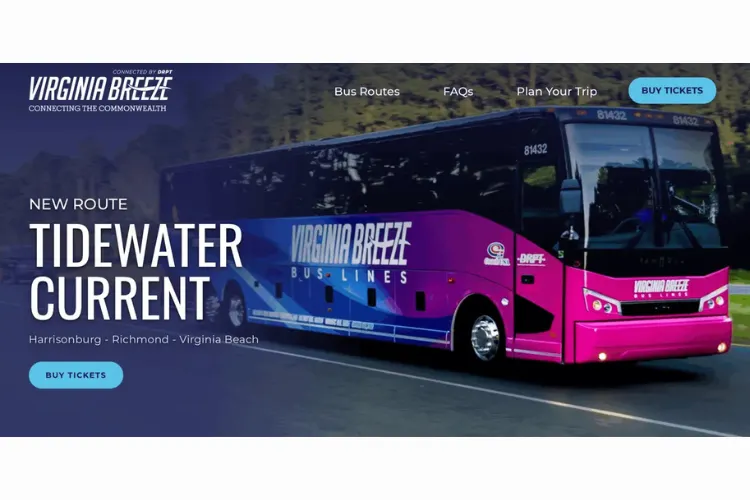
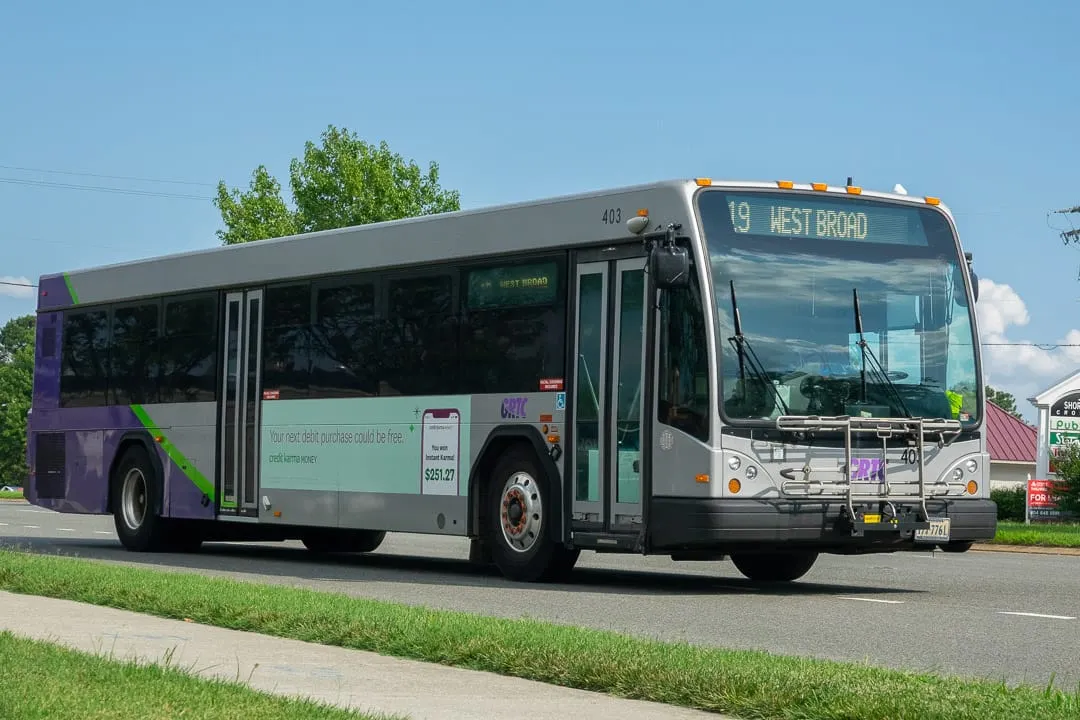
The state’s bus line The Virginia Breeze launched a new east-west route, The Tidewater Current, on April 20, 2026. Passengers may travel from Virginia Beach to Harrisonburg, with multiple stops along the way. (Photo courtesy Virginia Department of Rail and Public Transportation)

Travelers looking to traverse the commonwealth from east to west and vice versa have a new, daily option courtesy of the Virginia Breeze, the state’s city-linking bus service. The new line, dubbed the Tidewater Current, debuted Monday.

It “will connect 10 cities (and) five counties,” said Mariia Zimmerman, director of Virginia’s Department of Rail and Public Transportation. “You can jump on or off at Virginia Beach,” Zimmerman said, with the motorcoach service terminating in Harrisonburg.

This is the first time Virginia Breeze buses will run across the state in that direction. Past routes only ran south to north, from areas like Blacksburg, Danville or Bristol to Washington, D.C. 

The new line will leave daily from the Virginia Beach Convention Center at 6:30 a.m. and include stops in Newport News, New Kent, and Richmond’s Main Street Station. After a stop in Charlottesville, there’s a stop in Staunton before the bus reaches the final destination: Goodwin Transit Center on the James Madison University Campus.

For travelers heading west to east, the bus will leave JMU at 6:50 a.m. 

Tickets for the Tidewater Current range in cost from $15 to $60 and the trip from end to end will take just over six hours. Passengers are allowed one free checked bag and can bring one personal item aboard, and can access free Wi-Fi during the ride. 

Matthew Scalia, the executive director of the Williamsburg Area Transit Authority, said the new bus line will provide a welcome boost for the community.

“I think it’s another great option for residents (and) for tourists to use, especially with the 250th celebrations,” he said, noting local celebrations to observe the nation’s semiquincentennial anniversary and the area’s unique role in American history. 

“We expect a lot of tourism to come in here. We know people will be bringing the train in and this is just another great option for them to get here.”

Amy Inman, director of transportation development for New Kent County, also said the addition of the new bus service will be helpful, particularly for thrill seekers 

“The stop will be at Rosie’s (Gaming Emporium) right there off of exit 214,” she said. “That was really the most ideal spot from a central location — the ability to have overnight parking. That’s going to be a destination for folks once they realize, ‘Hey, I could go from Virginia Beach to Rosie’s for the day and get a trip back.’”

Zimmerman, who became director of DRPT only a few months ago, said the new route is coming at the right time, as cost-conscious public transportation options have contracted in recent years. 

“Folks may know Greyhound has cut back a lot of its service. And some communities that used to have inner city bus service no longer have that,” she said. “Some of those are also communities that maybe lost air service, (so) they’re looking for other ways to get mobility options to connect them.”

Future riders prepare to get on board

Tallon Cummings-Watson, a junior at James Madison University who lives on campus and uses on-campus transportation to get around, is excited to try out the new route. 

“I don’t use the Virginia Breeze. It hasn’t been a benefit to me because it hasn’t gone to Virginia Beach,” he said. “I’m from Virginia Beach and I have friends in UVA, at William & Mary. So overall, these new stops are going to be very beneficial to me.”

Normally when Cummings-Watson needs to get home or to other campuses, he carpools.  

“But there’s pros and cons to that. It’s fun to be with your friend but my friend doesn’t necessarily want to go home when it’s my nephew’s birthday,” he said, adding that when he becomes a senior, he’ll probably take the Virginia Breeze about four times a year. 

Sue George has ridden the Breeze only a few times, to conferences. 

“I took it about two years ago and then more recently in the spring. And both experiences were very positive,” she said. “It was very nice and stress-free to just sit on a bus and not have to actually drive myself to DC. It takes a little longer than driving, but you can take care of other things or just relax.”

George said she often travels by car back and forth to Charlottesville from her home in Harrisonburg; the Tidewater Current could be a viable option for her the next time she needs to go. 

“It expands your options,” said George. “I’ve had the opportunity to use the bus in Europe and it was great. They have a little more infrastructure there for that. And I look forward to seeing that hopefully grow in the U.S.”

For Zimmerman, who previously worked in the U.S. Department of Transportation under Secretary Pete Buttigieg, said the new route offers a window into a potential east-west train line. 

“We’ve seen ridership really increase across the state. There’s been a real interest in having an east-west rail corridor and we are actually studying that,” Zimmerman said.

While the potential rail line, called the Commonwealth Corridor, is under review “we have an inner city bus,” she added.

Riders who are traveling east to west will now also be able to grab a connection south to north, said Zimmerman.

“There are connections. For instance, the new route, if it’s leaving Virginia Beach or Harrisonburg around 6:30 in the morning, would bring you into Richmond,” she said. “And if you want to take the bus up to D.C. or up to Dulles Airport, it leaves Richmond around 10:30 in the morning from the Main Street station.”

Funding

Zimmerman said funding for the new Tidewater Current comes from a combination of sources, including the Federal Transit Administration’s 5311 rural transit dollars, as well from some state transportation grants.

“We can use a portion of those funds to support intercity passenger service so we are tapping into some of those,” Zimmerman said. “And then we do also have funds through the Commonwealth Transit Fund, a mass transit fund, that we’re able to use, too.”

Jayla Parker, spokesperson for DRPT, said for fiscal year 2026, the entire Virginia Breeze bus line was allocated $3.5 million by the Federal Transit Administration and approved for an additional $400,000 in state funding through the Transit Ridership Incentive Program.

“Specifically for the Tidewater Current, we budgeted the service at $1.2 million annually to operate 365 days per year,” Parker said“This amount includes expected farebox revenue, which helps offset operating costs.”

Once the new Tidewater Current starts rolling, Zimmerman said they expect to see about 18,000 passengers per year. 


Virginia Mercury is part of States Newsroom, a nonprofit news network supported by grants and a coalition of donors as a 501c(3) public charity. Virginia Mercury maintains editorial independence. Contact Editor Samantha Willis for questions: info@virginiamercury.com.

Comments