Henrico's Democratic shift accelerates as Republican congressional vote totals plunge
An analysis of the 2022, 2024 and 2026 congressional elections shows Democrats expanding their advantage in Henrico, with Republican vote totals falling sharply between the presidential election of 2024 and this year's midterms

Democrats strengthened their hold on Henrico County in Tuesday's congressional elections, continuing a political shift that has accelerated during the past four years.
The biggest change since the 2022 midterms wasn't simply that more people voted Democratic – it was that Democrats attracted significantly more votes while Republicans attracted slightly fewer, even as the county's population of registered voters continued to grow.
Democratic congressional candidates Shannon Taylor (First District) and Jennifer McClellan (Fourth District) received nearly 106,000 votes in Henrico this year, almost 30,000 more than Democrats Herb Jones and Donald McEachin received in 2022. That's an increase of nearly 39%.
Meanwhile, Republican candidates Rob Wittman (First District) and Robert Murray (Fourth District) combined for about 45,700 Henrico votes this year, roughly 2,300 fewer than Wittman and Leon Benjamin Sr. received four years ago.
That means that Democrats received nearly seven of every 10 votes cast for the two major parties in Henrico's congressional races this year, compared with about six of every 10 in 2022. Their countywide advantage over Republicans more than doubled during the same period, from about 28,000 votes to more than 60,000.
That shift can't be explained by an influx of new voters alone. Henrico added about 15,000 active registered voters during the four-year period — a 6.5% increase — while Democratic congressional vote totals grew by nearly 39%.
And although fewer Henrico residents cast congressional ballots this year than in 2024 (when a presidential election also was on the ballot), Democratic candidates retained nearly all of their presidential-year support in Henrico, while Republican candidates lost almost one-third of theirs.
That difference helps explain why Democrats expanded their margins so dramatically, even without a presidential race driving voters to the polls.
Presidential-year turnout provides an important comparison
The 2024 presidential election offers perhaps the clearest evidence of how Henrico's political landscape has shifted — particularly in the First Congressional District.
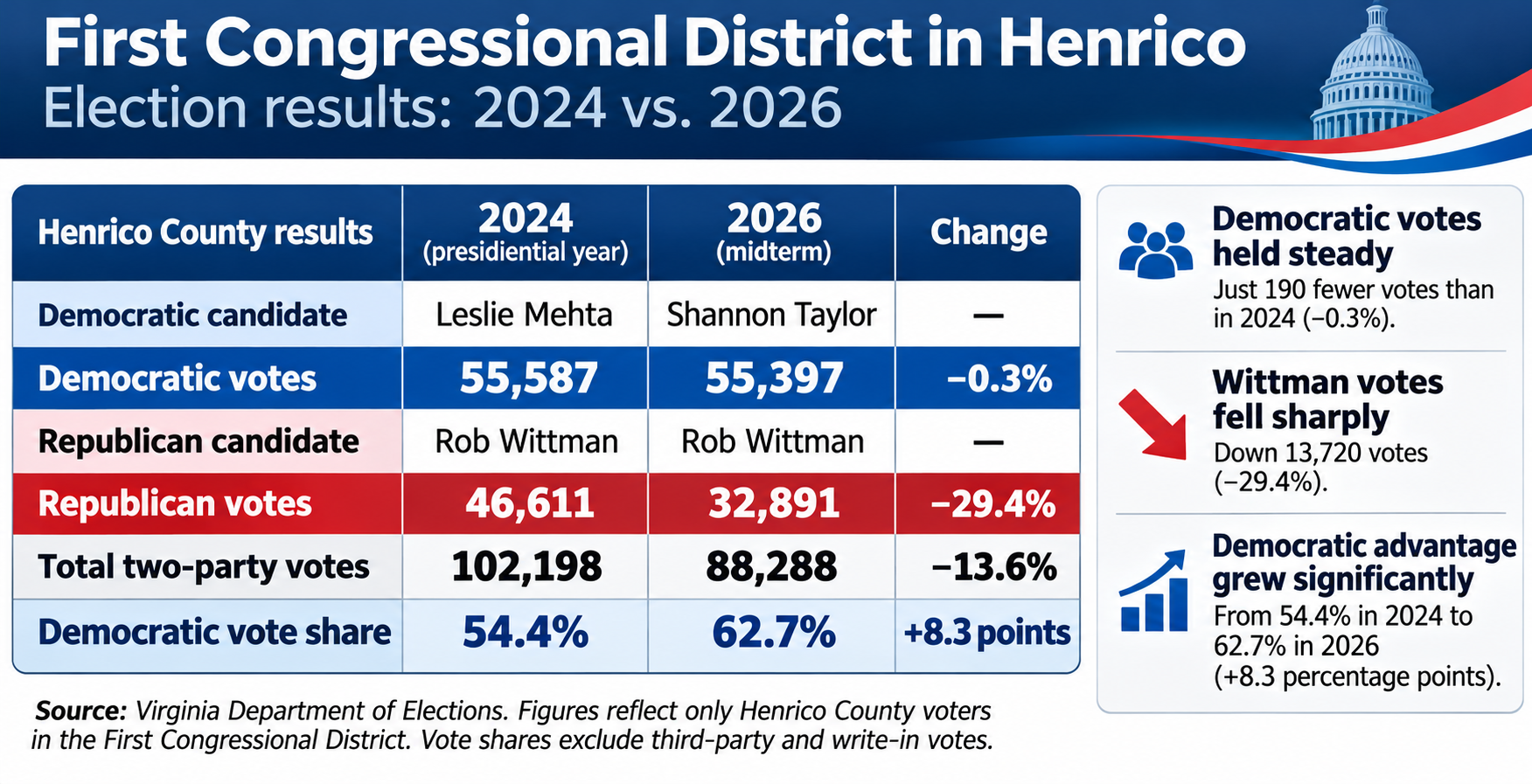
With Donald Trump and Kamala Harris atop the ballot, voter participation that year was significantly higher than in this year's midterms. More than 181,000 Henrico voters cast ballots in the presidential race, and more than 102,000 voted in the First District congressional contest between Democratic challenger Leslie Mehta and Republican incumbent Rob Wittman.
Mehta lost the districtwide race but defeated Wittman among Henrico voters, receiving about 55,600 votes to his 46,600.
But two years later, with no presidential contest to draw voters to the polls, participation in the First District congressional race in Henrico dropped only by about 14,000 votes – and nearly that entire decline came from Wittman's vote total.
Democrat Shannon Taylor received about 55,400 Henrico votes this year, just 190 fewer than Mehta had received during the much higher-turnout presidential election.
Wittman, meanwhile, received about 32,900 Henrico votes – nearly 13,700 fewer than in 2024. That represented a drop of almost 30%.
The result was a dramatic expansion of the Democratic advantage in Henrico's portion of the First District. Mehta had won about 54% of the two-party vote in 2024; Taylor won nearly 63% this year.
The figures don't necessarily mean that thousands of former Wittman supporters switched to Taylor or stayed home. Some voters may have changed their preferences, while others may have participated in one election but not the other.
What the results do show is that Democratic congressional candidates maintained their Henrico support between the presidential election and the midterms, while Wittman's support fell sharply. That difference helped turn an already Democratic-leaning portion of the district into an even more decisive advantage for Taylor.
Similar trend in the Fourth District
A similar trend emerged in Henrico's portion of the Fourth Congressional District, where Democratic incumbent Jennifer McClellan increased her already substantial advantage despite receiving fewer votes than she had during the 2024 presidential election.
As in the First District, participation declined without a presidential race at the top of the ballot. But Republican votes fell much more sharply than Democratic votes.
In 2024, McClellan received about 56,800 Henrico votes, compared with 19,400 for Republican Bill Moher. Two years later, she received about 50,600 votes, while Republican Robert Murray Jr. received about 12,800.
That meant McClellan's vote total declined by about 11%, while the Republican total fell by 34% — more than three times as sharply.
The result: McClellan won nearly four of every five major-party votes in the Henrico portion of her district this year, up from about three of every four in 2024.
Looking at three elections together
Henrico's congressional results from the past three elections show just how much the county has shifted toward Democrats.
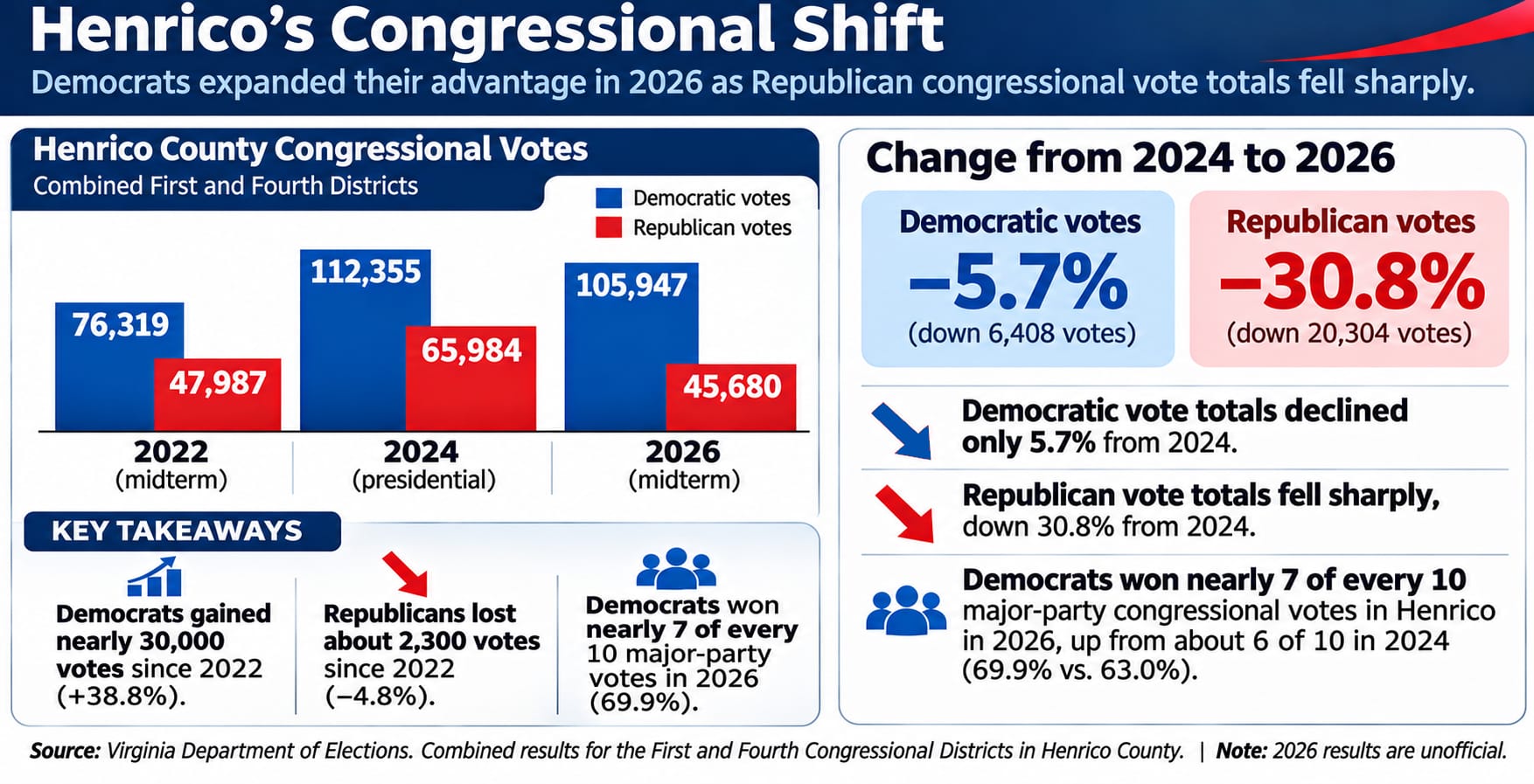
In the 2022 midterms, Democratic candidates received about 76,300 votes countywide, compared with 48,000 for Republicans.
Both parties attracted substantially more votes during the higher-turnout presidential election of 2024, when Democrats received about 112,400 votes and Republicans about 66,000.
But in the 2026 midterms, Democrats lost relatively few of those votes, while Republican totals plunged.
Democratic candidates received about 106,000 votes, down just 5.7% from 2024. Republicans received about 45,700, a decline of nearly 31%.
As a result, Democrats won nearly seven of every 10 major-party congressional votes in Henrico this year, compared with about six of every 10 in 2024.
Where Democratic support increased most
The biggest Democratic gains between 2024 and 2026 came primarily in Henrico's western and northern portions, where Republicans historically have been more competitive.
Innsbrook led the county's 90 precincts with a 12-percentage-point increase in Democratic vote share, followed by Johnson and Skipwith (about 11.2 points each) and Colonial Trail (10.5 points).
Holladay, Sadler, Shady Grove, Rivers Edge, Short Pump and Hunton completed the top 10.
Eastern Henrico remained overwhelmingly Democratic, but its precincts generally showed smaller increases because Democrats already held large advantages there.
Registration growth doesn't explain everything
Henrico added about 14,800 active registered voters between December 2022 and November 2026, an increase of 6.5%. But some of the biggest Democratic gains occurred in precincts that added relatively few voters.
Innsbrook, for example, added 850 registered voters, while Johnson added 750. Both recorded substantial increases in Democratic vote share.
But Holladay added just 45 registered voters, Hunton 51 and Shady Grove 80. Despite that modest growth, Democratic vote share increased by roughly 10 percentage points in each precinct between 2024 and 2026.
That suggests changes in who voted and how they voted — not simply an influx of new residents — helped drive the county's political shift.
An increasingly Democratic county
Collectively, the results point to a Henrico electorate that has become increasingly favorable to Democrats, including in western precincts where Republicans once enjoyed greater support.
That pattern helped Democrats expand their advantage across both congressional districts, even with fewer people voting overall.
For Republicans, the results underscore the growing difficulty of competing in Henrico. For Democrats, they show that the party's expanding advantage goes well beyond voter registration growth.
The data suggests that Henrico's ongoing political shift appears to reflect a combination of changing voter preferences and participation, a trend that has made the county an increasingly reliable source of Democratic votes.