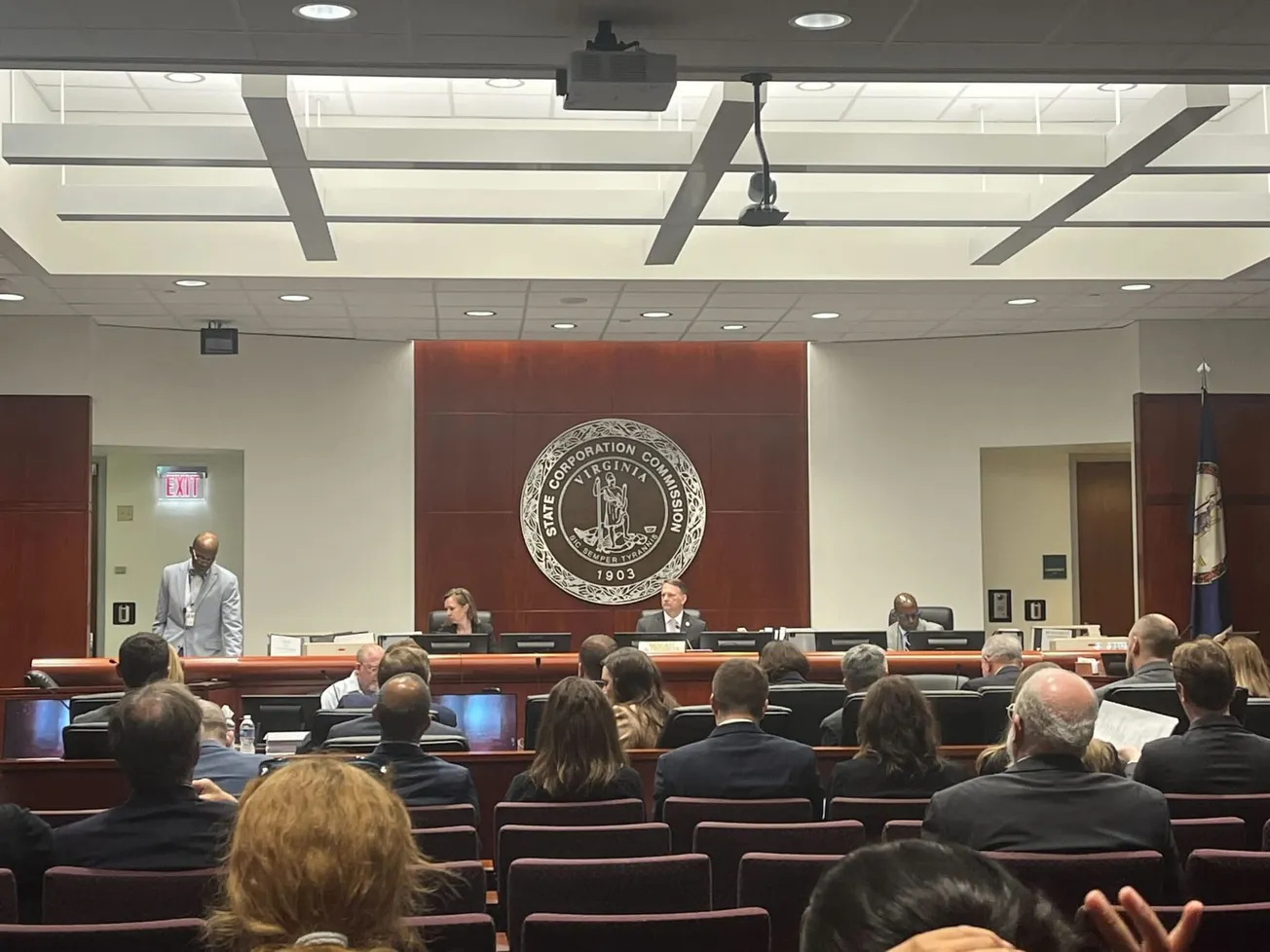
Data center concerns draw crowd to Varina town hall meeting
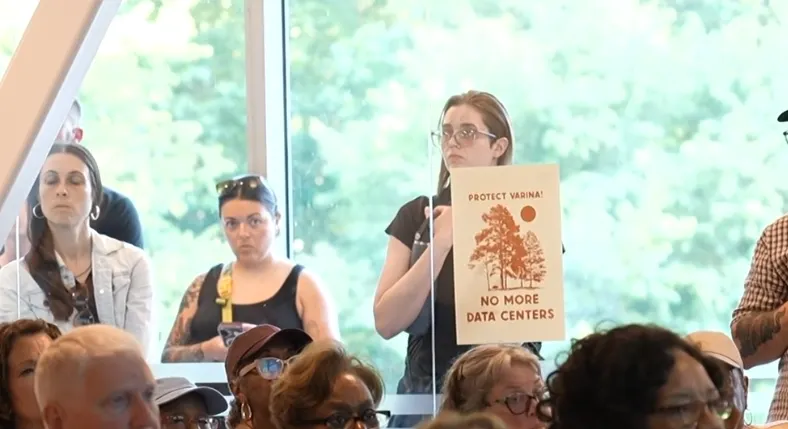
More than 100 residents packed the meeting room at the Varina Area Library on Tuesday night, filling every available seat, and the hallway, for a town hall that stretched nearly three hours, making clear that data centers are on the minds of many in the district.
Varina Supervisor Tyrone Nelson scheduled the event to cover routine but consequential topics – including the county’s fiscal year 2026-27 budget, summer programming from Henrico’s Recreation and Parks department, and updates from the Planning and Public Works departments.
But it was data centers, not a listed agenda item, that drove much of the energy in the room. Organizers from Studio Two Three, a Richmond community arts organization, handed out posters to those walking in that said, “Protect Varina No New Data” Centers, which many attendees held up throughout the meeting.
The turnout was prompted in large part by recent news that data center giant QTS is moving forward with plans to add 17 buildings across two campus expansions totaling 1,100 acres near its existing hub at White Oak Technology Park in Eastern Henrico.
The new facilities would add nearly 8 million square feet of data center space to the more than 3 million square feet QTS already has built at the site. The company also has applied to the Virginia Department of Environmental Quality to permit 370 additional diesel-fired emergency generators, on top of 544 generators and 11 cooling towers it is already permitted to construct and operate.
Nelson acknowledged the unusually large turnout throughout the meeting.
“I'm on Instagram too, so I know there was a concerted effort to get people here tonight to talk about data centers,” he told the crowd about halfway through the meeting. After filling the scheduled meeting time with his agenda, he asked at about 7:45 p.m. whether any residents had non-data-center questions, before opening the floor more broadly.
“I want to make sure that my Varina folk who are here get their questions answered because this is a Varina District town hall meeting,” Nelson said.
He also offered a good-natured aside to the television news cameras in attendance.
“Hopefully, Channel 6, thank you all for coming out tonight, y’all will report on something other than just the data center conversation,” he said with a laugh. “I'm sure that probably won't happen.”
The concern about data centers comes in the aftermath of Henrico County's decision to add new guardrails around their development. The Henrico Board of Supervisors enacted stricter rules in 2025 requiring public hearings and special use permits for any new data center projects, measures intended to give residents more of a voice before approvals are granted.
Under the new framework, developers must obtain special permits before breaking ground, and all proposed projects must go through a public hearing process. The changes place the board in the role of gatekeeper for new data center development in Varina and across the county.
For many of the residents who showed up Tuesday night, those rules, and how vigorously they will be enforced, remain an open question.
But Nelson explained that the additional data centers planned at QTS already had been approved by county officials before the new rules took effect.

Varina residents push back on 'outsider' narrative
The evening’s most direct exchange came when Kevin Gallagher, a Varina resident, spoke up and pushed back on a suggestion that data center opposition was being driven from outside the district.
“I do feel like there is a narrative in the room that the discussion today about data centers is coming from outside of Varina,” Gallagher said. “And I'm right here, and my family is a part of it.”
He welcomed supporters who had traveled from Chesterfield, Richmond, and Hanover, but asked those from Varina to raise their hands and about 80% of attendees did, showing that the concern was homegrown.
His remarks were less a question than a challenge, asking Nelson whether the county was prepared to keep the conversation open and take concrete steps in response to community pressure.
“Are there steps that you are willing to take to move forward from this process to be responsive to a community response?" he asked.
Nelson acknowledged that when the board first reduced the data center tax rate to 40 cents per $100 of assessed value in 2017, he did not anticipate where things would lead.
“Did I know the impacts that data centers would have on our communities? I did not,” he said.
He defended the board’s 2024 vote to rezone property for QTS to expand in the county’s technology park, tying it directly to an affordable housing tradeoff. That year, Henrico officials announced that they'd use $60 million in tax revenue from the county's data centers to fund a new affordable housing trust fund – a priority for which Nelson said he would not apologize.
“I'm a Black man, and when I ran for office, I was only the second Black person in Henrico county's history to hold such a position,” he said. "Most of the people I know are struggling trying to find housing, rent, housing, etc. And so $60 million to go into the affordable housing trust fund, which has helped a lot of people, was as important to me. And so I stand on that decision."
But Nelson also drew a clear line at what he said he would not support going forward. Since that 2024 vote, he said, he has committed to not approving any further rezoning for data centers. The county has also raised the data center tax rate from 40 cents to $2.60 per $100 of assessed value, short of the state average of $3.10, though he said conversations with colleagues about closing that gap are ongoing.
What is currently underway in Varina, Nelson said, is the buildout of what was already approved – projects confined to the technology park, which was originally designated for manufacturing and industrial uses.
In May 2024 – shortly before announcing plans for the affordable housing trust fund – the board of supervisors also approved rezoning plans for a controversial data center complex along the I-295/I-64/Williamsburg Road corridor in Sandston, just north of the White Oak Technology Park on property that will be known as White Oak Technology Park 2. About a dozen data centers ultimately could rise there.
But development on roads like Darbytown, in residential or mixed areas, is a different matter, Nelson said.
“That's when we say we don't want data centers in communities,” Nelson said. “And that's why we put the special permit provision in. I can say with assurance we won't approve any more data centers under that process.”
Another community member spoke up after this exchange saying, “What I think our community wants is for you to put your foot down. Those decisions impact our water. They impact our health; they impact my child. We want you to stop it. So, what are you doing to stop it?”
Nelson acknowledged the frustration.
“If there was a way to stop it right now, I would. If you know a way, or somebody else knows a way, okay, great. Tell us, okay?”
An ongoing battle
Among those distributing posters and organizing attendees were Kate Fowler and Ashley Hawkins of Studio Two Three. Both described the meeting as clarifying but far from settling.
Fowler, Studio Two Three’s director of community partnerships and development and a Varina resident, said hearing county officials detail their investments in the district provided genuine context. It did not ease her concerns about what has already been approved, or what is still to come.
“We haven't built the enormous part yet,” she said. "The 8 million square feet of data center, the 1,100 acres, we haven't built that yet. So we actually don't know the full impact.”
Fowler ticked off a list of unanswered questions: 333 backup generators not yet approved, 11 cooling towers whose size and environmental footprint have not been publicly addressed, and the downstream effects on a power grid already under strain. She said the electricity bill at her Varina home hit $1,100 one month this past winter, and pointed out that on the day before the meeting, data centers across Virginia were forced onto backup power systems.
“This is not an abstract thing,” she said. “It's a present thing that we're dealing with.”
She said she also observed that many people who spoke on behalf of the county took a poster.
"These people are hanging them up somewhere, and they have a feeling about it that they're not able to share," Fowler said. “I think we're all aggrieved by this process, and we know, deep down, that it's going to have a huge impact on this beautiful place."
Hawkins, Studio Two Three's executive director and co-founder, said she and Fowler were careful not to come in swinging.
“We both felt very awkward, because we don't want to roll into a meeting and discredit somebody's genuinely incredible work in a community,” she said. “This is going to be an ongoing battle, and we’re going to have to pull every lever that we possibly can.”
She noted that two of the five county supervisors went on record saying they oppose further data center approvals and support raising tax rates on the industry, a development she found encouraging but not sufficient on its own.
“That's going to be something we have to make sure they stick to over time,” she said.
Virginia’s position in the national data center landscape loomed large for Fowler. She cited figures suggesting data centers now account for somewhere between 20% and 28% of the state’s total electrical load, and that roughly 13 percent of all data centers in the country are located in Virginia.
“We carry the burden,” she said. "Our grid, statewide."
Fowler said she sees an opening for Nelson, rather than expressing regret over past decisions, to become an advocate going forward.
“I think there's an opportunity, rather than saying, ‘I wish I knew then,’ to say, ‘I've learned something here, and I can hear it's really important.’”
She said many attendees approached her after the meeting asking to be kept informed.
“A lot of people in the room came up to me and gave me their phone number and said, ‘Please text me an article. I actually don’t know about this. I need to learn more.’”
“This,” she said, “is the beginning of people asking.”