Skip to content

'A sacrifice zone' – Eastern Henrico event spotlights industrial emissions concerns, as EPA seeks to loosen standards
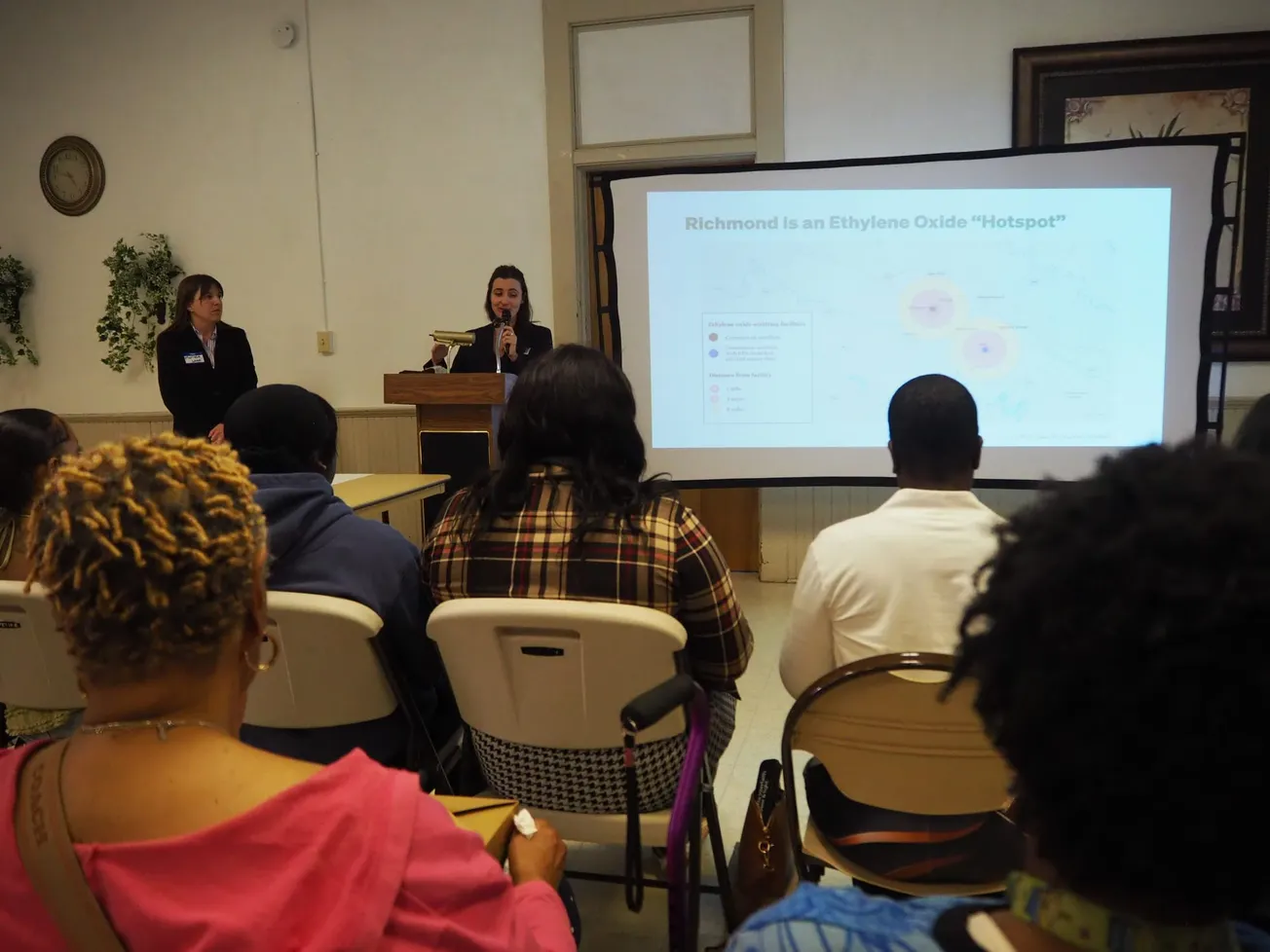
Southern Environmental Law Center lawyer Irena Como speaks at the lectern at the Gravel Hill community center last month about a lawsuit the organization filed with the Virginia Interfaith Power & Light focusing on the Environmental Protection Agency's proposed relaxed ethylene oxide (EtO) emissions standards. (Dina Weinstein/Henrico Citizen)

A legal organization is bringing attention to proposed relaxed federal clean air regulations that it claims would violate the Clean Air Act and imperil the health of some Henrico County residents.

Lawyers from the Southern Environmental Law Center, together with Virginia Interfaith Power & Light leaders, recently addressed about 100 people at a Varina meeting about concerns related to moves by the Environmental Protection Agency designed to loosen regulations of ethylene oxide (EtO) emissions.

EtO is the chemical used in two Henrico County sterilization facilities – the Sterilization Services of Virginia plant at 674 Eastport Boulevard (near the Laburnum Avenue-Charles City Road intersection) and the Central Virginia Health Network (Bon Secours Mercy Health) location in the Near West End – to purify medical equipment materials.

A 2022 report by the United States Environmental Protection Agency listed the SSV plant as one of 23 nationally that emitted potentially dangerous levels of EtO, a human carcinogen that is a colorless and flammable gas designated by the EPA as a hazardous air pollutant because, when inhaled, it can cause adverse health impacts, including lymphoma, leukemia and other cancers.

Although Virginia Department of Environmental Quality officials reported in the summer of 2023 that the SSV facility already had reduced its EtO emissions levels below the levels necessary to comply with stricter standards that hadn't yet been implemented, the SELC and VIPL are concerned about the Trump administration's actions to loosen those standards.

In April 2024, the EPA implemented those stricter standards for facilities that emit EtO in an effort to reduce hazardous emissions by 90%.

But last year, the Trump administration's EPA announced that it was providing a two-year exemption from the new standards for 40 EtO emitters nationally – including SSV – and that it also was considering rescinding a number of those new standards altogether, arguing on a technicality that they shouldn't have been permitted to be adopted by the Biden-era EPA in the first place.

VIPL is a plaintiff in a lawsuit filed by the SELC Jan. 28 in the United States District Court for Washington, D.C. seeking to overturn the Trump-era EDA's exemptions. (Click below to read the lawsuit.)

EPA: Existing EtO air quality standard 'threatens facilities' ability to sterilize equipment'

In addition to its usage by commercial sterilizers on medical equipment, EtO also is used in consumer products like antifreeze and to sterilize foods and spices.

The new 2024 EtO emission standards, current EPA leaders contend, were based upon recent "residual risk reviews" related to EtO emissions – but the agency already had ruled in 2006 that no further such reviews were necessary. Therefore, EPA officials contend, the new standards were based upon reviews that technically weren't allowed to take place.

"An implied authority to conduct discretionary risk reviews on an ad hoc basis disrupts the statutory scheme by eliminating the finality of residual risk reviews, undermining certainty for regulated industry and the public, and placing certain source categories on a different trajectory from the rest, all without providing a standard for the use of such implied discretion," EPA officials wrote in an explanation of their current efforts.

In a statement to the Citizen, the EPA wrote that the existing EtO standard “threatens facilities’ ability to sterilize equipment and jeopardize one of America’s only options for a secure domestic supply chain of essential medical equipment.”

The EPA’s statement also minimized the potential harm that EtO emissions could cause to people who live, work or study around such facilities without air emission controls. 

“EPA does not believe there are short-term or acute risks associated with EtO in the community surrounding Sterilization Services of Virginia,” officials wrote. “For the community around the facility, EPA estimates that there is a lifetime cancer risk that is at worst 100/Million depending on where you live near the facility.”

That risk assumes a person breathes air containing EtO at the current estimated level at the location 24 hours a day every day for 70 years and is in addition to cancer risk from other causes, the statement read.

EPA officials also are framing the issue as one of national security, claiming in a press release that after the 2024 EtO standards were implemented, concerns were expressed from some in the medical community, industry stakeholders and government agencies.

"These concerns included the feasibility of complying with the more stringent EtO emission standards and the significant impacts the requirements would have on maintaining a strong domestic supply chain for sterilized medical equipment essential to saving American lives," according to the release. "Commercial sterilizers utilize EtO to sterilize 50 percent of all medical devices in the U.S. every year — or 20 billion medical devices — with no viable alternative on the market.”

The EPA is accepting public comments about its efforts to rescind portions of the 2024 EtO standards through May 1.

(Courtesy Southern Environmental Law Center)

In Eastern Henrico, a polluting infrastructure

The SELC and VIPL are worried about what loosened EtO emissions standards could mean for the health of people who live near facilities that emit the chemical – many of whom in Henrico are lower income and people of color and who already face enhanced risks from air pollution.

At the community event at the Gravel Hill community center, one image in the SELC lawyers’ presentation showed a map of other polluting industries in Eastern Henrico.

“There's also the airport, the landfill and all of those industrial polluters together contribute to these environmental burdens,” said Irena Como, a North Carolina-based SELC senior attorney. “And the area that we are in right now is suffering from increased environmental burdens from this air pollution from the different industrial sources.” 

Many people concerned about potentially cancer-causing environmental issues listened attentively at the meeting and asked questions after Como and her colleague spoke about EtO, the plants that emit the chemical and the group’s concerns.

The presentation spurred questions from the audience asking how protections could be strengthened on a state and local level. Other people had questions about regulations and connections to emissions and cancer.

Beth Kreydatus, a Virginia Commonwealth University professor who brought to the event a group of students delving into environmental issues in Eastern Henrico to conduct interviews about residents’ concerns, said environmental justice in Virginia is connected to the legacy of racism.

“The bottom line is that the emission protection is being addressed through the lawsuit,” said Kreydatus who has highlighted numerous environmental issues in Eastern Henrico including PFAS in the Chickahominy Creek as Henrico NAACP environmental chair.

In an area that is largely working class and a community of color, Kreydatus said it is important to acknowledge that these populations have long been perceived by policymakers as not having resources and the ability to resist polluting infrastructure. (Of the more than 34,000 people who live within three miles of the SSV facility, 78% are people of color and 36% are low-income, according to demographic information.)

“And this area has many, all in one place,” Kreydatus said. “Decisions were made decades ago that Eastern Henrico was the preferred location for these industries. It had the cheapest property values. It is where it has put the landfills. The community is bearing disproportionate harm to itself and economic opportunity. It may be what’s considered a sacrifice zone.”

Threats to the most marginalized people mean they face the most severe harm, Kreydatus said. If environmental standards of sterilization plants are not maintained, a greater area of the population may be affected, according to the SELC attorneys.

Days after the event at the Gravel Hill community center, the EPA held a hearing at which citizens, scientists and environmental groups testified regarding their concerns about reducing EtO restrictions.


Rev. Dr. Faith B. Harris, Virginia Interfaith Power & Light executive director, spoke at an event on March 26 at the Gravel Hill Center of Varina focusing on relaxed standards for the ethylene oxide chemical which sterilization facilities use and emit. (Dina Weinstein/Henrico Citizen)

The EPA set an "acceptable" lifetime cancer risk related to EtO at a baseline of 100 cases in 1 million people, but without the 2024 standards in place, “the increase in lifetime cancer risk associated with any sterilizer is 6,000 in 1 million,” said Marissa Land, a Georgia-based SELC associate attorney who specializes in air pollution and who spoke at the March 26 meeting in Varina. “That's 60 times above the acceptable baseline that EPA has developed with the 2024 EtO rule in place.”

According to the Virginia Department of Health, the incidence rate for all cancers for 2019 to 2023 in Henrico County is roughly equivalent to the national rate and slightly higher than the Virginia rate.

The SELC's lawsuit, which calls on the EPA to uphold federal protections, is not in isolation. Environmental groups are raising the alarm broadly regarding the Trump administration's other efforts to shred federal environmental protections.

The SELC also is working with partners such as the VIPL to ensure stronger protection in place at the state and local level, according to officials.

Following the 2022 EPA report that identified the SSV plant as emitting potentially dangerous levels of EtO, the EPA hosted a webinar in June 2023 during which EPA Air and Radiation Division Director Christina Fernandez explained that the cancer risk for people who lived within about 1,000 feet of the facility was low.

“The latest analysis that [the] EPA has done predicts that if 1 million people living close to [Sterilization Services of Virginia] breathe in ethylene oxide for 24 hours a day, seven days a week, for 70 years, then 900 of them would be expected to get cancer from that exposure," Fernandez said (shown below).

There are no residential units within 1,000 feet (about one-fifth of a mile) of the facility.

But state and federal officials who visited the facility that year found that certain employees who handled the gas were at a much higher risk of developing cancer – perhaps as high as 1 in 117 if exposed over 35 years of employment.

At that time, the EPA was aiming to reduce health risks posed by the Henrico sterilization plant, according to Citizen coverage. During the EPA's on-site inspection of the SSV facility, company officials were in the process of voluntarily installing a new control system, estimated to be operational by that September, that would cut about its EtO emissions substantially.

An Aug. 24, 2023 Citizen article reported on an in-person meeting with EPA officials in Varina to answer residents’ questions about EtO after the SSV facility made a list of dangerous chemical-producers.

The EPA has removed a link from its website that previously listed details about Sterilization Services of Virginia in Varina, which the agency had listed in 2022 as one of 23 facilities in the nation emitting potentially dangerous levels of ethylene oxide. (Image from EPA.gov)

At that meeting, officials said the plant had installed new scrubbers that were dramatically reducing the amount of EtO the facility released – as much as 99% of the emissions from its largest emissions source, which a Virginia DEQ official said at the time was responsible for half of its overall emissions. The scrubbers had reduced the emissions to a level at which they already were exceeding stricter EtO standards that were proposed to take effect two years later, officials said.

Most of the remaining EtO emissions from the facility were "fugitive" emissions, according to the DEQ at that time – meaning those that escaped through an open door or window, for example.

A 2024 EPA Detailed Facility Report of Sterilization Services of Virginia stated that no violation had been identified there.

Numerous links to EPA data that were included in the Citizen's 2023 coverage now return error messages on the EPA's website.

DEQ: Varina facility 'equipped to meet 2028 emission standards'

At last month's Varina meeting, SELC lawyers presented a map of 500 sterilization facilities across the country showing concentrations in certain areas, including Puerto Rico. Como raised concern about the Central Virginia Health Networks sterilization location in Henrico’s West End, and expressed specific concern about Sterilization Services of Virginia, which was opened in 1990 just off of the intersection of Charles City Road and South Laburnum Avenue, 11 miles from the Gravel Hill community center meeting house.

The SELC’ s lawsuit states the EPA identified that emissions from SSV presented elevated cancer risks as high as 1,000 in 1 million.

According to the Virginia Department of Environmental Quality, SSV holds an air emissions permit from DEQ.

“In 2025, SSV installed additional control equipment to further reduce their emissions of EtO,” according to a DEQ statement sent to the Citizen. “They began operating this new equipment in October of 2025. With the addition of this equipment, SSV is now equipped to meet 2028 EtO emission standards [two years early].”

 The SELC argues EtO emissions from SSV contribute to elevated cancer risks, with a maximum excess cancer risk level of 1,000 additional cases per 1 million people.

According to the SELC’s lawsuit, in 2022 alone, the facility reported releasing 13,821 pounds of ethylene oxide. SSV did not respond to requests for a response to SELC’s allegations.

The EPA will accept comments about its proposed changes to the National Emission Standards for Hazardous Air Pollutants until May 1.


Dina Weinstein is the Citizen’s community vitality reporter and a Report for America corps member, covering housing, health and transportation. Support her work and articles like this one by making a contribution to the Citizen.

Comments