Skip to content

Youngkin pitches final budget, touts strong revenues as he prepares to leave office

Outgoing governor proposes pay raises, tax relief and a child welfare overhaul, but drops car tax repeal as he urges Democrats to keep Virginia’s pro-business course

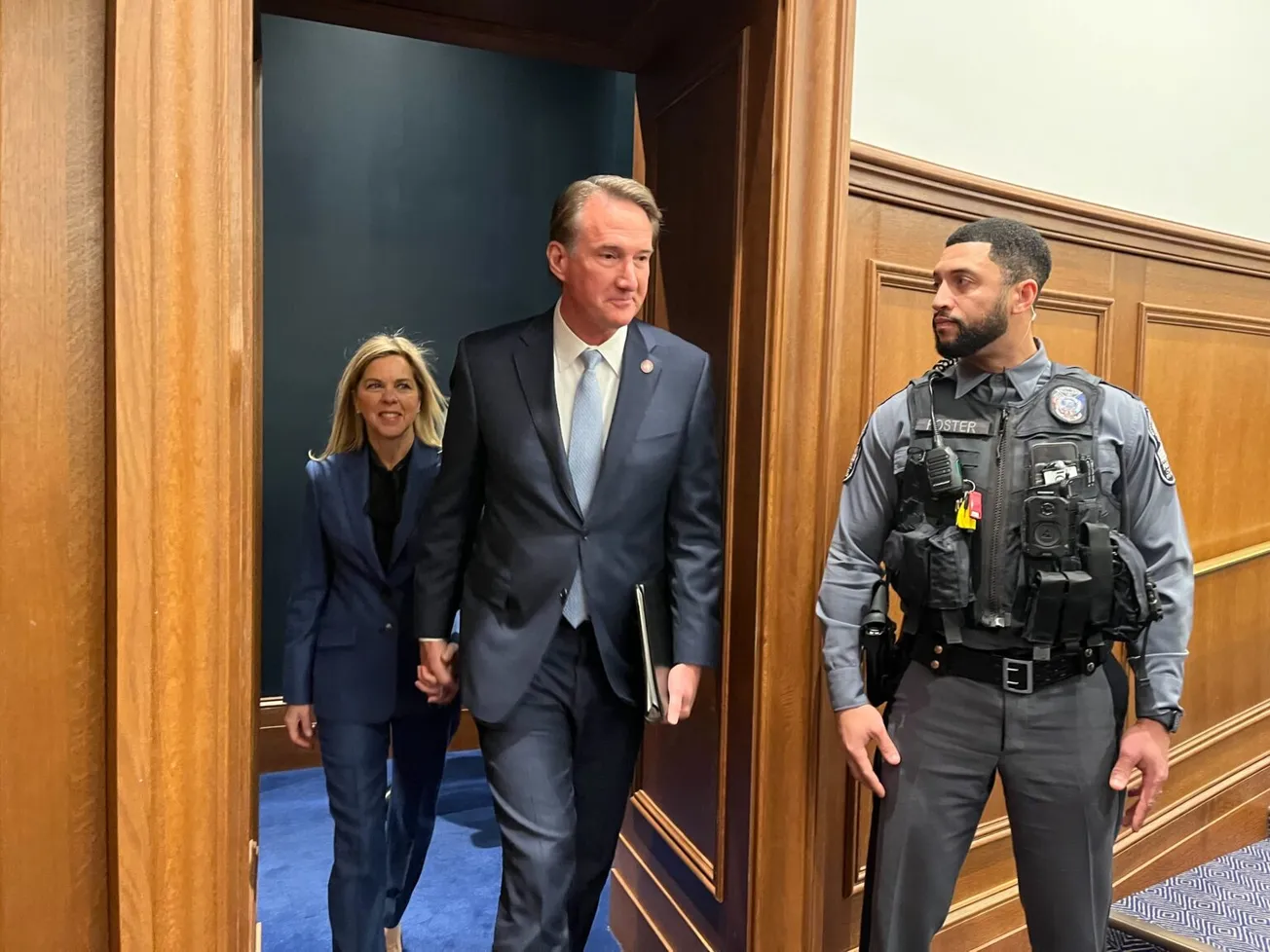
Gov. Glenn Youngkin and first lady Suzanne Youngkin enter a committee meeting room at the General Assembly Office Building in Richmond before the governor presented his final budget to lawmakers at the joint meeting of the House Appropriations, House Finance and Senate Finance & Appropriations Committees on Dec. 17, 2025. (Photo by Shannon Heckt/Virginia Mercury)

Table of Contents

Outgoing Gov. Glenn Youngkin on Wednesday rolled out his final two-year budget proposal before a joint meeting of the General Assembly’s money committees, pitching a plan built on what he called Virginia’s strong fiscal footing while using the moment to cement his administration’s legacy as he prepares to leave office next month.

The $72 billion general fund proposal — part of a $212 billion total spending plan — covers the biennium running from July 1, 2026, through June 30, 2028. It includes pay raises for teachers, state employees and local public workers, tax relief for individuals and businesses, major increases in Medicaid spending, and a $50 million investment to overhaul Virginia’s child welfare system, one of Youngkin’s final policy priorities.

The proposal also marks the last major policy statement from a governor who is constitutionally barred from serving a second consecutive term and who leaves office Jan. 17, handing the reins to Gov.-elect Abigail Spanberger, a Democrat who attended Wednesday’s presentation.

“Once again, we come together to discuss Virginia’s financial strength, and how to best be good stewards of the enormous resources,” Youngkin said, describing the budget as the culmination of four years of economic growth, tax cuts and regulatory rollbacks. “My friends, we have done all of that, and so much more, together.”

Youngkin framed the proposal as both a reflection of his administration’s record and a bridge to the next one, emphasizing that revenue forecasts were intentionally conservative and designed to leave flexibility for Spanberger and lawmakers who will take office amid unified Democratic control of state government.

“This leaves a meaningful upside for the next administration,” Youngkin said.

The budget is built on a revenue forecast projecting 3.5% compounded annual growth — roughly 3% after accounting for tax policy changes — far below the average 8% annual growth Virginia experienced during Youngkin’s term.

The administration estimates that revenues continued to grow by 5.2% during the first five months of fiscal year 2025, producing another surplus even as some analysts had predicted economic fallout from federal policy changes.

“Despite the predictions for financial calamity … financial calamity has not happened,” Youngkin said.

Secretary of Finance Stephen Cummings told committee members that recent revenue trends helped give the administration confidence in proposing a cautious but workable budget. 

“Through the first five months of 2025, we’ve had a strong performance, up 5.2%, year over year,” he said, noting that growth has been driven largely by individual income tax collections. 

Revenues so far are nearly $500 million higher than projected, he said, and payroll withholding — which he described as the best indicator of workforce health — is up 5.9% year to date. 

“Federal actions have not had the impact that everybody has been calling for for a year now,” Cummings added, pointing to the concentration of Virginia’s federal workforce in national defense, security and intelligence roles. 

Pay raises and education funding

One of the largest line items in the proposal is roughly $1 billion for compensation actions, including for state employees, teachers, school support staff, sheriff’s deputies, state police and other state-supported local employees.

The plan calls for a 2% one-time bonus in the current fiscal year, followed by 2% salary increases in fiscal years 2027 and 2028.

Youngkin said the raises reflect an effort to stabilize Virginia’s workforce, particularly in education, where the administration has made recruitment and retention a central focus.

Teacher vacancies, Youngkin said, have declined by more than 35% during his term, an improvement he attributed to higher pay, licensing reforms and changes such as cellphone-free classrooms.

The budget includes an additional $544 million in general fund support for K-12 education over the next biennium, bringing total state investment to a record $22.8 billion.

Much of that increase is driven by the state’s biennial recalibration of its school funding formula, which updates staffing and cost assumptions. A senior administration official told reporters during a briefing Tuesday evening those mandatory adjustments, along with Medicaid growth, crowded out room for larger increases in other areas.

Youngkin pointed to improvements in student attendance as evidence that previous investments are paying off.

“Students are also doing better because they’re in school in the first place,” he said, referring back to the pandemic-era move to virtual learning that ended early in his term. “Virginia now leads the nation in reducing chronic absenteeism.”

The administration announced earlier this year that Virginia was recognized by Attendance Works for progress in reducing absenteeism, though there is no universally accepted national ranking of states on the issue.

The budget also redirects $137.6 million in unused Virginia Preschool Initiative funds to expand child care subsidies, creating an estimated 6,745 new slots annually for children from birth to age 5 in fiscal years 2027 and 2028.

For school construction, the proposal adds nearly $300 million in additional state support, bringing total authorized funding for the biennium to $519 million.

Higher education would receive a $434 million increase in general fund support over two years, totaling $7.8 billion. The proposal includes additional funding for financial aid and expanded health sciences programs, including nursing and medical education.

Medicaid, SNAP and mandatory spending

The largest growth area in the budget is Medicaid, where costs are projected to rise sharply due to enrollment, utilization and health care inflation.

Youngkin’s proposal increases Medicaid funding by $2.6 billion over the biennium, bringing general fund support to $17 billion and total program funding to $59 billion. That represents a $10.7 billion increase compared with the budget adopted just two years ago.

“To address the rising cost of health care and secure the future sustainability of this critical program, we also introduce responsible cost controls,” Youngkin said, citing efforts to root out waste, fraud and abuse.

The budget also includes $3.6 million to reduce errors in the administration of Supplemental Nutrition Assistance Program benefits, with a goal of bringing Virginia’s error rate below 6%. The current rate is 11%, Youngkin noted, which is in line with the national average.

“I don’t believe Virginia is average in anything,” Youngkin said. “There is no reason why Virginia can’t get there as well.”

One notable exception to the budget’s overall spending constraints is a $50 million increase to fund a sweeping overhaul of Virginia’s child welfare system, a priority Youngkin has elevated during his final year in office.

The funding would raise base pay for Child Protective Services social workers, establish a centralized intake system and create statewide performance standards with enhanced oversight of local departments.

The initiative is aimed at addressing inconsistencies across local agencies and a system in which more than three-quarters of children assessed as high risk or very high risk do not receive in-home services.

Tax relief, but no car tax plan

The governor’s proposal includes $730 million in tax relief, including provisions that conform state tax law more closely with federal rules. Those measures include making permanent the increased standard deduction and the refundability of the earned income tax credit, along with phased-in exemptions for tips, overtime pay and car loan interest.

“It’s their money, not the government’s,” Youngkin said. “There is no need for any new taxes.”

Notably absent from the plan is a proposal to eliminate the car tax, which Youngkin has previously called “the most hated tax” in America. Administration officials reportedly said the scale of mandatory spending obligations left little room for such a change.

The budget also proposes changing Virginia’s corporate tax sourcing rules from cost-of-performance to market-based sourcing, which would tax companies based on where their customers are located.

Youngkin’s plan includes nearly $2 billion in new capital authorizations and maintenance funding, using a mix of cash and debt. About $890 million would come from the general fund, with $1.1 billion in new debt issued under Virginia’s AAA bond rating.

The funding would allow the state to resume construction projects at public universities that were paused earlier this year amid concerns about federal policy uncertainty.

“Our AAA bond rating was reaffirmed,” Youngkin said, pointing to Virginia’s strong credit position.

Gov. Glenn Youngkin addresses lawmakers at the joint meeting of the House Appropriations, House Finance and Senate Finance & Appropriations Committees in Richmond, Dec. 17, 2025. (Photo by Shannon Heckt/Virginia Mercury)

Warning to Democrats 

With Democrats set to control the governorship and both chambers of the General Assembly next year, Youngkin used his remarks to issue pointed warnings about policy changes he believes could undermine Virginia’s economic growth.

“My cautionary message is to stay with the program, and don’t pass anti-business legislation,” he said.

Youngkin urged lawmakers not to rejoin the Regional Greenhouse Gas Initiative, a multistate cap-and-trade program aimed at reducing carbon emissions from power plants. Virginia withdrew from the program during his term after a legal and political fight, a move deemed unlawful by a Floyd County Circuit Court judge last year.

“RGGI only drives up utility bills and drives up the cost of living for Virginians,” Youngkin said, arguing that rejoining would impose millions of dollars in additional electricity costs.

He also warned against weakening Virginia’s right-to-work law, which prohibits requiring union membership as a condition of employment.

“Pro-business policies attract jobs,” he said. “Anti-business policies chase jobs and opportunities away.”

Spanberger, who will inherit Youngkin’s proposed budget, said in a statement following the governor’s presentation that Virginians expect leaders to focus on affordability, jobs and schools.

“The biennial budget is a critical opportunity to deliver on those priorities and position Virginia for success in the years to come,” Spanberger said. “As the next governor of Virginia, I look forward to working with the General Assembly to lower costs for Virginia families, invest in Virginia’s public schools, and protect access to critical healthcare services.”

Under Virginia’s budget process, the incoming legislature will amend Youngkin’s proposal during the session that begins Jan. 14. Spanberger will then sign the final budget, which is expected to differ substantially from the outgoing governor’s plan as Democrats reshape spending to reflect their priorities.

Even so, Youngkin said he believes he is leaving Virginia on solid financial ground.

“Our revenues are strong,” he said. “And Virginia is roaring — and she needs to stay that way.”


Virginia Mercury is part of States Newsroom, a nonprofit news network supported by grants and a coalition of donors as a 501c(3) public charity. Virginia Mercury maintains editorial independence. Contact Editor Samantha Willis for questions: info@virginiamercury.com.

Comments