Voting access bills move forward as Democrats block GOP early voting limits
Lawmakers approve ERIC membership, absentee ballot change and transparency measure
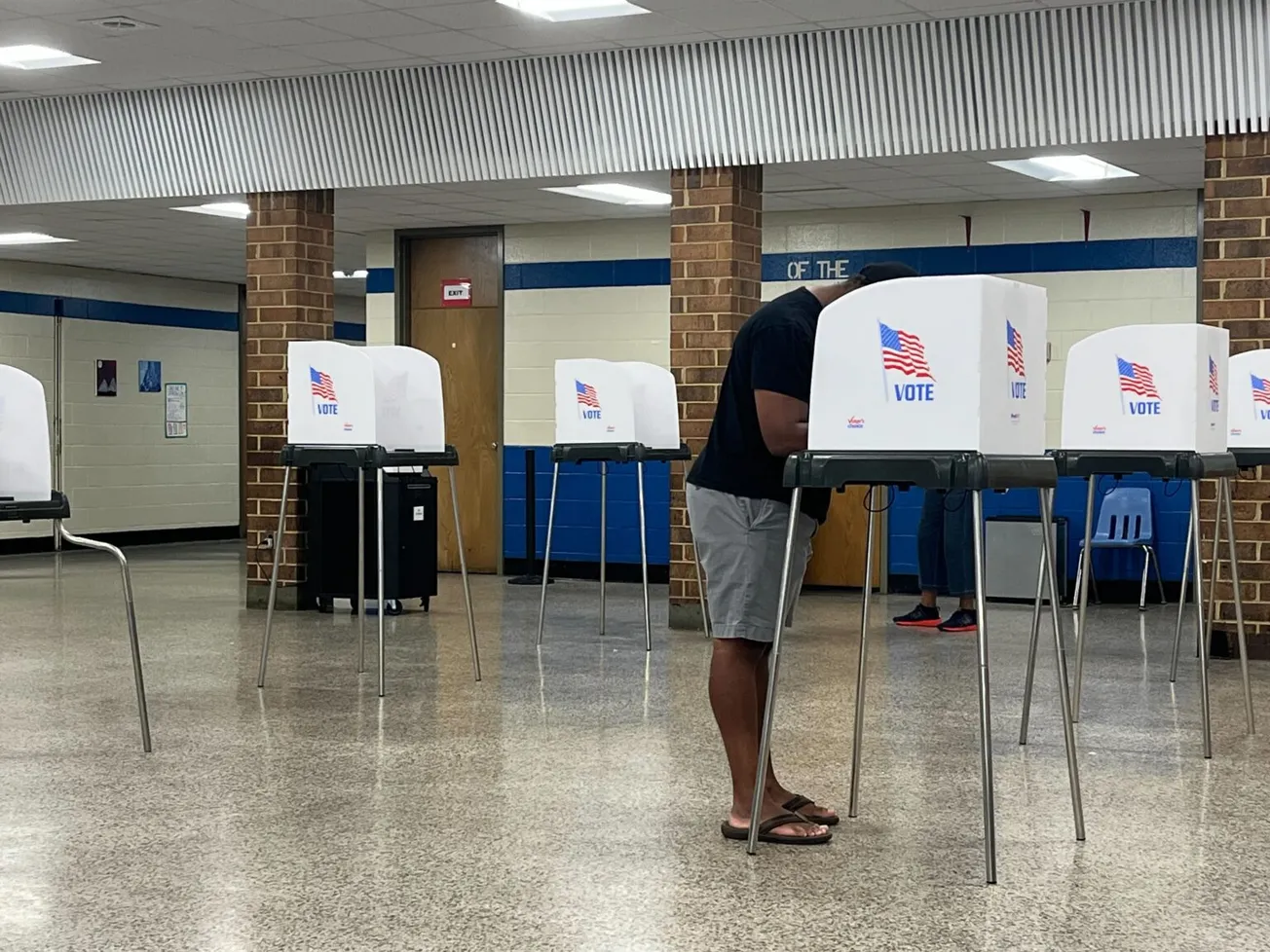
With the 2026 General Assembly session in full swing, Democrats on Tuesday advanced a slate of voting and campaign finance measures aimed at expanding access to the ballot box and increasing transparency in elections, while narrowly rejecting a series of Republican-backed proposals that would have scaled back early voting and limited when voters could cast ballots in person.
Before dawn, a House Elections Subcommittee on campaign finance unanimously advanced House Bill 44, sponsored by Del. Paul Krizek, D-Fairfax, which would require the State Board of Elections to create a comprehensive, user-friendly online campaign finance portal.
The proposal would mirror many of the functions currently offered by the Virginia Public Access Project, a nonprofit organization that aggregates campaign finance data, election results and political information to make it accessible to the public, journalists and researchers.
Krizek told the panel the bill is designed to modernize how campaign finance information is disclosed and accessed, making it easier for the public to analyze political spending.
“It’s a really good open government bill,” Krizek said. “It would be a friendly portal where you have the interface where you can manipulate the data, create your own reports, and put it in Excel, and things like that. So it’s just really modernizing campaign finance reform disclosures.”

Krizek carried a similar measure last year that passed the House but stalled in the Appropriations Committee, raising questions again Tuesday about whether funding had been secured.
“This bill goes back to my very first year in the House of Delegates,” said Del. Phillip Scott, R-Spotsylvania. “Is this in the budget now, or is this something that we’re just going to have to wait and see?”
Krizek responded that the funding question had been addressed.
“The governor’s budget has money for this, I believe $2 million,” he said.
Del. J.J. Singh, D-Loudoun, also questioned how the state-run portal would differ from existing tools, including the state’s Legislative Information System and private platforms like VPAP.
“I personally think we could use a better interface,” Singh said, describing the state’s current Legislative Information System as “a little clunky,” but asked whether the bill would simply duplicate what already exists.
Krizek said the measure was not meant to replace VPAP but to ensure that access to campaign finance data is not dependent on private fundraising.
“It’s not about being better, really. I think VPAP does a pretty good job,” Krizek said. “It’s really about not relying on private charity to be the one that’s filling in this gap.”
He added that VPAP’s work helped establish the standard the state now seeks to adopt and said the bill was a direct result of that success.
The subcommittee reported the bill unanimously to the full committee.
Senate panel advances ERIC, absentee ballot bill
Later Tuesday, the Senate Privileges and Elections Committee advanced several Democratic-backed election measures while rejecting multiple Republican efforts to limit early voting.
On an 8-7 vote, the committee passed Senate Bill 57 by Sen. Schuyler VanValkenburg, D-Henrico, which would require Virginia to maintain membership in the Electronic Registration Information Center (ERIC), a multistate data-sharing consortium used to help states maintain accurate voter rolls.
But the panel rejected another VanValkenburg proposal, SB 76, on a 9-6 vote.
The bill would have consolidated presidential-year primaries by moving all primaries for offices appearing on the November ballot to the presidential primary date, while also adjusting petition signature rules and campaign finance deadlines.
VanValkenburg said the current system of holding two primaries in presidential years confuses voters and suppresses turnout.
“This is just because in presidential primary years, we have two primaries, which leads to a lot of confusion among voters,” he said.
The committee advanced SB 58 by Sen. Barbara Favola, D-Arlington, on a 9-5 vote.
The bill would extend the deadline for receipt of absentee ballots, ballot cure materials and certain provisional ballot documentation from noon to 5 p.m. on the third day after an election.
Favola said the change reflects current mail delivery realities.
“The only thing this bill does is it extends the time that a ballot can be received from 12 noon on the third day after the election to 5 p.m.,” she said, noting that postal delivery now takes nearly three days longer on average.
Republican early voting limits fall on party-line vote
On mostly party-line votes, the committee rejected several Republican proposals aimed at scaling back early voting.
SB 46 by Sen. Christie New Craig, R-Chesapeake, would have reduced in-person absentee voting from 45 days before an election to 15 days. Craig said registrars are struggling with the volume and cost of elections.
“We’re having so many more elections, and so my bill just takes it to 15 days,” she said, arguing that long early voting windows make it harder for candidates to meet voters and for registrars to manage workloads.
The committee killed the bill 8-7.
A similar proposal, SB 298 by Sen. Mark Peake, R-Lynchburg, would have limited early in-person voting to the 10 days immediately preceding an election, with expanded daily hours. Peake said local governments are being stretched thin.
“We might end up with 170 or 180 days of voting,” he said. “It’s really too much of a burden.”
Peake emphasized that his bill would not affect mail-in voting and described it as a cost-saving measure.
The committee rejected the bill, also by an 8-7 vote.
The panel likewise voted down SB 533 by Sen. David Suetterlein, R-Roanoke County, which would have standardized early voting hours statewide.
Suetterlein argued that uneven local discretion could influence election outcomes, particularly in primaries.
Virginia Mercury is part of States Newsroom, a nonprofit news network supported by grants and a coalition of donors as a 501c(3) public charity. Virginia Mercury maintains editorial independence. Contact Editor Samantha Willis for questions: info@virginiamercury.com.