Virginia’s new public health leaders take the helm as state agencies weather uncharted waters
Virginia health secretary Marvin Figueroa and health commissioner Cameron Webb are steering the state’s public health agencies as state health departments nationwide grapple with federal shifts that threaten to drain budgets and slash workforces
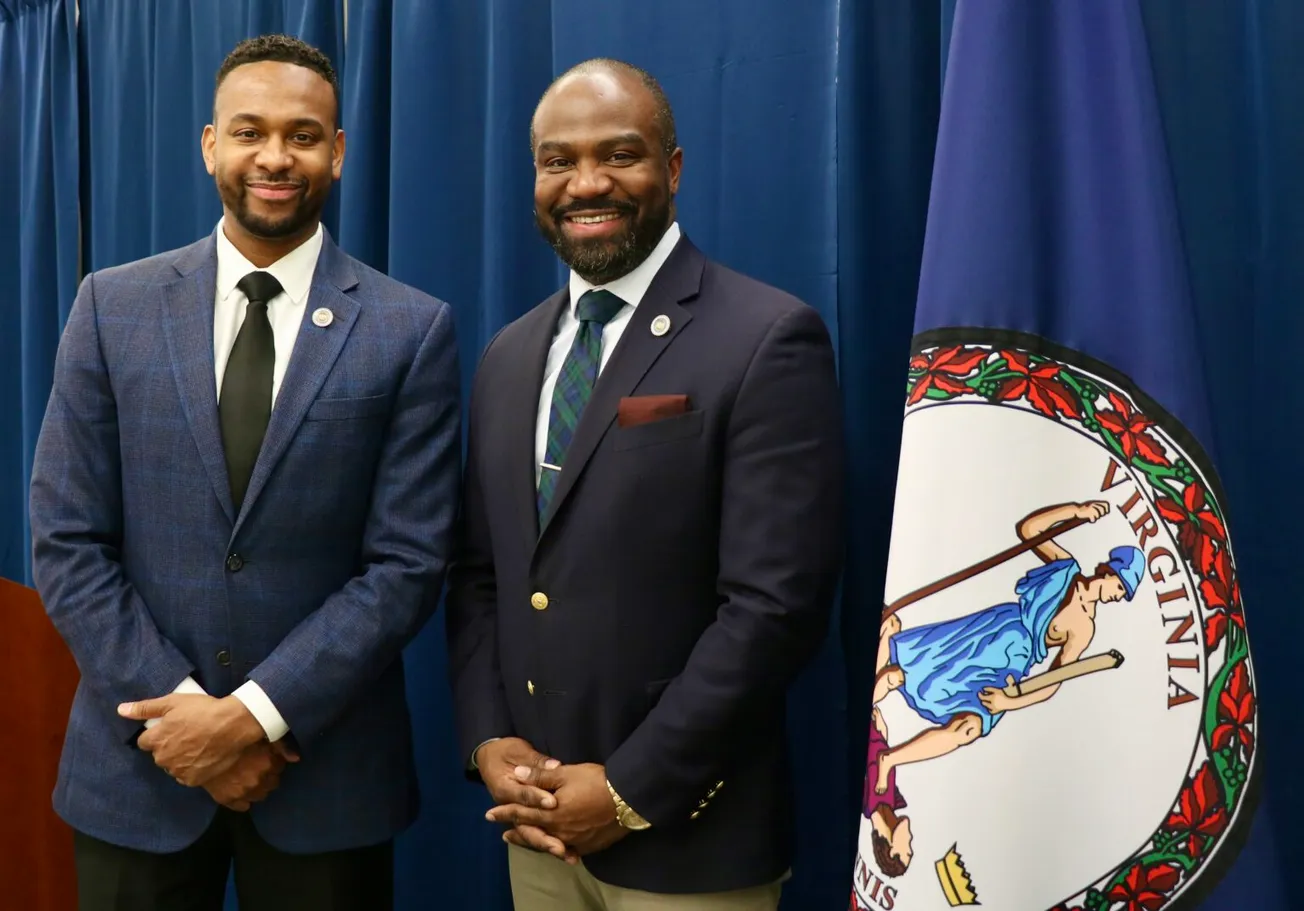
Two men with deep experience in health care policy and practice have recently been tapped to oversee Virginia’s public health agencies, as health care remains a top concern for residents and an ongoing challenge for state and federal lawmakers.
Virginia Department of Health Commissioner Dr. Cameron Webb and Virginia Secretary of Health and Human Resources Marvin Figueroa — the former a leading Black physician and educator raised in Spotsylvania, the latter an immigrant and nationally recognized health policy expert — say their work will be rooted in a commitment to enhancing Virginians’ health and wellbeing and improving the state’s public health services.
Webb, appointed to the role by Gov. Abigail Spanberger in January, remembers being inspired by seeing his childhood family doctor — “a Black man in a white coat.”
The experience spurred Webb to become a doctor himself and eventually move into public policy at the state and federal level, taking him to advisory and fellowship roles under Presidents Barack Obama, Donald Trump and Joe Biden.
Figueroa remembers how his mother worked as a home health aide amid the family’s immigration journey into the U.S. from Honduras.
“These are the kinds of jobs that most immigrant women perform, and they’re low wage,” he said.
While her work provided care and support to clients, it also allowed her to support her family. That experience and witnessing how social services like Medicaid, food stamps and housing vouchers helped his family inspired Figueroa in his path as a federal and state public health policy leader.
“(The social services) are how my mother was able to give us a fair shot and how this country was able to give us a fair shot,” Figueroa said. “I’m one of those individuals that benefited from America giving me a chance and being able to take advantage of those chances.”
Familiar partnership
The two men also inspired each other over the years as their paths crossed, they said.
Webb said when he was a professor at the University of Virginia, he’d “cold-called” U.S. Sen. Mark Warner’s office to discuss Medicaid policy and it was none other than Figueroa who answered. At the time, he was senior policy advisor for the senator.
Later, the two men were involved in a virtual town hall with Virginia Sen. Lashrecse Aird, D-Petersburg, who was then a delegate, to discuss how to minimize COVID-19 spread in the area.

Reflecting on that time, Aird said she was “inundated with calls” from constituents that were worried about the virus and if they needed the vaccine. When vaccines were rolling out in 2021, fewer Black Americans were lining up for it initially.
That reluctance was rooted in a history of medical exploitation of Black and Hispanic people — ranging from the Tuskegee Syphilis Study to white doctors using the cells of Henrietta Lacks — a Black woman born in Virginia — for research without her consent.
As a Black woman representing a majority-Black area of Virginia, Aird said wanted to help sow trust, and turned to Figueroa and Webb, two health professionals of color, for assistance.
“I was like, ‘okay, we have two great individuals here who are health experts,’” she said. “We were trying to build trust with the recommended health actions for the virus and they were also just perfect representatives of knowledge and expertise.”
Figueroa and Webb connected again via virtual calls when Webb was a COVID-19 senior policy advisor to Biden and Figueroa was a senior official with the U.S. Department of Health and Human Services.
Figueroa said he felt proud to see another Black man on health leadership teams like himself.
“It wasn’t too long ago where folks like us didn’t have the opportunity to be in these rooms,” Figueroa said. “Every time we walk in together, we don’t ignore that. Every meeting we’re trying to make the best out of that meeting, because we stand on the shoulders of people that previously were locked out of those conversations.”
Shared visions and shared challenges
While each man offers his experience in public health policy after years spent working in different state and federal administrations, they said their collaboration and communication will be key aspects of their new roles.
At the top of Virginia’s public health umbrella as HHR Secretary, Figueroa oversees Webb and other departments including social services, medical assistance services and behavioral health.
“We are one HHR,” he said, and both men noted the intersections between the departments and how their services often overlap in service to Virginians.
In their first two months on the job together, they’ve been part of calls and meetups with local and state departments to keep communications lines open.
“Sometimes it’s as simple as ‘let’s go grab lunch together,’” Figueroa said.
They’re also preparing to tackle the ongoing challenges the health department has weathered in recent years.
VDH was beset by financial mismanagement — including a $33 million deficit with the conviction of a former department lead — over the past five years, as well as issues with staffing retention and hiring, leading to silos and knowledge gaps.
This time last year, VDH was also grappling with the premature cancellation of federal health grants to the tune of $219 million dollars the agency had used to support public health initiatives around the state.
Former Commissioner Dr. Karen Shelton, appointed by former Gov. Glenn Youngkin, who left office in January, helped lead VDH in its own healing journey while it served the health needs of millions statewide. Webb said their conversations leading up to him taking on the role have been helpful.
“One of the really good things they did as they were heading out the door, was that they were able to staff up our Office of Licensure and Certification,” Webb said. “So that’s who certifies our nursing homes, our hospitals. And it was impossible for that office to do its work without adequate staff.”
Shelton had also aimed to bolster inter-agency communication, a goal Webb said he will continue pursuing. After longstanding vacancies in local health district director roles, those positions were filled in the back half of her tenure. Regional health directors began to report to the commissioner of community health service.
Instead of “going it alone,” local directors now have a “layer of support,” Webb said.
But the local health offices have signaled they need more resources and support, Webb acknowledged. How much more can be provided, however, stems from several factors.
In steering multiple departments, Figueroa acknowledged that federal shifts are placing extra hurdles on state governments.
The One Big Beautiful Bill Act, a reconciliation bill signed into law by Trump last summer, entails forthcoming changes to Medicaid and hospital funding mechanisms that mean thousands of Virginians stand to lose health insurance and will be more likely to strain safety nets like Federally Qualified Health Centers and free clinics.
The bill also outlined changes to social service administrations like the Supplemental Nutrition Assistance Program.
“When you look at the amount of money that’s being taken out of the system, states can’t make up those dollars,” Figueroa said.
Congress also failed to renew expired tax credits that help people purchase insurance on the Affordable Care Act marketplace, leaving thousands scrambling to afford insurance.
In an attempt to pick up where Congress is leaving off, Virginia state lawmakers proposed budgets this year that include millions of dollars earmarked for state-level subsidies along with other health care investments.
The House and Senate versions of the budget still have a few weeks of workshopping before they are reconciled and sent to Spanberger’s desk.
“Right now we’re in the middle of policy making. It’s the messy part,” Figueroa said.
Democrats, who control the legislature and the executive branch, have had success so far in advancing their affordability agenda, including several meaningful health bills that could make it across the finish line.
Still, with the state forced to be more reliant on its own dollars rather than federal funds that have always backstopped its budget, meeting all their goals won’t be easy, Webb said.
“Pulling resources from public health, sometimes with little or no notice, makes it hard to do work in that environment,” Webb said. “I think we’re being as thoughtful as we can be to deliver services (Virginians) deserve.”
Virginia Mercury is part of States Newsroom, a nonprofit news network supported by grants and a coalition of donors as a 501c(3) public charity. Virginia Mercury maintains editorial independence. Contact Editor Samantha Willis for questions: info@virginiamercury.com.