Virginia Democratic veterans rally for ‘yes’ vote in redistricting referendum
Speaker Don Scott dismisses early voting concerns as party leaders say Democratic-leaning voters often cast ballots later in the early voting window
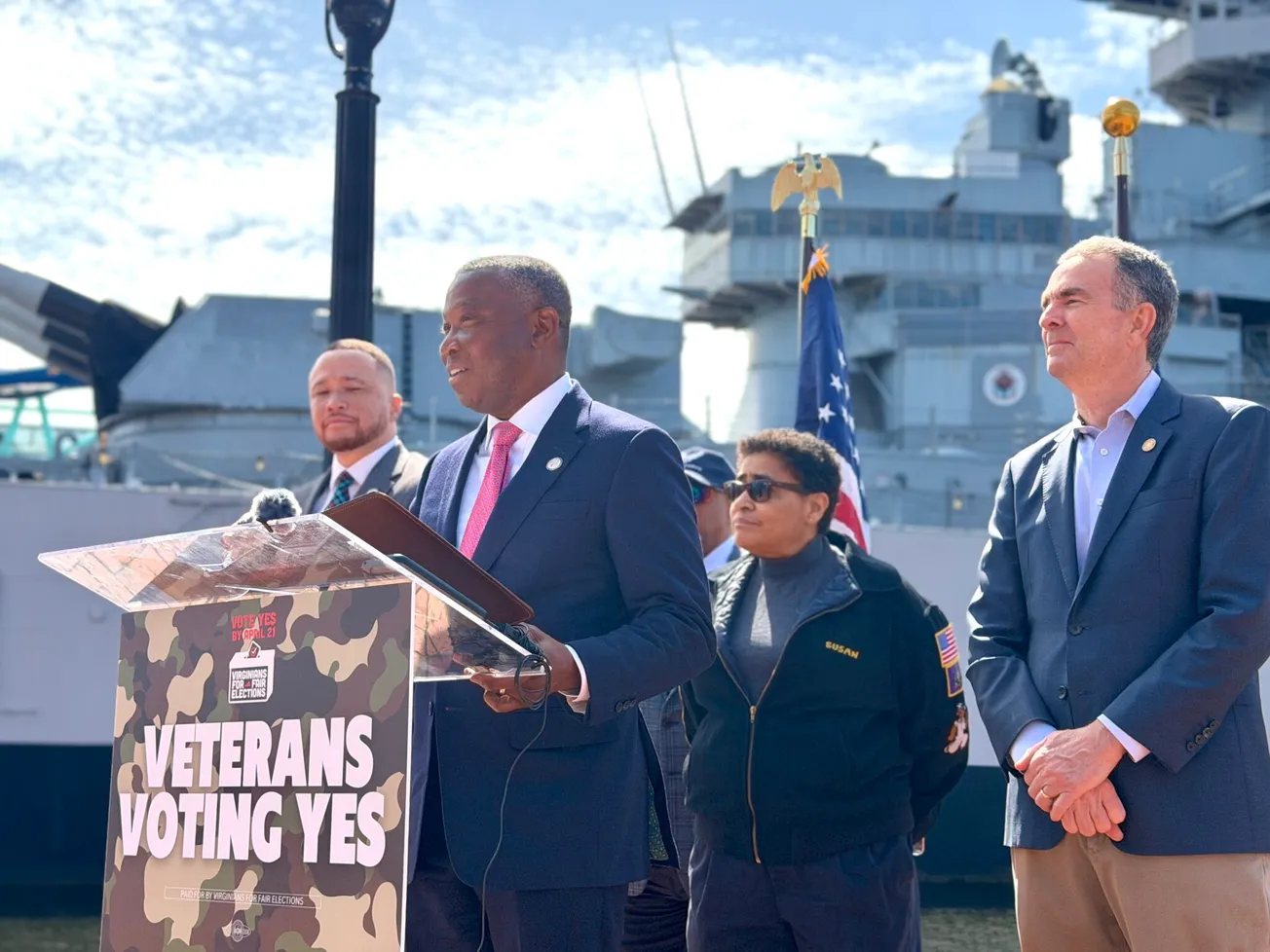
House Speaker Don Scott, D-Portsmouth, on Wednesday brushed aside concerns about early voting trends in Virginia’s April 21 redistricting referendum, arguing that despite stronger turnout so far in Republican-leaning areas, Democrats remain on track to prevail in an election that could reshape the state’s congressional map ahead of the 2026 midterms.
Speaking during a press conference featuring Democratic veterans in front of the U.S.S. Wisconsin in Norfolk, Scott pointed to voter data he said closely tracks past election cycles, signaling confidence within the party.
“If you look at our voter scores right now, the last cycle in 2025 at the same point of early voting, we were about 60-40 in voter profiles. Right now, it’s like 59-41,” Scott said. “We’re good. I feel very good about this election.”
The referendum, scheduled for April 21, asks voters whether to approve a one-time mid-decade redraw of Virginia’s congressional districts — an unusual step outside the traditional once-a-decade redistricting cycle.
Supporters say the measure is intended to counter Republican-led efforts in other states and give Virginians a direct say in how district lines are adjusted ahead of the next round of federal elections.
If approved, lawmakers would be authorized to revisit the current map, while the state’s bipartisan redistricting framework would remain in place for future cycles.
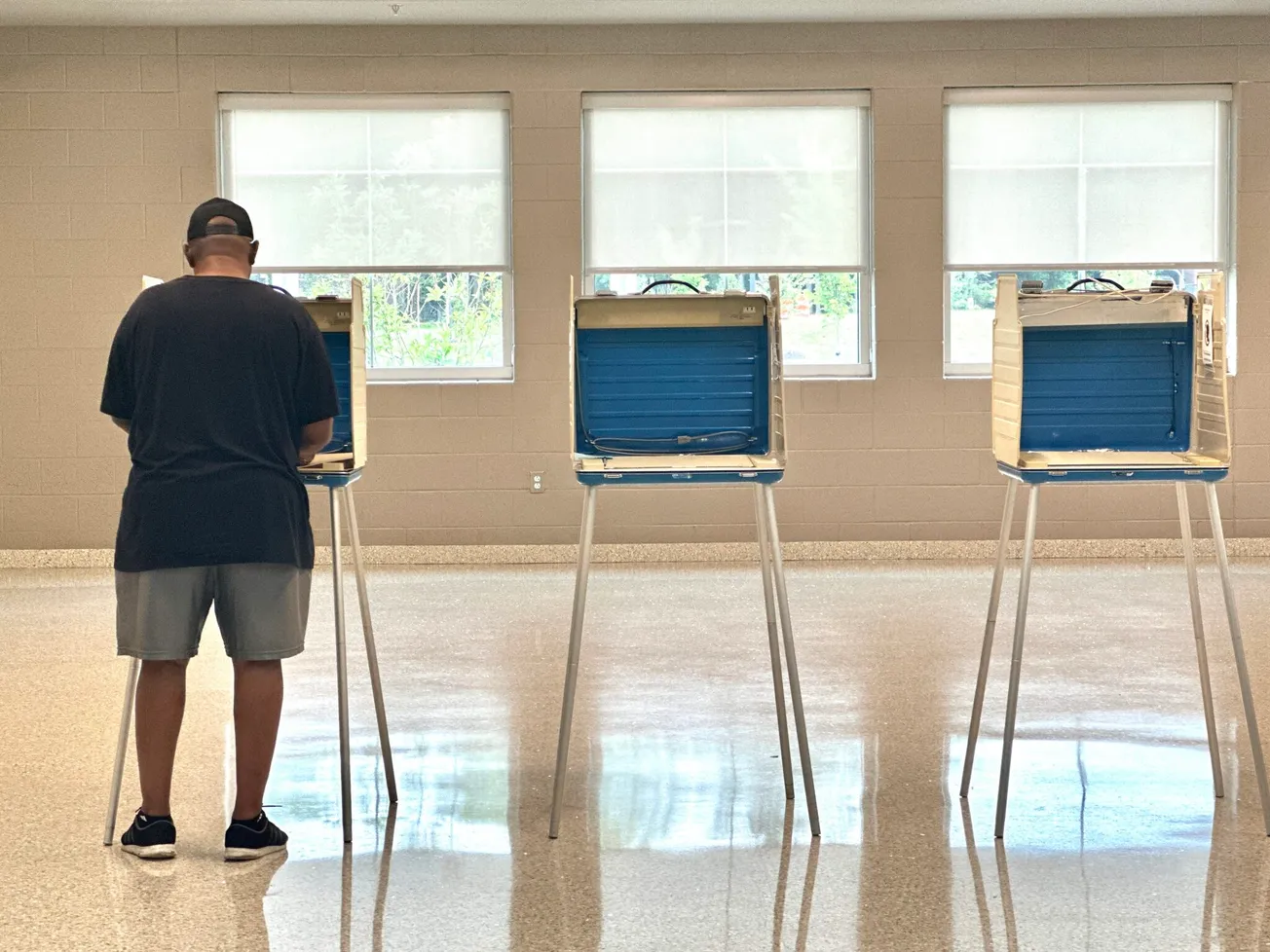
Early voting began March 6 after the Supreme Court of Virginia allowed the election to proceed, despite ongoing legal challenges over timing and ballot language.
Initial data has shown relatively higher participation in GOP-leaning localities, raising questions among some Democrats about enthusiasm in their base.
But with several weeks of voting left to go in a state, Democratic leaders emphasized that overall voter composition remains consistent with previous elections and that Democratic-leaning voters often cast ballots later in the early voting window.
Scott, a U.S. Navy veteran, was joined by other Democratic leaders with military backgrounds — including former Gov. Ralph Northam — who framed the referendum as both a political and constitutional issue, tying their support to their service and oath to defend the Constitution.
Northam, an eight-year U.S. Army veteran, said the measure is fundamentally about preserving democratic norms.
“There is nothing more important than fair elections and openness to voting,” Northam said, adding that Virginia has historically upheld peaceful transfers of power. He described recent developments as “a power grab, an attack on our democracy,” and said the referendum is meant “to level the playing field.”
Northam argued that failing to respond to redistricting moves in Republican-led states would leave Virginia at a disadvantage, saying Democrats cannot “sit back as a commonwealth” while others “stack the deck.”
“It’s about our democracy, saving our democracy, and stopping the power grab that’s going on from the MAGA-Republicans,” he said.
U.S. Air Force veteran Del. Michael Feggans, D-Virginia Beach, said his support is rooted in the same oath he took while serving, emphasizing the importance of protecting voting access.
“I also took an oath to defend the Constitution. That oath didn’t end just when I took off the uniform,” Feggans said. “Right now, we’re really living in what is not known as normal times.”
Feggans recalled voting from overseas while deployed, describing it as a powerful reminder of how important it is to ensure ballots are counted and voices are heard.
He said the referendum ultimately leaves the decision in the hands of voters, despite what he described as misinformation and efforts to undermine participation.
“One of the most important things we want people to know is that this is temporary, and the voters ultimately get to decide what happens,” he said.
Susan Hippen, chair of the Virginia Democrats Veterans & Military Families Caucus, connected the referendum to broader national dynamics, arguing that political instability and policy decisions in Washington have tangible consequences for service members and their families.
“The chaos in Washington isn’t just political, it has real impacts on our veterans and military families,” Hippen said, citing concerns about cuts to services, job uncertainty and military readiness.
She pointed to redistricting actions in states such as Texas and North Carolina, saying Virginia is now asking voters for permission to respond in kind.
“Protecting democracy isn’t separate from supporting veterans. It is directly connected,” Hippen said, adding that the referendum is about maintaining checks and balances and ensuring that “no one can rig the system.”
The proposal has drawn national attention and legal challenges, including disputes over ballot language and the timing of the vote.
It has also sparked controversy over campaign messaging, including civil rights-themed mailers that have prompted criticism from both parties.
Scott downplayed concerns that competing narratives could confuse voters, saying he trusts Virginians to sort through the information and make their own decisions.
“Virginia voters are smart,” he said. “I trust the voters. They’re going to get the right information, and they’re going to make the right choice.”
He framed the referendum as a broader response to national political forces, arguing that Virginians have an opportunity to assert themselves at the ballot box.
“This is Virginia, we don’t like kings,” Scott said Wednesday afternoon, three days before No Kings protest rallies against President Donald Trump’s administration are planned in multiple Virginia cities and across the nation.
“We have stood up, and we will continue to stand up. We’re not going to let somebody steal this next election.”
Virginia Mercury is part of States Newsroom, a nonprofit news network supported by grants and a coalition of donors as a 501c(3) public charity. Virginia Mercury maintains editorial independence. Contact Editor Samantha Willis for questions: info@virginiamercury.com.