
Skip to content

Spanberger urges action on democracy, costs in first address to Virginia lawmakers

Governor backs four constitutional amendments and outlines plans on affordability, housing, health care and energy

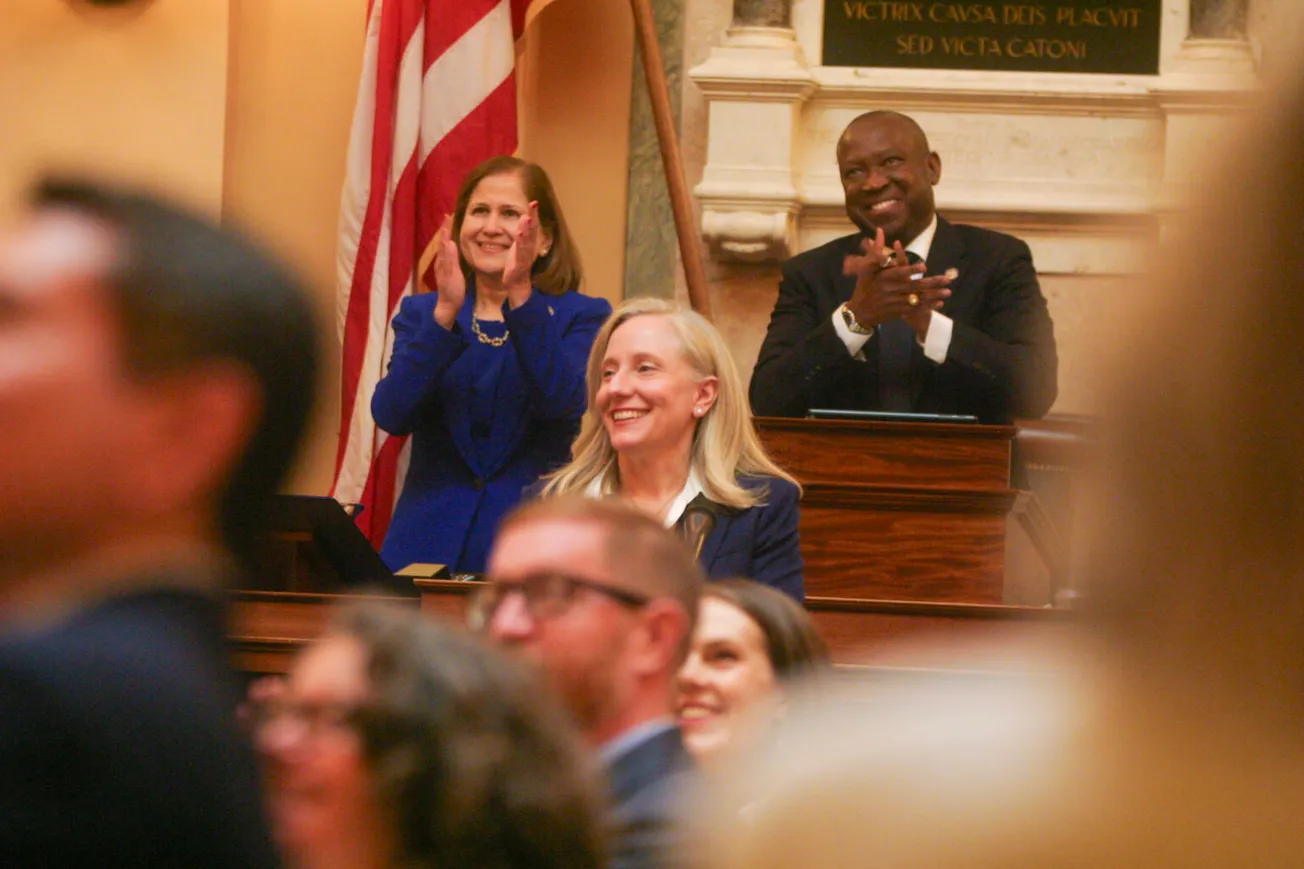
Gov. Abigail Spanberger gives her first address to the joint General Assembly on Jan. 19, 2026 in Richmond. (Photo by Shannon Heckt/Virginia Mercury)

Two days after taking the oath of office as the first woman to lead Virginia, Gov. Abigail Spanberger on Monday voiced strong support for a slate of constitutional amendments already approved by lawmakers and pressed for action on cost-of-living legislation, framing the moment as an early test of whether Virginia’s new political alignment can deliver results.

In her first address to a joint session of the General Assembly, Spanberger outlined her governing priorities and pressed for swift action on four Democratic-backed constitutional amendments, singling out a proposal that would allow lawmakers, under narrow circumstances, to redraw congressional maps mid-decade. 

She described the measure as narrowly tailored to counter what she said are growing efforts in other states to undermine democratic norms.

“Virginia’s proposed redistricting amendment is a response to what we’re seeing in other states that have taken extreme measures,” Spanberger said, emphasizing that any change would be “short-term, highly targeted, and completely dependent on what other states decide to do themselves.” 

Ultimately, she said, voters should have the final say.

Spanberger also voiced strong support for amendments protecting reproductive freedommarriage equality and automatic restoration of voting rights for Virginians who have completed felony sentences — all of which will now be on the ballot in November. 

Democrats have argued the measures are necessary to lock in rights they fear could be rolled back through future court rulings or shifting political control.

Beyond constitutional questions, the new governor used the address to press lawmakers to focus on affordability — an issue she repeatedly returned to as the defining challenge of her administration. 

She pointed to rising housing costs, prescription drug prices and energy bills as pressures cutting across regions and party lines.

“More than 70% of Virginians say they cannot find housing they can afford to rent or buy,” she said, rejecting claims that affordability concerns are exaggerated. “This is not a hoax. This is real life.”

Spanberger said executive actions she signed immediately after her inauguration are intended to jump-start that effort, including orders directing agencies to identify ways to cut costs for families and to review regulations that slow housing construction. 

But she also emphasized that lasting relief will require legislation.

To that end, she pointed to what she called an “Affordable Virginia Agenda,” asking lawmakers to move a package of bills aimed at lowering costs in health care, energy and housing. 

The proposals include new rules governing pharmacy benefit managers to push drug rebates back to patients, targeted assistance to offset rising Affordable Care Act marketplace premiums, and incentives to recruit health care providers to underserved areas.

On energy, Spanberger called for expanded energy storage, increased weatherization programs for low-income households and renewed commitment to a diversified power mix that includes solar, nuclear and offshore wind. 

She pledged to rejoin the Regional Greenhouse Gas Initiative, saying its proceeds previously helped fund flood mitigation and energy-efficiency programs. Her comments come as Virginia’s offshore wind project has faced renewed uncertainty amid federal actions. 

Housing proposals outlined in the speech included extending the period tenants have to respond to eviction filings, giving localities more flexibility to adopt affordable housing programs and creating a revolving loan fund to finance mixed-income developments.

Republicans offered a competing affordability vision following the address. 

House Minority Leader Terry Kilgore, R-Scott, said House Republicans agree that lowering costs should be the General Assembly’s top priority and pointed to their newly announced the GOP’s “Affordability Done Right” agenda, which includes eliminating the grocery tax, phasing out the car tax, making the higher standard deduction permanent, lowering power bills and expanding auto insurance options. 

If the governor “truly wants to make life more affordable,” Kilgore said, she should support those proposals.

In her speech, Spanberger also waded into debates over public safety and gun policy, calling on lawmakers to revive measures vetoed in recent years. 

She said she respects the Second Amendment but urged passage of bills banning ghost guns, restricting firearm access for convicted domestic abusers and strengthening “red flag” laws.

“These are commonsense measures,” she said. “Virginia is ready. And I am ready to sign. Send them to my desk.”

Education was another focal point, with Spanberger calling for higher teacher pay and renewed emphasis on reading and math instruction after Virginia ranked last nationally in math recovery. 

She said her administration would avoid what she described as culture-war battles in classrooms and instead prioritize academic outcomes and partnerships between parents and educators.

The governor also addressed higher education governance, announcing a review of appointments to boards of visitors and signaling support for reforms to prevent future administrations from politicizing university leadership — a topic that has generated intense scrutiny in recent months.

Woven throughout the speech was a warning about economic turbulence stemming from Washington, including federal job cuts, trade policies and their ripple effects on Virginia’s economy. 

Spanberger said she has created an Economic Resiliency Task Force to assess the damage and recommend responses, particularly for displaced federal workers and rural communities affected by declining exports through the Port of Virginia.

While emphasizing bipartisanship — noting she was ranked among the most bipartisan members of Virginia’s congressional delegation — Spanberger said she would not shy away from confronting federal actions she believes harm the commonwealth.

“When federal actions attack and threaten Virginia jobs, I will not hesitate to push back,” she said.

She closed by invoking the Rev. Martin Luther King Jr., whose holiday coincided with the address, urging lawmakers to reject political intimidation and dehumanization and to model a different approach to governance.

“Disagreement need not mean contempt,” Spanberger said. “Before anything else, we are all Virginians.”


Virginia Mercury is part of States Newsroom, a nonprofit news network supported by grants and a coalition of donors as a 501c(3) public charity. Virginia Mercury maintains editorial independence. Contact Editor Samantha Willis for questions: info@virginiamercury.com.

Comments