Skip to content

Schedule changes coming to Staples Mill Amtrak station ahead of new Potomac River bridge construction

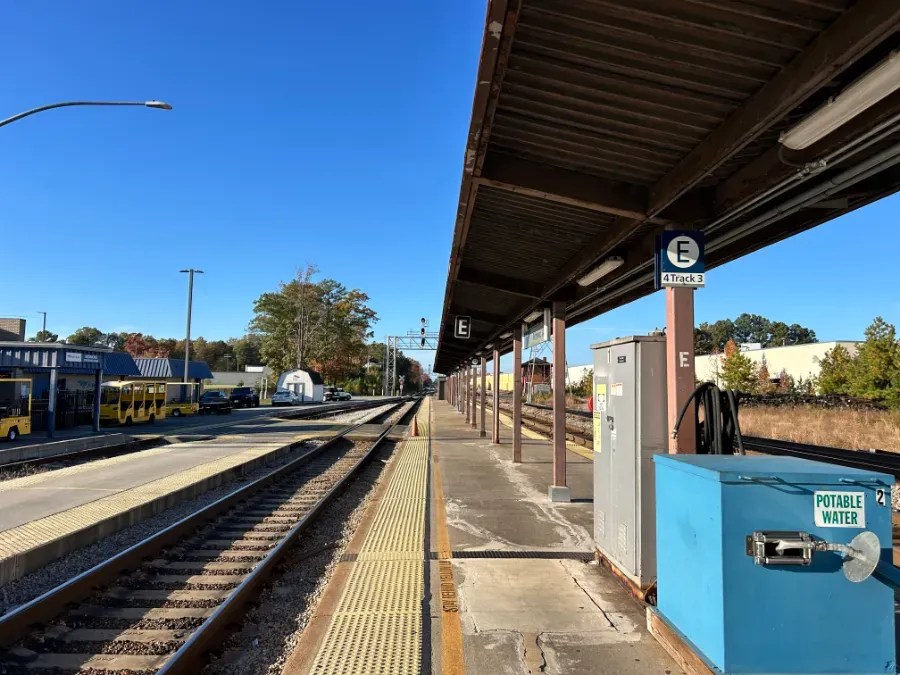
The Richmond Staples Mill Road Amtrak station in Henrico County. (Seraina Caviezel for the Henrico Citizen)

Table of Contents

Passenger rail service changes for travelers between the Staples Mill Amtrak Station and Washington, D.C. are being implemented in mid January, to accommodate construction of the Long Bridge Project on the Potomac River.

The Long Bridge Project is a 1.8-mile rail improvement that will relieve what the Virginia Passenger Rail Authority calls one of the biggest rail bottlenecks on the East Coast, causing numerous delays. 

“The project is going to construct a number of bridges,” said Gerica Goodman, VPRA director of external affairs. “The first one is the Long Bridge Project that’s going to construct a second rail bridge across the Potomac, and then a series of connecting bridges into D.C. that will double the rail capacity. This is the beginning of the separation of passenger and freight rail lines in D.C. with the Long Bridge project."

(Courtesy Virginia Passenger Rail Authority Long Bridge Project)

The Long Bridge Project will create a continuous four-track corridor. The current Long Bridge is a CSXT owned two-track, century-old bridge that spans the Potomac River in Washington, D.C.

As part of the 1.8 mile corridor of improvements, the Long Bridge Project will add a new two-track rail bridge next to the existing CSXT owned rail bridge, separating freight and passenger trains. The flagship project of the state’s Transforming Rail in Virginia initiative to expand rail in the commonwealth also includes two new pedestrian and bicycle bridges .

For Staples Mill station passengers, that will mean that during the Long Bridge Project construction, one daily roundtrip between Washington, D.C. and Main Street Station (that also stops at Staples Mill) will be cancelled.  In addition, one daily roundtrip between Washington, D.C. and Norfolk (that includes a stop at Staples Mill) also will be cancelled.

In addition, one Washington D.C.-to-Norfolk daily roundtrip will be cancelled, according to VPRA Communications Manager Karina Romero. 

"There will still be two daily roundtrips between Washington D.C. and Norfolk and two daily roundtrips between Washington, D.C. and Newport News each day," Romero wrote to the Henrico Citizen in an email.  "The two daily round trips from Newport News to D.C. will continue to call on Main Street and Staples Mill Stations.  The two daily round trips from Norfolk will continue to call on Richmond Staples Mill as well [during the construction period]."

Image of construction timeline of Virginia Passenger Rail Authority projects presented during the VPRA October board meeting. (Courtesy VPRA)

During the construction period, trains cannot enter from or leave Washington, D.C. southward between 8 a.m. and 1 p.m. So trains that currently are scheduled to arrive and leave Union Station between those times will be shifted earlier or later.

Another change starting in January will be direct bus service between Norfolk/Newport News and Washington, D.C. to accommodate passengers seeking a non-stop ride to D.C. 

VPRA made the announcement at the beginning of this month to let passengers know about the years-long construction projects, which are meant to improve rail travel, making it a more efficient and attractive way to travel.

The completion of the Long Bridge and other TRV projects will bring about generational changes in passenger rail for Virginians, benefiting both passenger rail and freight traffic nationally, according to a VPRA press release.

The VPRA was established in 2020 to promote, sustain, and expand the availability of passenger and commuter rail service in the Commonwealth. VPRA is focused on delivering and expanding its state-supported Amtrak Virginia passenger rail service.  Virginia first launched state-supported service in 2009 with one roundtrip between Washington, DC and Lynchburg according to web materials. Since then, Virginia’s service has grown to include eight roundtrips daily with stops at 17 stations in Virginia plus Washington, DC along four corridors. 

(Courtesy Virginia Passenger Rail Authority Long Bridge Project)

The Staples Mill Road Amtrak station is the busiest in the Southeast and the state of Virginia. In 2024, it had the highest ridership in both categories, with more than 461,800 passengers. August 2025 passenger numbers for Staples Mill station totaled 17,800 people embarking and 17,000 passengers disembarking.

In 2024, Amtrak operated an average of about 29 intercity trains per day on eight permanent routes serving Virginia, with 2.3 million total passengers boarding or alighting in the state.

State-supported trains that go through the Staples Mill station include the Carolinian. Virginia Northeast regional train routes that go through Staples Mill and on to Washington, D.C. also include the Norfolk, Newport News and Richmond lines.

During construction, the morning trains from Norfolk and Newport News to Washington, D.C. will be replaced by earlier express buses that will not make a stop in Richmond. Route 51 which stops at both Staples Mill and Main Street Station is cancelled during construction.  That is the one daily round trip from Richmond Main Street.

The long-distance trains that traverse through Staples Mill and on to Washington, D.C. include the Auto Train, the Palmetto route to Savannah, and the Silver Meteor and the Silver Star, which both end up in Miami.

Screenshot schedule of trains stopping at the Staples Mill Amtrak station to Union Station in Washington, D.C. on Friday, Dec. 5, 2025. (Dina Weinstein/Henrico Citizen)

Work windows begin Jan. 12

As the Long Bridge Project enters full construction, Washington, D.C. requires major construction activities to occur during daytime “work windows.” VPRA has coordinated service planning efforts with Amtrak, NCDOT, CSX, NS, and VRE, which have jointly developed a plan to preserve service.

Work windows will begin Jan. 12 and will continue until the project’s completion in 2030. Schedule changes seek to preserve optimal times for Amtrak service while protecting the highest ridership “peak” for VRE’s morning and evening commuter trains. CSX has also rescheduled its freight traffic to accommodate the work window.

“While we are thrilled with the progress of the Long Bridge Project, we understand that these necessary service changes will be difficult for a number of our passengers,” VPRA executive director DJ Stadtler said in a press release.  “We want those passengers to know that we did not take these decisions lightly, and we evaluated every possible scenario to limit the disruptions while providing our construction teams with the work window they need to safely complete the project on time and on budget.  Our goal is to offer as much service as possible while working to upgrade our infrastructure, with the final result being more rail service throughout the Commonwealth.”

The short-term hardship is viewed by experts as beneficial in the long-term.

According to Tom Shaw, communications manager with the Greater Washington Partnership, driving north out of Richmond toward D.C. has become increasingly time-consuming.

Shaw cited a 2025 Texas A&M Transportation Institute Urban Mobility Report, showing the average commuter in the Richmond metro region spent about 42 hours per year delayed by traffic, representing a post-pandemic high. Meanwhile, D.C. continues to rank among the most congested metro areas in the country according to a recent article in the Washington Post.

"Two decades ago, driving between Richmond and D.C. may have been a relatively congestion-free drive, but it increasingly takes more time, especially in peak periods and through Northern Virginia, making rail, transit, and express lanes often more desirable options," Shaw said.

Long Bridge project designed to relieve rail bottleneck

Annually, as many as 2 million Amtrak passengers and 3 million VRE commuters traverse the current Long Bridge, which operates at 98% capacity during peak hours.

The purpose of the $2.7-billion project is to create greater railroad capacity between Virginia and the District of Columbia while alleviating the rail congestion caused by the existing two-track Long Bridge.

That congestion also causes delays. At an Amtrak board meeting this summer, officials reported ridership up along with delays, especially on long haul routes. Amtrak has a permanent webpage up grousing about how freight companies, which own tracks, cause the passenger lines to face delays.

“The major benefit is that separation of passenger and freight, because CSX owns the rail lines for the commuter VRE and Amtrak, the passenger service, they have to share the corridor with freight,” said Goodman.

“That results in additional congestion, especially coming out of D.C. when it's at peak hours, the bridge is already at capacity, so we can't add any new trains. If there's ever any issues, it causes schedule delays. If there's one train delayed, then all trains are delayed because there's no way to get around that bridge. So when we add a second bridge and this additional infrastructure, it allows us to not only alleviate that congestion, but to add 13 new round trips for Amtrak Virginia and additional VRE service up in Northern Virginia.”

Virtual Flyover of the Long Bridge Project. This animation illustrates the planned new two-track rail bridge that will run parallel to the existing Long Bridge, as well as related improvements between Arlington and DC. Together, these enhancements will reduce congestion, support economic growth, and advance sustainable transportation across the region. (Courtesy VPRE YouTube channel)

Screenshot of Long Bridge construction photos from VPRA October 2025 publication.

Largest railroad construction project in decades

As train riders cross the Potomac, they can observe the base construction of the Long Bridge project, which VPRE staffers categorize as “one of the largest railroad construction projects undertaken in the Commonwealth in decades.” 

Goodman said VPRA and its partners will continue to measure performance and update the schedules as operating conditions change along the rail network.

“While we have a schedule, if something we find is not working, we will evaluate and make necessary changes when we have to,” Goodman said.


Dina Weinstein is the Citizen’s community vitality reporter and a Report for America corps member, covering housing, health and transportation. Support her work and articles like this one by making a contribution to the Citizen.

Comments