Parents demand answers after Henrico Virtual Academy eliminates grades K-2
Just after noon on Monday, Feb. 9, instructional assistant Stephanie Bell received a phone call from Henrico Virtual Academy’s principal saying that the combined Kindergarten and first grade class she co-teaches would shut down at the end of the school year.
During the next hour, all parents who had enrolled their children in HVA’s 2026-2027 kindergarten, first grade, and second grade classes received the same phone call. When Bell logged back on to her computer after lunchtime, she saw her students’ faces wet with tears on her screen.
“All of our kids were crying, literally hysterically crying,” she said. “Because now they know they’re not going to have their teachers next year.”
Henrico Schools’ decision to permanently close HVA’s grades K-2 came as a huge shock to parents. The closure was announced just three days after the virtual school hired its new principal Bradley Fernald, and “conspiracy theories” quickly circulated among parents.
“I got the call and was like, ‘wait what is going on?’” said Elie Mora, who has a daughter in kindergarten at HVA. “It was so very rushed, and all the information was just thrown at you in less than two minutes.”
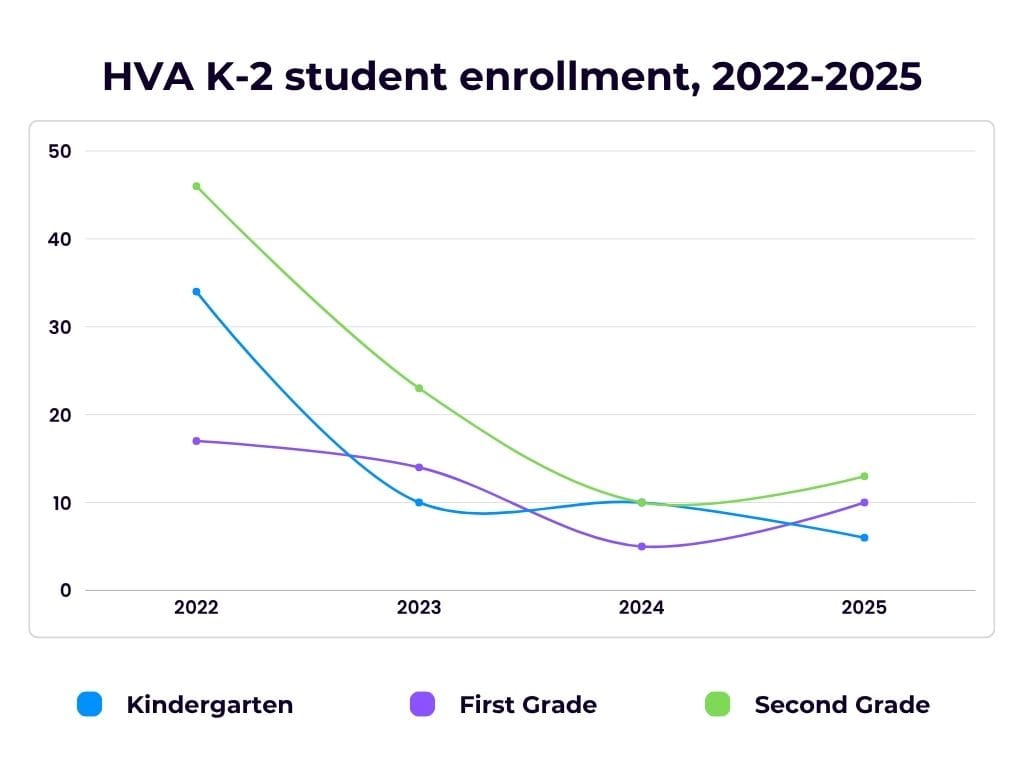
HCPS’ decision to close grades K-2 was solely based on the program’s declining enrollment during the past few years, said HCPS spokesperson Eileen Cox.
HVA, which launched as Henrico’s first-ever K-12 fully virtual school in 2021, had a kindergarten enrollment of 17 students in 2022, but shrunk to 10 students in 2025. From fall 2022 to fall 2025, HVA’s first grade and second grade classes went from 34 students and 46 students to only six students and 13 students respectively.
During HVA’s application window for new students from Jan. 5 through Jan. 30, only nine students applied and were eligible for the kindergarten class. That number fell below Henrico’s average 19:1 student-to-teacher ratio for elementary school classes this school year, Cox said.
“School administrators monitor school enrollment annually and have noted lower participation in grades K-2 over time,” said Cox. “Decisions regarding HVA class/course offerings are made based on enrollment, just as they are at all schools in Henrico.”
HCPS’ in-person schools are “ready to welcome HVA students to their buildings,” Cox said. But many HVA parents are hesitant to send their children in-person, with some parents stating that in-person schools are simply “not an option” for their families.
“I can speak for myself and my son, I don’t know what we’re going to do if this program closes down. But in-person is definitely not an option,” said Tamika Washington, who has a son in kindergarten at HVA. “So if they’re going to come with the handcuffs, I’ll be at the front door, but I will not put my son through any mental anguish or anything that’s going to set him back.”
“It would be detrimental for my son, he doesn’t learn the same as his sister and gets very frustrated and distracted. He has extreme anxiety. I’d probably be picking him up from in-person school every day,” said Megan Fuller, who has a son and a daughter in kindergarten at HVA. “So we’re kind of stuck. I’ll have to homeschool them.”
Parents fear students will 'fall through the cracks' at in-person schools
Bell joined HVA as an instructional assistant last year, just as the school decided to combine the kindergarten and first grade classes due to lower enrollment. Bell’s own daughter is a second-grader in the online program.
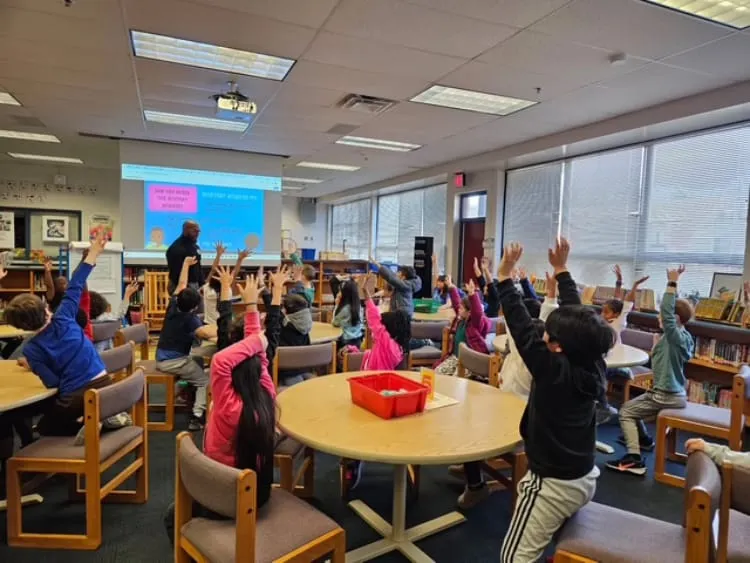
Students log on to their computers for a full day of learning and interaction with their teachers and classmates every day, getting the same academic and social experiences as their in-person peers but with the safety and comfort of being in their home, said Bell. Classes will also gather in-person every so often for testing, field trips, or other bonding activities.
“It’s like no other school, what Henrico Virtual Academy offers. We’re a village. These children are in my home, and I am in their homes with them every day. We share that connection,” Bell said. “All of us come from different backgrounds, from different areas of the county. We serve as far out in the West End as you can go all the way to the East End.”
HVA currently hosts a total of 503 students in grades K-12. The majority of the student population, about 57%, is Black, and nearly 60% of students are economically disadvantaged.
Many of the students in Bell’s class struggle with social-emotional challenges such as anxiety and other learning or behavioral challenges that make them prone to being easily distracted or frustrated, she said. Among a class of 10 kindergarteners, eight students needed intervention resources, with six of those students being labeled “high-risk.”
But by February, with Bell and her co-teacher conducting intervention sessions every day with all eight students, four of those students no longer needed intervention resources and the other four only required moderate intervention. All kindergarten and first grade students were also reading at the next grade level and ready for a smooth transition next year, Bell said.
After her older daughter dealt with bullying at her in-person school, Tamika Washington decided to enroll her kindergartener in HVA and immediately saw the benefits.
“I have seen him blossom into this bright young man. He’s very smart, he’s caring, he’s loving, and he’s learning all of these things from just being in this group with Ms. Bell and Ms. Mayer,” she said. “His classmates, they take care of each other. I love where he’s at and I can’t wait to see where he will go if this program continues.”
'I'm not putting my kids through any of that trauma again'
Despite being fully online, students experience no lack of socialization, said Jennifer Spears, who has a first-grader and third-grader in the program. Once classes are over, students flock to sites like Roblox or Minecraft to play video games with each other, often being joined by their older classmates and siblings.
“Up until now, they had no friends playing on PlayStation. Now, they have friends, it’s the whole class, I mean even the whole school,” Spears said about her children. “After school, it’s a party. The fourth graders will play with the third graders, building on Minecraft or Roblox together, just having fun.”
Bell worries that if sent to in-person schools, some of her students would “completely shut down” and be unable to function in their new classrooms. Many parents share the same concerns, afraid that pulling their children out of the virtual environment they’ve already acclimated to would completely disrupt their education and cause behavioral problems.
“My son Gabriel, he’s cautious with people. He has anxiety and loud noises really trigger him and cause him to shut down,” said LaVoria Jefferson, whose son Gabriel is a kindergartener at HVA. “Going in-person, I don’t think he can handle it with all the extra noises around him. If he goes to a regular school, I don’t think he’s going to sit still. He’s going to get very distracted and have a meltdown.”
Megan Fuller, who has twins in HVA’s kindergarten class, said her older son’s experience at Henrico’s in-person schools was “traumatic,” especially because of frequent school lockdowns, and is afraid her younger twins will have similar experiences. She also said she fears her children would not receive the same individualized attention.
“When my fourth-grader did in-person school, the school was always broken down, always no air conditioning or heat. It was always a hot mess. They had lockdowns four times while he was in elementary,” Fuller said. “I’m not putting my kids through any of that trauma again.”
Spears remembers taking her first-grader and third-grader to an in-person school for gifted testing one day. When the security officers stopped her children and instructed them to walk through the school’s weapons detectors – a daily practice for all elementary-schoolers at Henrico’s in-person schools – she could see the visible fear and confusion on their faces.
“They walked through the metal weapons detectors. We’re Black. They were scared. And I couldn’t justify or explain to them why they had to do it,” Spears said. “They’re so naive but so innocent. And to open them to that, it’s like we’re setting our kids up to be exposed to evil.”
Other virtual options come with a price tag
HVA teachers who will be impacted by the closure will be placed at in-person schools starting this fall, said Cox, and HVA’s non-full time employees can apply for any roles open in HCPS.
HVA students also have another option: enrolling in “Virtual Virginia,” the state’s K-12 online education program. But the cost for K-5 students would be $5,500 per year – a price some HVA parents said they would be unable to afford.
Several parents also said that on their initial phone call with HVA Principal Fernald, he had said that HCPS would be willing to assist parents with Virtual Virginia tuition expenses – but parents later heard from other HCPS officials that this would not be the case.
Cox said that while Fernald had offered parents “assistance with researching other virtual programs,” he did not specifically offer “financial assistance.” Families would be responsible for any costs related to Virtual Virginia if they chose to participate in the program, she said.
With a current combined class of 16 kindergarten and first grade students, HVA falls below the average 1:19 student-to-teacher ratio in Henrico’s elementary classrooms. But Henrico has a wide range of average class sizes, with the higher end being 25 students at some Far West End schools and the lower end being 11 students at less-populated schools in Varina.
The Code of Virginia identifies 1:24 as the ideal student-to-teacher ratio for grades K-2, a metric also used by HCPS. But currently no Henrico school reaches that average.
“There are 46 elementary schools in the county. I called almost all of them to find out how many kids they have in their kindergarten class,” Bell said. “Do you know how many of them have 24 kids in their current class? None of them.”
Without involving HVA teachers and parents in the decision to close grades K-2, HCPS has failed to factor in students’ unique individual needs, said Fuller. Every student learns differently, she said, and every student should be given a learning environment where they will be able to succeed.
“It’s really negligent of the school board to just leave our kids hanging like this, leaving their education hanging,” she said. “It’s their job to be there for our children, more importantly than anything else, and they have not. They have failed to do so in this case.”
Liana Hardy is the Citizen’s government and education reporter. Support her work and articles like this one by making a contribution to the Citizen.