Lacking drivers, certain GRTC routes set to run less frequently
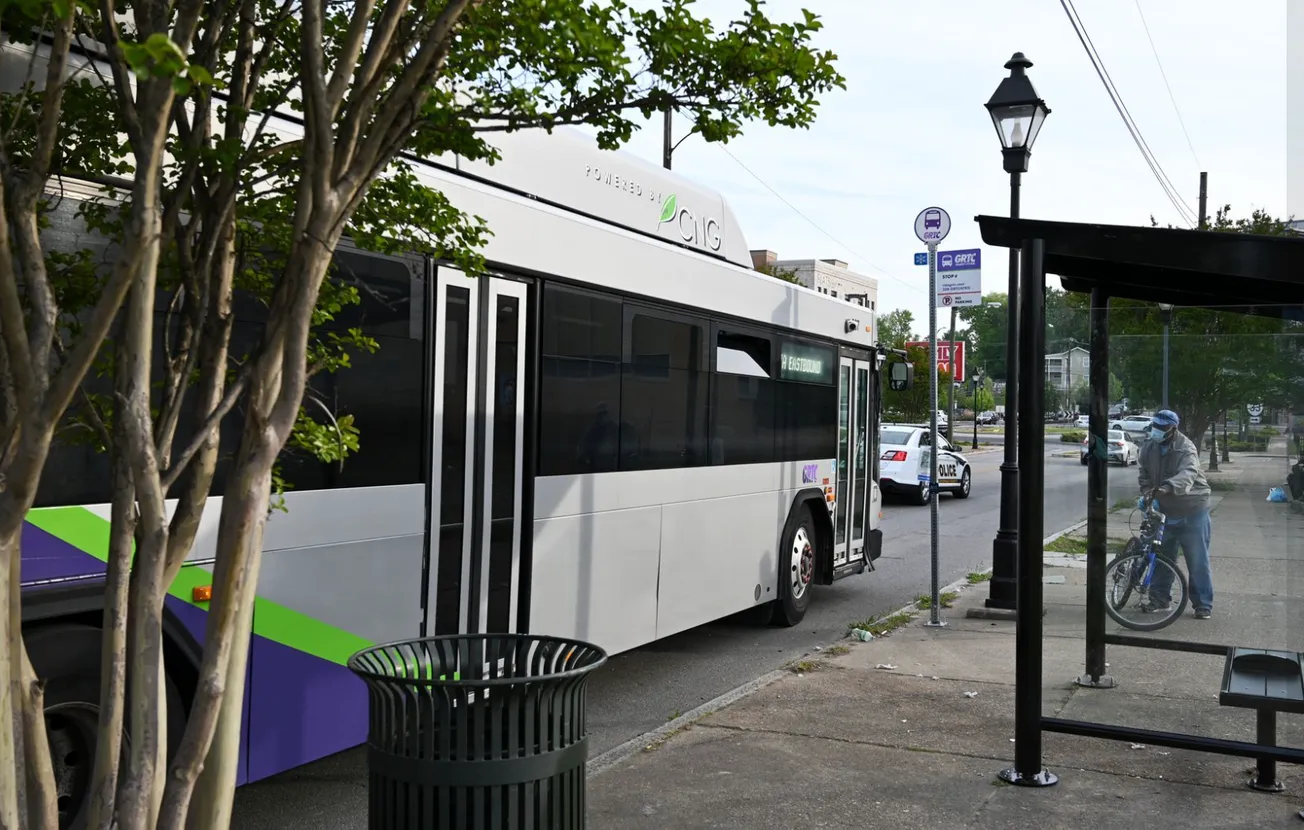
The Greater Richmond Transportation Company board voted recently to approve proposed bus scheduling changes that impacts five Henrico County routes starting on Sunday, Feb. 22.
The Henrico County GRTC routes slated for cutbacks include:
• Routes 7A and 7B (Nine Mile/Airport);
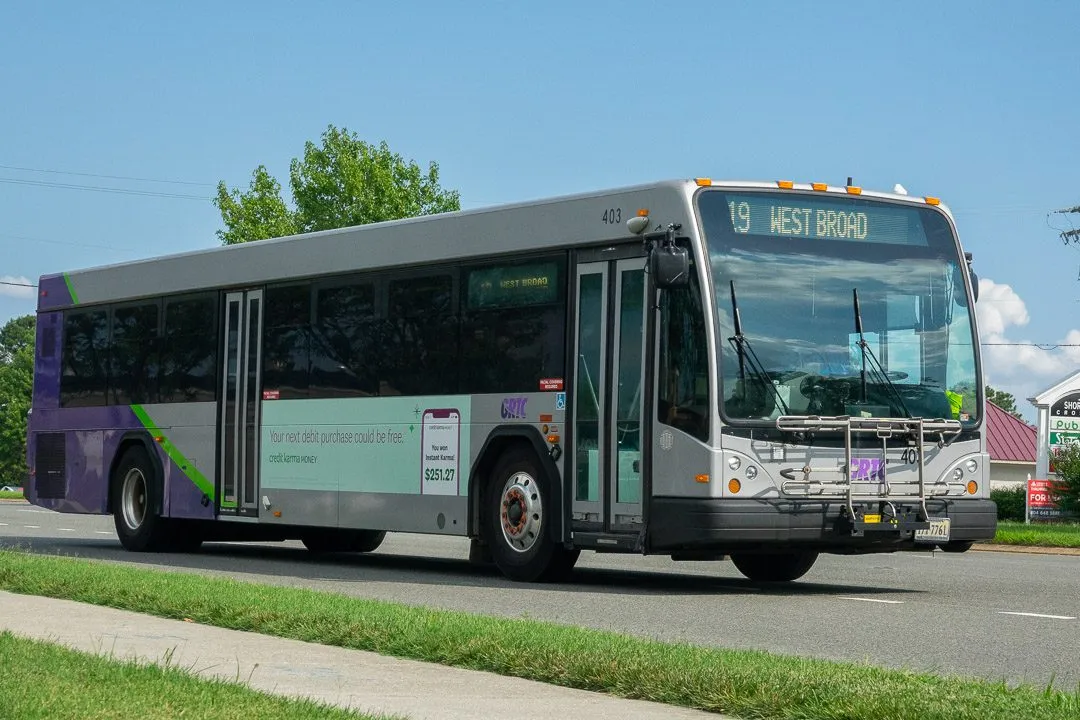
• Route 19 (West Broad Street);
• Route 76 (Patterson);
• and Route 79 (Patterson/ Parham).
“These changes are primarily night and weekend and focused on low ridership trips in the evenings,” GRTC Assistant Director of Planning and Scheduling Patricia Robinson said during a presentation at the monthly GRTC board meeting Feb. 10.
“We have a lot of same day cancellations because we're not able to have enough operators right now for our current level of service. So, these reductions are necessary to give people reliable and dependable transportation. By cutting specific nights and weekend service, we're able to mitigate the impacts.”
The issue leading to route cutbacks is not a budget issue, but rather a lack of drivers.
GRTC staffers told board members they are short 26 drivers, to fully staff the region’s crucial public transportation system which includes 33 fixed express and local routes. In 2025, riders took more than 12 million trips.
Currently, 300 drivers maneuver the region’s buses, microtransit and paratransit services.
Leaders attribute the shortage of drivers to attrition and the fact that the GRTC did not run driver training classes during June, July and August of 2025.
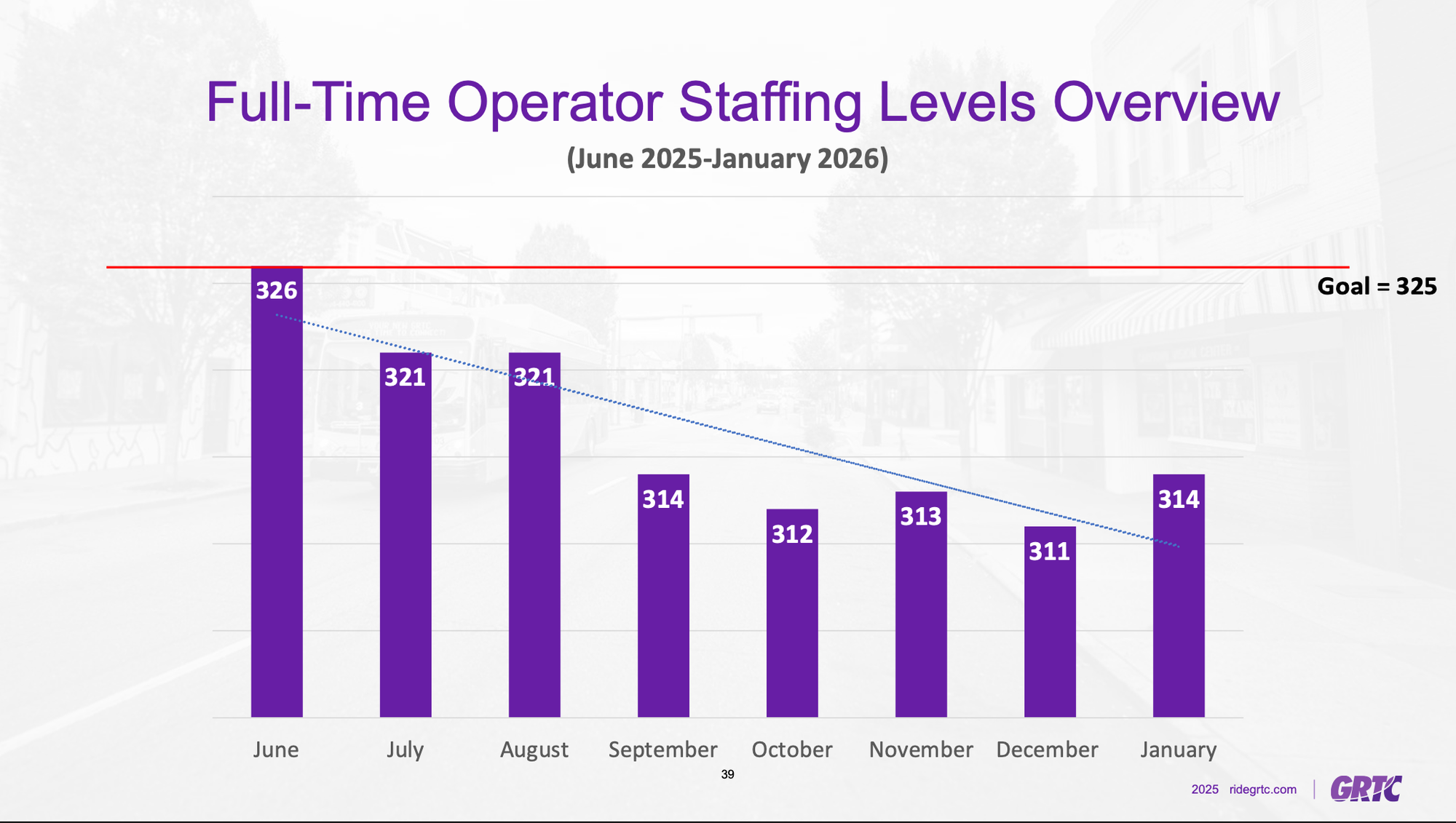
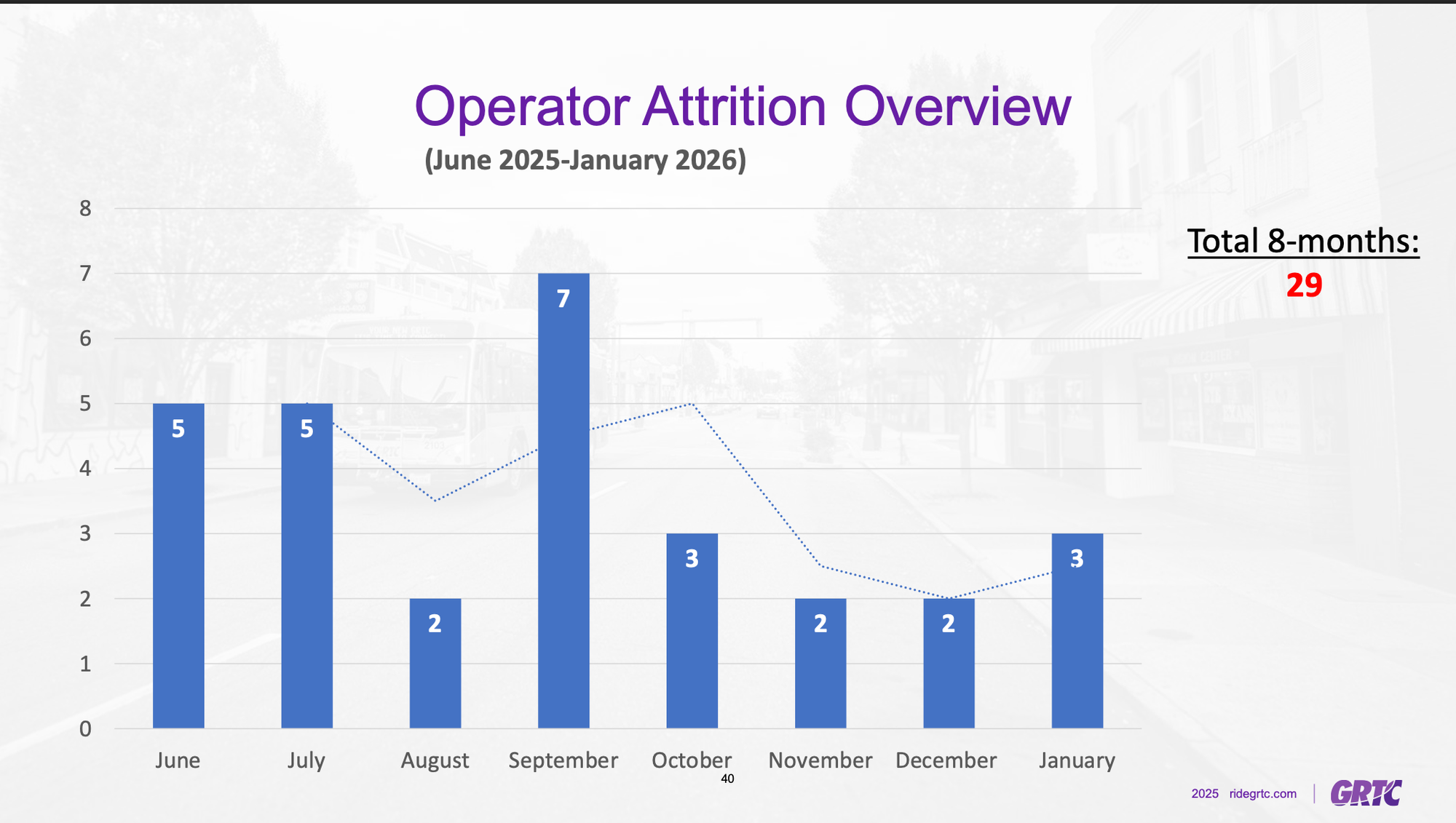
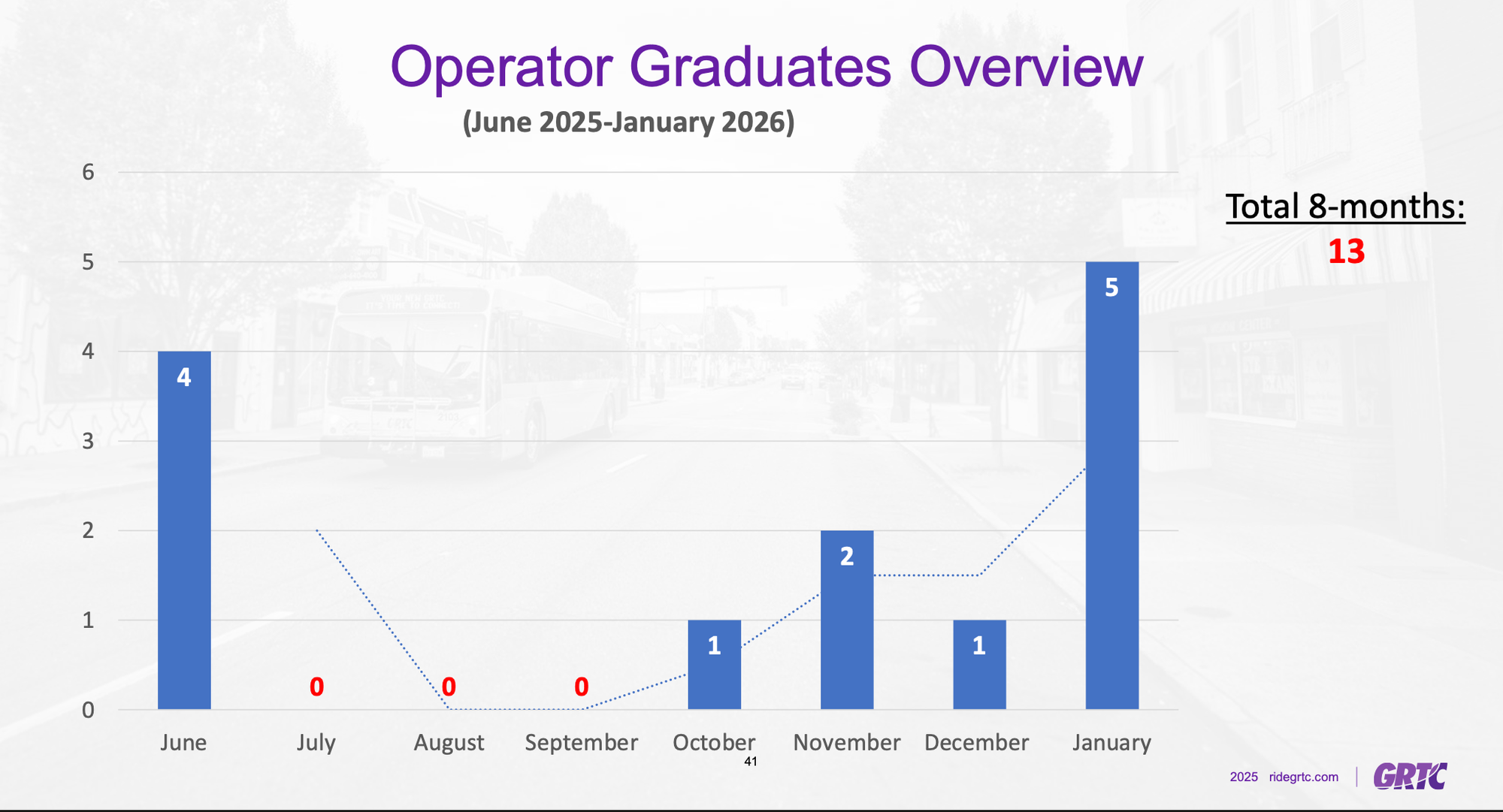
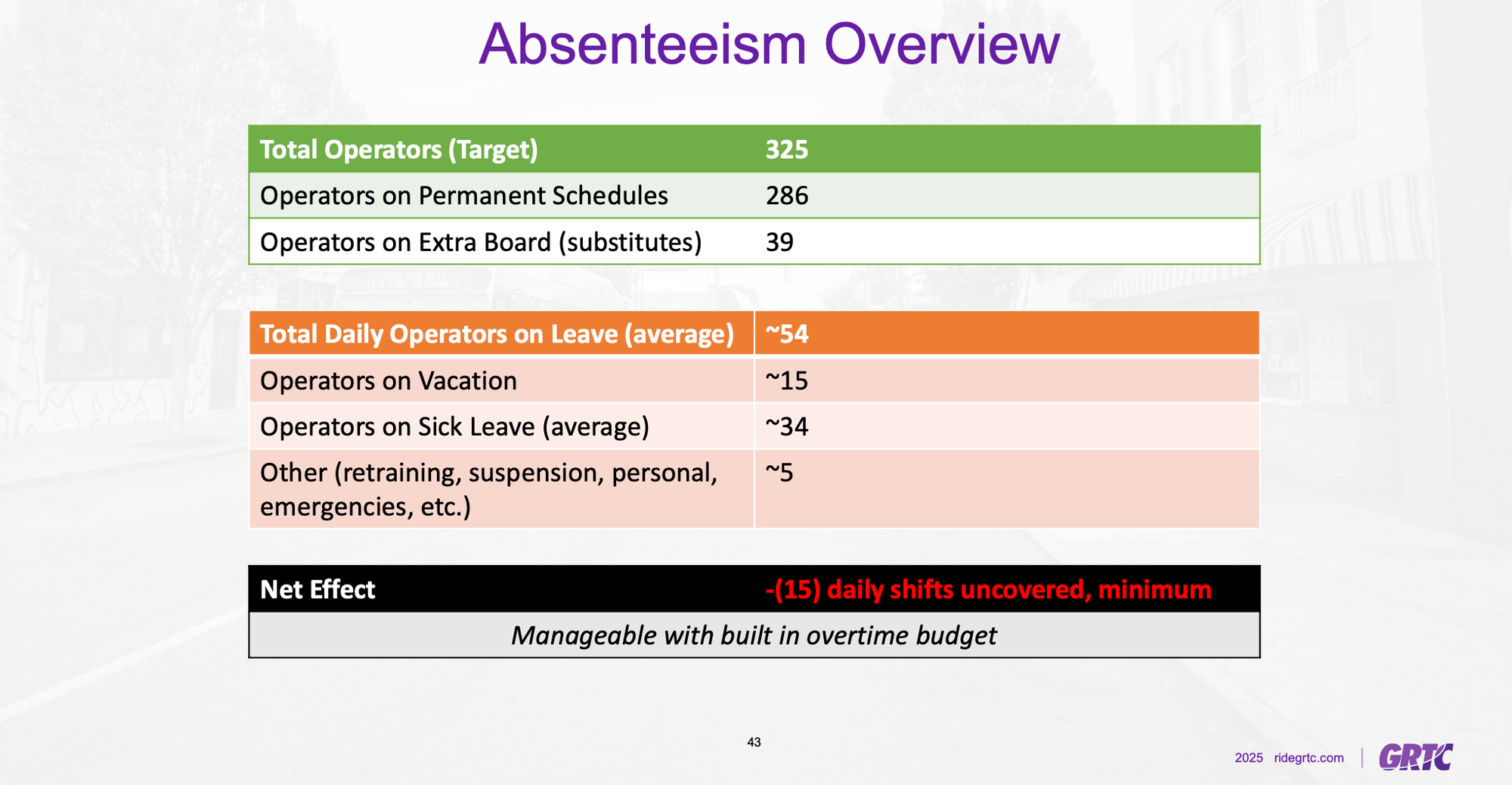
Operations report data at the the monthly GRTC board meeting presented by Christian Hernandez, GRTC COO, explaining the shortage of bus drivers in the system forcing service cutbacks.
Robinson told the board that GRTC staff identified trips on routes to be cut that had low utilization.
“This time last year, we were missing about 30 trips a month. We're up about 30 trips a day that we are cutting. So those are times that people are waiting for a bus, which is not coming,” Robinson said.
“We looked at the max load capacity on either side of the trip to make sure it could accommodate additional riders as people chose those trips. These impacts are aimed at getting our most bang for the buck here. How do we help the operator shortage as much as we can while reducing impacts to our riders?”
Robinson said the impacts are temporary and that as soon as GRTC has more operators come on board, the trips that were cut would be added back in.
“Gradually each month we've been losing operators,” said Sheryl Adams GRTC CEO. “It did not happen overnight. Part of it is, we stopped classes for a couple of months. So that's a lesson learned where we will continue to have classes.”
Adams said GRTC started driver classes in January and has another full class starts in two weeks. GRTC has increased the driver class size to 12 and is considering adding more classes each month. With a $25.55 an hour salary, the GRTC bus operator job description says a CDL or CDL Learners Permit with a "P" endorsement is required for the role.
GRTC Chief Operating Officer Christian Hernandez detailed the training and staffing shortcomings in his operations report, which showed increase absenteeism, staff taking Family and Medical Act and vacation time impacting driver staffing.
Board members admonish GRTC staff
Board members at this month's GRTC board meeting both admonished GRTC staff on the situation that is now leaving riders in the lurch.
“One thing people expect is for us when they show up at a bus stop or when they're depending on transportation, that they're able to receive it and access that transportation,” said Odie Donald, II, Richmond's chief administrative officer.
Richmond City Councilmember Ellen Robertson said GRTC’s top priority must be delivery of service.
“That's why we exist,” Robertson said.
The issue was on the agenda of the January GRTC board meeting, which was abruptly cancelled as the result of insufficient public notice.
“The biggest concern I have over anything is what sounds to be very thin margins for healthy operation and on time delivery of our product versus, it doesn't seem like there's a lot of room for error if there's people that aren't calling in or that aren't coming in,” said Brookland District Dan Schmitt, one of Henrico's representatives on the agency's board. “We need to talk more about what a healthy margin is so that we're not looking at this, because this seems to be a potential for repeating if those end margins are there.”
GRTC board chair and Varina District Supervisor Tyrone Nelson, another of Henrico's representatives, questioned whether GRTC’s culture might be an issue, leading drivers to call out. He urged GRTC to investigate the issue and to develop a strategy about how to change and deal with it.
Commuters 'forced to make tough choices'
Jacob Sherrod, who is involved in the Strong Towns RVA organization, said he frequently uses Route 19.
“I would be sad to see a service reduction on that line, especially in the face of additional cuts elsewhere on Broad Street. The Pulse midday service frequencies were also reduced,” Sherrod said. “Folks with no other option will be forced to make tough choices if these service cuts go through. Transit is so much more than just a service of last resort for folks with no other options, but we can’t forget that transit can be a lifeline for those with no other option.”
Sherrod thinks higher pay would make it easier to attract and retain qualified drivers, and more funding for GRTC from the Central Virginia Transportation Authority would help.
“The current CVTA regional funding allocation rules make it much easier for new highway projects to receive funding than for funding to go to transit and other non-highway projects,” Sherrod said. “If we want to avoid having to cut funding for transit, we need to change the rules so that the value of transit to our region is fully reflected in the projects the CVTA supports.”
One rider sent in a comment asking the GRTC board not to cut her busy bus route as it would dramatically impact her mobility.
A handful of people attended a public meeting with GRTC staffers Monday night focusing on the service changes. One Henrico resident questioned GRTC’s transparency. He asserted the routes that are being cut make up neighborhoods that are 40% more likely to be minorities and up to 70% more likely to be low income.
Many at that meeting lamented the lack of accurate real time data in apps.
“I have been left behind by the bus, by a ghost bus, 15 to 20 times since November,” one attendee said. “And before that it was fine. I understand there have been some staffing challenges, but the lack of communication to these third-party providers about what's not running. These aren't trips that I planned a day in advance. It was a situation where I am looking up on my phone what's running.”
One attendee asked if GRTC could address driver shortage by collaborating with localities to hire school bus drivers during times they are not transporting students.
At the GRTC board meeting, Tim Martin, GRTC director of transportation, said that could work.
“If someone wants to be a part time bus operator and say that their availability is just the weekends, that would work out where every weekend, you're obligated to us,” Martin said.
Financial focus
The board meeting ended with a fiscal committee discussing GRTC’s estimated budget of approximately $36 million set forth by CEO John Zinzarella.
Schmidt described the proposed GRTC budget as “fairly flat and consistent with last year, laying out full operating costs.”
“It plans for consistent regular service. Putting back the service lines that you saw we got today. It's a pretty solid budget,” Schmidt said.
The committee discussed a gap in funding that involves finding additional revenue, or figuring out how to provide services, with less expense, Schmidt said.
In March jurisdictions served by GRTC, including Henrico, meet and put budgets together for the next fiscal year.
“The planned expenses from the municipalities to GRTC has to be baked into the jurisdictional budgets in March. We vote on our budgets in March and they come to fruition in July. GRTC’s projected budget and revenue from the localities has to get sent to the jurisdictions fairly soon.”
GRTC bus routes in Henrico County impacted by scheduling changes beginning Feb. 22:
• Routes 7A and 7B (Nine Mile/Airport) will change to run every 60 minutes after 7 p.m. Ten trips will be cut per route. GRTC’s most recent performance dashboard data from November showed those two routes had a combined average 3,041 people boarding daily during weekdays, 1,822 average daily boardings on Saturdays in November and 1,570 average daily boardings on Sundays in November. The routes have an average of 12 passengers per trip after 7 p.m. and just 5 after 11 p.m.
• Route 19 (West Broad Street) will be reduced on Saturdays to run every 30 minutes before 7 p.m. and every 60 minutes afterwards. Sunday trips will be reduced to every 60 minutes all day. GRTC’s most recent performance dashboard data from November showed the route had an average of 2,099 people boarding daily during weekdays, 1,769 average daily boardings on Saturdays in November and 1,149 average daily boardings on Sundays in November.
• Route 76 (Patterson) will no longer have weekend service during this change due to low utilization (an average of just 2 passengers per trip, according to GRTC data). GRTC’s most recent performance dashboard showed the 76 route had an average of 129 people boarding daily during weekdays and 48 daily boardings on Sundays in November (no data that month was available for Saturdays).
• Route 79 (Patterson/Parham) will be reduced to peak periods only (6 a.m. to 9 a.m. and 4 p.m. to 6 p.m.) because of an average utilization of 7 passengers per trip during off-peak hours. GRTC’s most recent performance dashboard showed the 79 route had an average of 79 people boarding daily during weekdays.
Other GRTC bus routes with planned changes in their schedule are:
• Route 1 along Chamberlayne/Hull/Southside Plaza;
• Route 1A along Chamberlayne/Hull/Midlothian;
• Route 5 along Cary/Main/Whitcomb;
• Route 12 to Church Hill;
• Route 20 Orbital;
• Route 87 to Bellemeade/Hopkins.
Dina Weinstein is the Citizen’s community vitality reporter and a Report for America corps member, covering housing, health and transportation. Support her work and articles like this one by making a contribution to the Citizen.