Skip to content

Home health workers, ‘backbone’ of public health work, support collective bargaining legislation

Vetoed last year, Virginia’s new governor could have a chance to weigh in

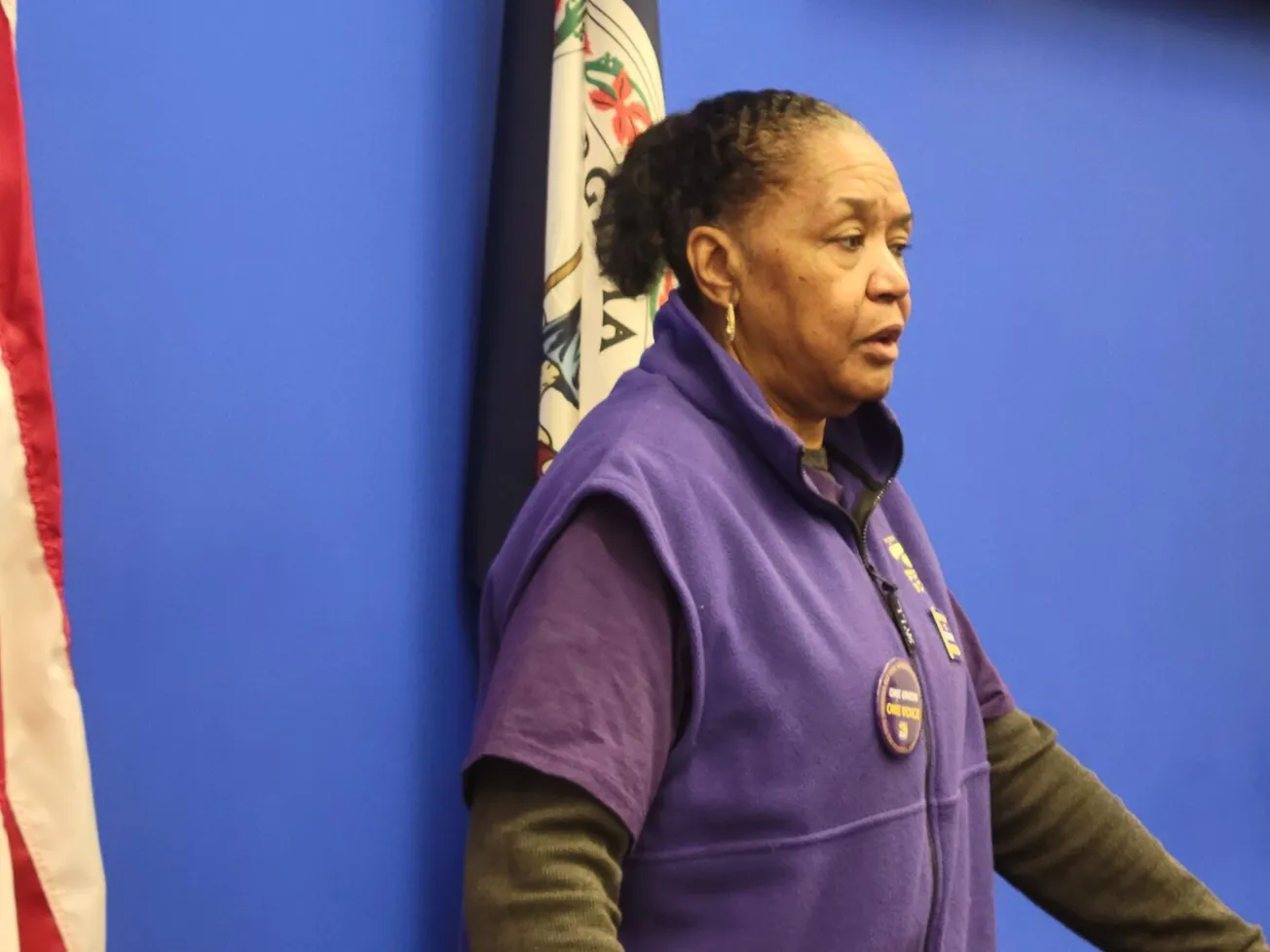
Home health care worker Joy Barnes shares her experiences during a press conference at Virginia’s Capitol on Jan. 20, 2026. Her union is advocating for a collective bargaining bill that would allow government workers and state-funded employees to negotiate things like wages or working conditions. (Photo by Charlotte Rene Woods/Virginia Mercury)

SEIU Virginia  512 is part of the Service Employees International Union, which advocates for a range of service workers around the world. At Virginia’s state Capitol on Tuesday, the group urged lawmakers to pass a bill that would allow home health workers to collectively bargain for better wages, benefits or working conditions.

While the bill broadly applies to public employees like government workers, it would also create the Virginia Home Care Authority within the state’s Department of Medical Assistance Services. 

SEIU leaders said the legislation would empower Joy Barnes, a home health worker who can’t afford to take a sick day when she falls ill.

After a medical emergency due to her anemia, Barnes relayed how she struggled “to play catch up” on bills afterwards. Her job also puts her health at risk, and she has caught both minor colds and infections that have required hospitalization while caring for some of her clients. Each time she has had to take a break, she loses pay. 

Workers like Barnes are the “backbone” of the health care industry and support all other types of workers, SEIU Virginia 512 member Athena Jones added during the group’s press conference on Tuesday. 

Jones and others said the bill is necessary because public employees are barred from collective bargaining at the state level. Some local cities or counties have permitted it, but with home health care workers typically compensated through Medicaid, they’ve not had a seat at the table to negotiate along with other types of public employees. 

“We need the opportunity to be able to say what we need as home care workers — being able to thrive, not just survive,” Jones said, who described being treated as “invisible” among other types of health workers. 

“We’re a part of the system that allows other people to be able to go to work, allows industries to thrive, allows opportunities where there may not be because the support isn’t there,” she said. 

Clients of home health workers, like Olson of Arc of Virginia, also support the bill.

As she lives with a genetic condition called Williams Syndrome, Olson works with Arc of Virginia as a coordinator. Assistance from a home health worker has allowed her to keep doing the work that she loves, she said, which is why she supports the current bill and has spent nearly two decades advocating for other measures and providing insights to lawmakers who craft them. 

“Me and my friends need services so we can live a life like yours,” she told the crowd at Tuesday’s press conference. “I want to be honest, I could not do the things I do without support.”

The collective bargaining bill is being carried by Del. Kathy Tran, D-Fairfax, in the House and Sen. Scott Surrovell, D-Fairfax, in the Senate. It will likely advance through the legislature again this year and may be less likely to face a governor’s veto, as it did under Republican Glenn Youngkin. New governor Abigail Spanberger had campaigned on addressing affordability issues and could view this bill through that lens 

Surovell said that he’s “optimistic” about the bill’s success, but noted that more nuance and details might need to be sorted out in the months ahead. 

“It’s a complex subject,” he said, noting challenges in determining how it would apply to governmental entities around the state along with public universities. ”A lot of people assumed Youngkin would veto it before, so they didn’t spend a lot of time on it.”

Now, Surovell anticipates robust discussion in committees before the bill can advance to both chambers where it could be workshopped further or advanced with no tweaks.

The 2026 legislative session is scheduled to run through mid-March.


Virginia Mercury is part of States Newsroom, a nonprofit news network supported by grants and a coalition of donors as a 501c(3) public charity. Virginia Mercury maintains editorial independence. Contact Editor Samantha Willis for questions: info@virginiamercury.com.

Comments