Funding for GRTC Pulse expansion into Henrico authorized, as officials await state budget clarity
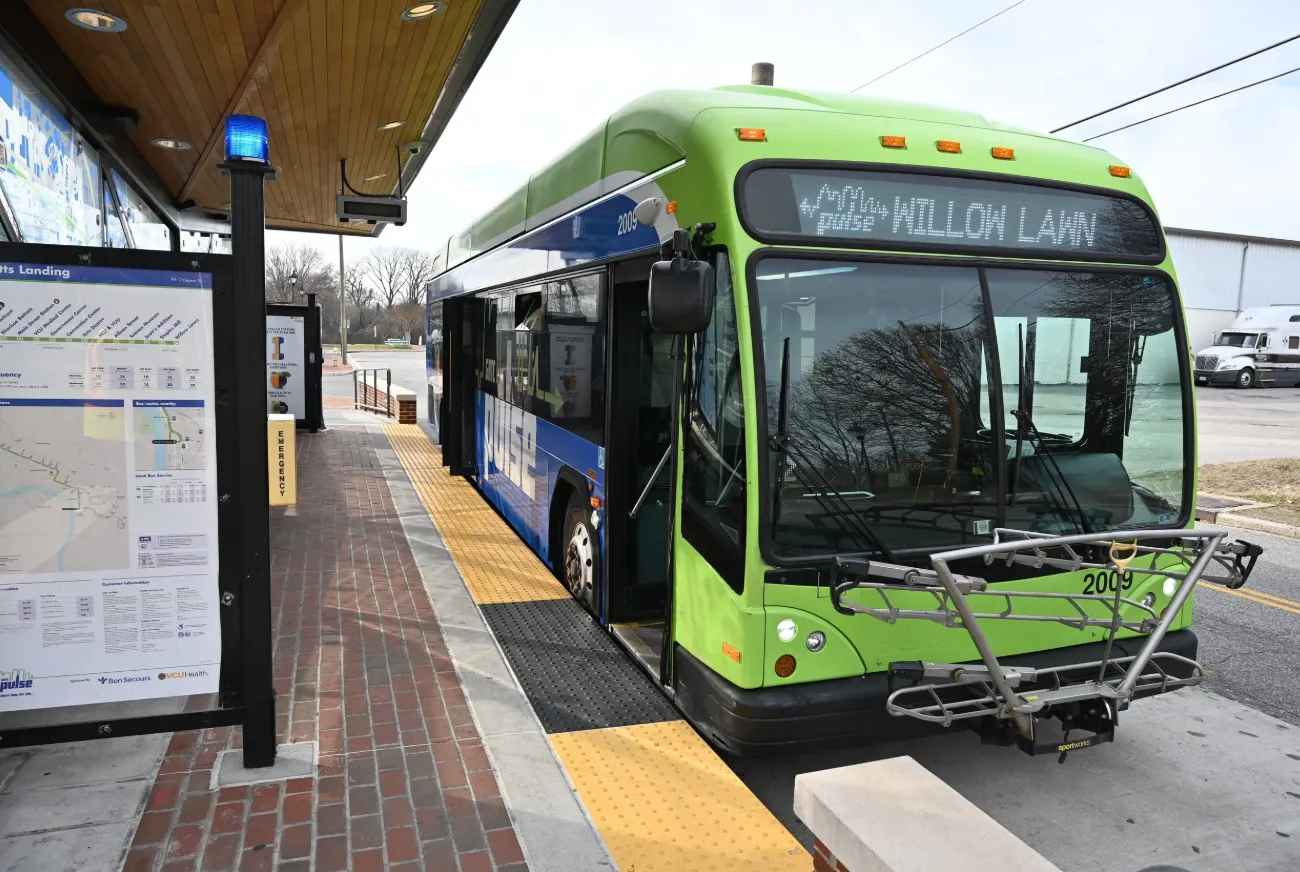
The Greater Richmond Transit Company is steps closer to executing and gathering funds for the Pulse Rapid Transit Western Extension Project that will extend the express bus line farther into Henrico County.
The planned western extension of the Pulse BRT will lengthen the route approximately four miles, from Willow Lawn Drive to Parham Road, with a turnaround on Skipwith Road to Parham to begin the return east on West Broad Street.
The GRTC board voted April 21 to award a $5.9-million contract for the execution of the project design development plans and specifications to the STV civil engineering firm.
According to the project’s timeline, the firm would complete the plans and right-of-way acquisition by August 2027. Bidding would take place from September to November that year, construction contracts would be awarded by December, and construction would take place during an 18-month span from April 2028 to September 2029.
This project is being funded through a Virginia Department of Rail and Public Transportation MERIT grant of $3.9 million for design of the project, with 80% coming from the state of Virginia, 16% of the funds from the federal government and 4% from local funding.
Bus-stop enhancements
The GRTC board also voted to develop more essential transit infrastructure, including 44 shelters and 28 benches at prioritized bus stops across Henrico and Chesterfield counties and the City of Richmond.
As part of a $175,264.05 contract awarded to RK&K consultants at the GRTC board meeting, the firm would provide construction management and construction engineering inspection for these sites and evaluate the designed bus stops to ensure they have passed inspection.
GRTC’s online ETI Installation Status Tracker shows 37 bus stops in Henrico have received a bench, trashcan or shelter, with the most recent shelters and trashcans installed at bus stops at Brook Road at St. Joseph’s Villa on April 3. The bus stop improvement project also can be tracked in a map format.

State support and suspense
During its Tuesday morning workshop meeting, the Commonwealth Transportation Board – which oversees transportation funding, statewide planning, project selection, and other initiatives in Virginia – focused at one point on the Draft FY27-32 Six Year Improvement Program and FY27 Budget.
Virginia Department of Rail and Public Transportation Chief of Public Transportation Zach Trogdon said the DRPT was committed to funding the GRTC’s Western Pulse Bus Rapid Transit line expansion with $23.1 million of the total cost of the $62-million project. He also said the Central Virginia Transportation Authority has pledged $20 million to the project.
On Wednesday, the CTB voted to approve the DRPT's Six Year Improvement Plan, which includes the GRTC Pulse funding.
GRTC Communications Manager Ashley Potter said the gap of about $16 million to execute the Westward Pulse would be made up with grants.
GRTC staff also had high hopes placed on Wednesday's state budget meeting, because if the Virginia Senate's version of the budget passed, the GRTC was to receive $1.5 million to support operations.
GRTC Director of Government and External Affairs Joe Dillard described the Virginia House of Delegates's version of the budget as the "skinny plan" with zero funds for the region’s fare free public transportation system.
“If that Senate [budget] passes with the data center tax, we can expect upwards of $1 [million] to $1.5 million additional [funds],” Dillard said. “We've been lobbying. It's going to be a long, long process. Typically, they would have already met and have a resolution. But we are looking at paying attention to lobbying the Senate version of the bill because ultimately, not just GRTC, but transit as a whole across the commonwealth will benefit from this. A more connected transit hub or region is huge for us.”
However, there was no agreement on the state budget.
The current budget will expire on June 30, leaving the state without funding until an agreement is reached. The legislature is convening in a brief "pro forma" session on Thursday, during which no legislative business is conducted and no votes are taken until an agreement is reached.
The state budget funding for GRTC is not a budget amendment but rather connected to the data center sales tax exemption; there are formulas throughout the tax code explaining that any money that goes into the Commonwealth Transportation Fund would flow to various entities, including the GRTC.
Analysis in a Virginia Senate Finance & Appropriations Committee Report of the Subcommittee on Capital Outlay & Transportation from this winter said retiring the data center sales and use tax exemption would provide $291.7 million over the biennium to the Commonwealth Transportation Fund to support all modes of transportation.
"This new, ongoing revenue will continue to grow and support highway maintenance while also investing in transit systems that affordably move Virginians. Transit providers will receive $15.6 million over the biennium for operating and capital needs from the Mass Transit Fund, along with a one-time $19.0 million general fund cash infusion specifically for their capital needs," the report said.
"Similar to a family's checking account where every paycheck is deposited into one account and then directed to various items such as the mortgage, daycare, groceries, savings, etc.," said Danny Plaugher, executive director of the Virginia Transit Association (VTA).
"Virginia's Transportation Budget works on a waterwall formula where every transportation revenue dollar goes into one pot and then is further divided by transportation mode - roads, transit, rail, airports, ports, etc. Transit receives $11.27 of every $100 in transportation dollars collected. That $11.27 is then further divided within the Commonwealth's Mass Transit Fund to support the operational and capital needs of Virginia's 40+ transit agencies."
Of that $11.27 per $100 in state transportation funding, historically, GRTC has received about $0.39 from the state to support the agency's operating needs, Plaugher said. So, from the increased transportation revenue included in the Senate's budget over the biennium budget, VTA estimates that GRTC would be projected to receive an additional $1.2 million.
Stewart Schwartz, executive director at the Coalition for Smarter Growth, said that funding would be crucial, since the Commonwealth Transportation Fund and other sources do not provide enough dedicated funding for the capital and operating needs of transit systems around the state.
CSG and other transit organizations site a need for $200 million in additional funding this year, with $153 million of that to meet the mandatory funding obligations for Metro Rail and and Metro bus operating needs in the DC area. Virginia's share is $153 million. The other $47 million to $50 million will be for all of the other transit local transit agencies in the state. Virginia Railway Express' operating needs are a little more than $200 million.
"We have a terrific little system in Richmond with the GRTC, with the Pulse, with the bus network redesign that was implemented when we started the Pulse, which gave us more frequent routes in a number of parts of our city. There's no question that deserves much more operating and capital funding," said Schwartz, who points to Virginia Commonwealth University ceasing to contribute to the transit system as a big financial challenge.
"These connections are much needed. There are significant number of people who have tight budgets who live in the inner suburbs of Henrico and Chesterfield, who very much need expanded transit service. So we should keep it going, keep it growing."
Summer growth
GRTC CFO John Zinzarella, described the fare free public transportation system’s current budget as slightly unfavorable owing to operator wages and salaries and paid absences due to the heightened levels of overtime GRTC is incurring due to a lower headcount.
GRTC CEO Sheryl Adams said operator staffing in the summer is expected to grow with another class of drivers expected to graduate this month and also in May.
GRTC evaluates scheduling quarterly, with the next booking taking place next month.
“Every time we do a booking, we're looking at numbers of riders and drivers. We're pulling the data, we're seeing the route connectivity,” said Potter. “By June we'll be rolling out a new booking and schedules.”
Bus riders are invited to participate in a customer satisfaction survey with the American Bus Benchmarking Group, through which GRTC can compare its service and ideals with other agencies throughout the country. This customer satisfaction survey is for fixed route service will run through May 10.
Dina Weinstein is the Citizen’s community vitality reporter and a Report for America corps member, covering housing, health and transportation. Support her work and articles like this one by making a contribution to the Citizen.