Early voting begins Friday for Virginia redistricting referendum
Democrats say amendment would counter GOP map changes elsewhere; high court clears way for April 21 election after lifting temporary injunction
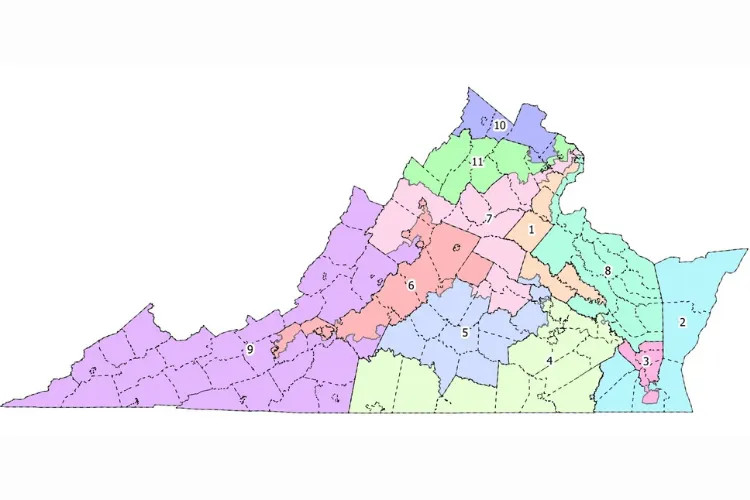
Early voting is set to begin Friday across Virginia for an April 21 statewide referendum that could allow the General Assembly to redraw the state’s congressional districts ahead of this fall’s midterm elections. If voters approve, the move would likely reshape the current 6–5 partisan split in Virginia’s delegation into a map favoring Democrats in as many as 10 of the state’s 11 districts.
The referendum comes amid an ongoing series of legal challenges and court rulings that have created uncertainty about the election’s legality, even as local election officials move forward with preparations.
One of the most significant cases stems from a lawsuit filed in Tazewell County challenging the legality of the referendum itself.
In that case, Circuit Judge Jack Hurley issued a temporary injunction blocking the Virginia Department of Elections and the State Board of Elections from taking steps to prepare for the vote, concluding that Democrats’ effort to fast-track the constitutional amendment may have violated state law.
But the Supreme Court of Virginia on Wednesday afternoon granted a stay of that order, clearing the way for the election to proceed as scheduled.
“I’m proud of the decisive action my office took to immediately bring this case before the Supreme Court of Virginia, the proper forum to consider these claims,” said Virginia Attorney General Jay Jones, in a statement.
“We moved quickly to protect the orderly administration of this election. The Court’s order is clear: the referendum election will proceed. I’m grateful to the lawyers in the Office of the Attorney General who worked swiftly and skillfully to ensure that the voices of Virginians will be heard at the ballot box.”
House Speaker Don Scott, D-Portsmouth, said the ruling confirms that voters will decide the issue. “The Supreme Court of Virginia’s decision ensures that this referendum will move forward and that Virginians will have the opportunity to make their voices heard,” Scott said. “This question has always belonged to the voters, and I’m glad the Court made clear that the people will decide.”
The referendum would determine whether Virginia temporarily suspends its bipartisan redistricting commission and instead allows the Democrat-controlled General Assembly to redraw the state’s 11 congressional districts before the Nov. 3 midterm elections.
If approved, lawmakers would regain map-drawing authority only until the next redistricting cycle following the 2030 census. State legislative districts would not be affected.
“In some respects, the question of whether to approve the constitutional referendum is really a debate over ‘fairness’ and what it entails,” said Alex Keena, an associate professor of political science at Virginia Commonwealth University, referring in part to the Democratic campaign promoting the proposal as a push for “fair maps.”
“The drama over redistricting over the last 15 years has taught us that there is no single definition of gerrymandering and no one specific way to identify it or to measure it.”
Keena said voters bring different expectations to the concept of fairness — a debate that has intensified as Republicans question whether the proposed new congressional map would be fair.
“People have lots of ideas about what is ‘fair’ in democratic elections,” he said. “They want the parties to win seats in proportion to the votes they earned. This is one criterion of fairness. People also prefer to have somewhat competitive elections, so that the maps are sensitive to shifts in voter support.”
A proposal to redraw the map
Virginia’s current congressional districts were adopted in 2022 after the state’s newly created redistricting commission failed to reach agreement on maps. Under the state Constitution, the task then fell to the Supreme Court of Virginia, which hired two independent experts — one Republican and one Democrat — to draw the districts.
The resulting map produced a congressional delegation of six Democrats and five Republicans, a split roughly consistent with the state’s recent statewide voting patterns. The Princeton Gerrymandering Project gave Virginia one of the highest ratings in the country for its maps.
Urban areas across Northern Virginia, Richmond and Hampton Roads largely elect Democrats under the current map, while rural regions such as the Shenandoah Valley and the Northern Neck tend to elect Republicans.
But the proposal before voters would create a dramatically different arrangement.
The map drafted by Democratic lawmakers would shift nearly half of Virginia residents — about 48% — into new congressional districts. With the exception of far Southwestern Virginia, most voters currently represented by Republicans would be placed in districts that favor Democrats.
The plan would attempt to limit Republicans to a single district anchored in the state’s far southwestern corner. Several new districts would extend outward from the population centers of Northern Virginia, stretching into rural areas.
Two of the proposed districts — one centered on Blacksburg, Roanoke, Lynchburg and Charlottesville and another covering parts of Hampton Roads and the Eastern Shore — are considered competitive based on recent statewide election results.
Parties look to Virginia in fight for House control
The Virginia referendum has drawn national attention as both parties look for ways to influence control of the U.S. House.
The push for mid-decade redistricting gained momentum last year when President Donald Trump urged Republican-controlled states to redraw maps to strengthen the GOP’s position in Congress. Texas lawmakers responded by adjusting their districts in hopes of adding several Republican seats.
Other states followed with similar efforts. Missouri and North Carolina both approved map changes expected to produce additional GOP seats, and Florida lawmakers are considering new lines that could further expand the Republican advantage.
Virginia became a focal point for Democrats seeking to offset those changes.
U.S. House Minority Leader Hakeem Jeffries said earlier this year that national Democrats would invest heavily in the referendum effort.
“We will spend tens of millions of dollars to make sure … that voters have all of the information necessary to make a decision around whether they want Donald Trump to rig the midterm elections and halt the ability for the American people to decide who’s in the majority,” Jeffries told CNN last month.
Advocacy groups on both sides have been organizing for the referendum campaign for weeks.
Virginians for Fair Elections, which supports the amendment, has raised nearly $20 million from Democratic-aligned organizations. Attorneys representing the group told a court last week that about 1,000 volunteers have been recruited.
According to VCU’s Keena, the financial stakes reflect more than the potential impact on House control.
“Democrats do not need Virginia to gerrymander the map in order to secure a majority in the House this fall,” he said. “My read is that most analysts agree the Democrats will almost certainly capture the House. Why is so much money pouring into this race?”
Instead, Keena suggested the redistricting proposal could reshape primary contests and favor candidates with stronger institutional backing.
“My suspicion is that moneyed interests prefer the candidates who are likely to prevail when the district lines have been disrupted,” he said, referring to Virginia lawmakers like Del. Dan Helmer, D-Fairfax, who has already launched his bid for the Democratic nomination in a redrawn 7th District.
The amendment’s opponents include Virginians for Fair Maps, a coalition that includes former Virginia Attorney General Jason Miyares, and the bipartisan group called No Gerrymandering Virginia, which says it wants to ensure there is no lapse in the redistricting commission’s authority.
Legal battles continue
The referendum has been the subject of several lawsuits since lawmakers advanced the amendment for a second time earlier this year, as required under the state Constitution.
In February, the Supreme Court of Virginia allowed the measure to proceed to the ballot, rejecting an emergency challenge filed by Republican lawmakers and the Republican National Committee.
Other cases remain pending. Two Republican members of Congress have filed a lawsuit in Richmond challenging the wording of the ballot question, while a Washington County resident has filed a separate pro se case seeking to stop the vote.
On Monday, a Lynchburg Circuit Court judge dismissed a lawsuit filed by the city seeking to halt early voting for the redistricting referendum, ruling that it was not appropriate for the court to intervene while the constitutional amendment process is already underway and leaving questions about the measure’s legality to the Supreme Court of Virginia.
Because the state’s highest court scheduled arguments after the April 21 referendum, it is unlikely to issue a final ruling on the amendment’s legality until after ballots are cast.
“The Supreme Court of Virginia has said it is going to rule on whether or not the constitutional amendment advanced by Democrats comports with the procedural standards imposed by Virginia law,” Keena said.
“But if the vote does pass, then the court will be in an awkward position if it decides to strike down the amendment. It will do what courts almost never like to do: invalidate the will of a majority of voters.”
Primary elections moved
Anticipating the possibility that congressional districts could change this year, lawmakers also adjusted the schedule for Virginia’s 2026 primary elections. The General Assembly approved legislation last month shifting the primary date from June 16 to Aug. 4, a measure signed into law by Gov. Abigail Spanberger.
The change gives candidates and voters more time to adapt if congressional district boundaries are redrawn before the midterm elections.
Even if the referendum fails or is halted by the courts, the Aug. 4 primary date will remain in place. The change applies only to the 2026 election cycle, according to the Department of Elections.
Early in-person voting for those primaries will begin June 19 and continue through Aug. 1. The deadline to request an absentee ballot by mail will be July 24.
With less than two months before the April referendum, polling suggests the outcome of the referendum remains uncertain.
A Roanoke College poll released last week found that 52% of surveyed Virginians said they would vote against the amendment, while 44% supported it.
But turnout could prove decisive, Keena said.
“This election is different because it is not concurrent with a general election. This makes it super hard to predict. Victory will be determined by which side can mobilize greater support, given the inconvenient timing of the election.”
Virginia Mercury is part of States Newsroom, a nonprofit news network supported by grants and a coalition of donors as a 501c(3) public charity. Virginia Mercury maintains editorial independence. Contact Editor Samantha Willis for questions: info@virginiamercury.com.