Skip to content
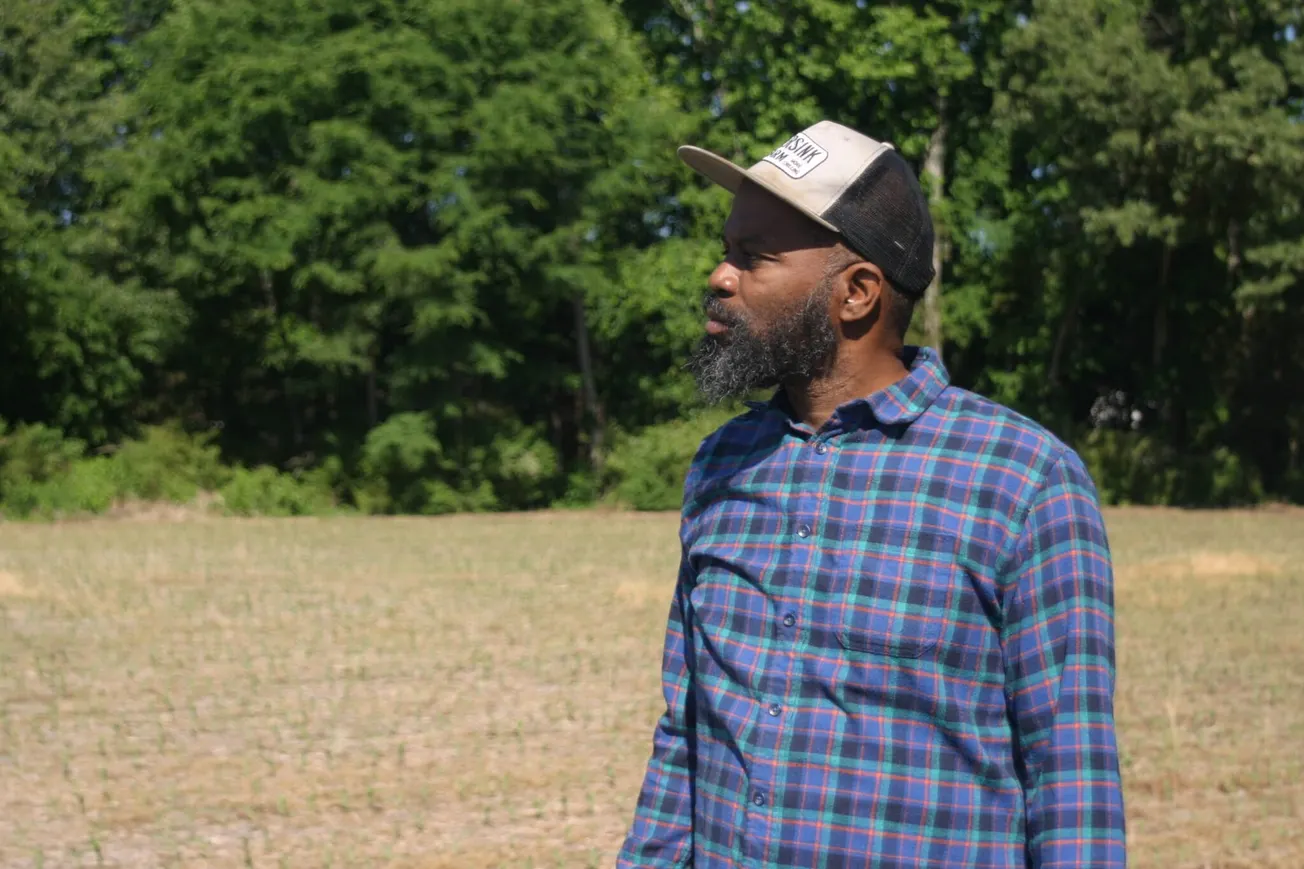
Duron Chavis on land transferred to the Central Virginia Agrarian Community Land Trust. May 2026. (Photo by Shannon Heckt/Virginia Mercury)

In a fallow field off the Virginia Capital Trail in Henrico County Tuesday morning, urban agriculture expert Duron Chavis walked through the grass alongside Parker Agelasto, a former Richmond City councilman who now leads the Capital Region Land Conservancy. 

Chavis explained how putting 61 acres of land at the cross section of Duran and New Market Roads into a conservation easement protected it from development and brought down the cost of the property, making land ownership more accessible to Virginia farmers of color amid a persistent racial wealth gap and decades of Black land loss. 

“The conversation was about racial equity. In this moment, we are talking about real equity, land ownership by community organizations of color,” Chavis, who is also board chair of the Central Virginia Agrarian Community Land Trust (CVACLT), said.

Landowner Randy Welch donated the property to the Capital Region Land Conservancy, which has now transferred it CVACLT, a nonprofit that trains Black people and others of color in farming practices to combat food deserts and bolster access to healthy food and land to grow it.

The land, located in the Varina community in the county’s eastern end, includes “54 acres of prime farmland,” a release about the project reads. The CVACLT’s plan is to develop about four tiny homes on the property; the program’s trainees will apply to live there and work the land, with an opportunity for future plot ownership, at little to no cost. 

Parker Agelasto and Duron Chavis on land transferred to the Central Virginia Agrarian Community Land Trust. May 2026. (Photo by Shannon Heckt/Virginia Mercury)

“If you think about the value of 60 acres, this property could have had potentially 40 or 50 houses out here. It’s very valuable land,” Agelasto said.
” Once you take out that development potential, it means that the land is really there as agricultural land and it makes it affordable for the farmers.”

The Capital Region Land Conservancy has protected over 2,400 acres in the county over the past 20 years via easements, the organization said.  

As a population that was historically promised 40 acres and a mule post-slavery that never materialized, Chavis said the project is a way for  Black Virginians to reunite with agricultural practices on their own land and terms.

“Cultivating the next generation of farmers is of extreme importance, especially if we’re talking about issues like increasing access to healthy food, food deserts, food justice,” Chavis said. “How do we get the communities that are most impacted by that? In the game of agriculture vocationally, (that) is the real solution that we’re trying to drive towards.”

Chavis runs the training so that community members can learn what it takes to cultivate the land, and to shore up the aging ranks of his fellow Black farmers, who experienced wide scale loss of their property throughout the 20th century. 

The average age of American farmers is about 60 years old, according to the 2022 Census of Agriculture. Black farmers have lost 15 million acres of their land since the 1910s “through state-sanctioned violence and discriminatory structures that limited Black wealth building,” the American Bar Association reports.

Most of Chavis’ trainees so far have largely been women, but more recently young families and couples have started to show more interest in farming healthier food choices or trying to keep farmland in their families, he said.

In CVACLT’s last partnership with Henrico County that created a 20- acre community farm, over 140 people applied to work the land.

“We already are showing that farmers want to farm, but they just don’t have the capital to get the land to do it. Well, we’re moving that barrier. So, who could be mad at that?” Chavis said.

With a conservation easement on the property that is bisected by the trail, there are some requirements for protecting view sheds and limitations to trees being cut down set by the conservancy around the trail. The group is pursuing further grant funding for the housing part of the project. Chavis said he hopes to have construction for the first house started by the end of next year.

Land belonging to the Central Virginia Agrarian Community Land Trust in Henrico County May 2026. (Photo by Shannon Heckt/Virginia Mercury)

The land now rolls quietly alongside Route 5, but a battle was once waged there, as evidenced by some of the earthworks seen in the forest today. Sections of the property are part of the historic Darbytown and New Market Road Battlefield, Chavis said, where the U.S. Colored Troops won the battle and were the first Union troops to enter Richmond during the war.

Reflecting on the land transfer, and forthcoming community farm’s location and the nation’s concurrent celebration of its 250th year of independence, the moment feels significant to Chavis, who called it “a redemption to that promise … with this historical connection to the United States Colored Troops.”

“To me, (it) is like a signal flare going on that there’s unfinished business, as far as the United States and its relationship to people of African ancestry. Especially as it pertains to land and who has control of it and ownership of it,” Chavis added.


Virginia Mercury is part of States Newsroom, a nonprofit news network supported by grants and a coalition of donors as a 501c(3) public charity. Virginia Mercury maintains editorial independence. Contact Editor Samantha Willis for questions: info@virginiamercury.com.

Comments