Skip to content

Blue wave rebuilds the House: Democrats soar to at least 64 seats in Virginia

Suburban surge and abortion-rights messaging fuel sweeping gains as GOP bid to retake chamber falls flat, signaling a shifting electoral map ahead of 2026
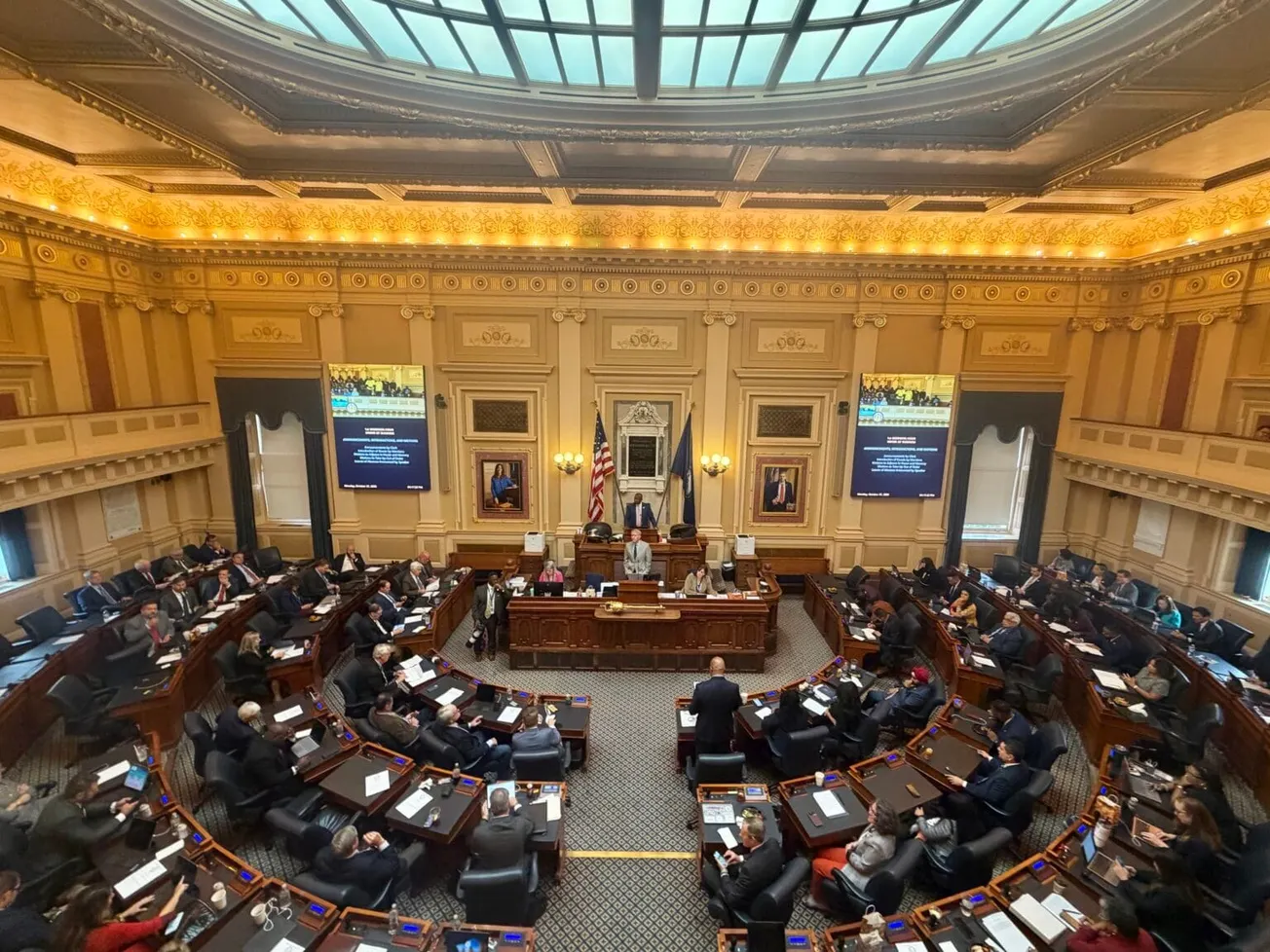
The Virginia House of Delegates in October 2025. (Photo by Markus Schmidt/Virginia Mercury)

Table of Contents

Democrats managed to increase their majority in the Virginia House of Delegates, moving from 51 to 64 seats (with one race still undecided as of 11 p.m.) as voters turned out Tuesday in a pivotal election for control of the chamber. The win came amid a backdrop of fierce competition across suburban and exurban battlegrounds, with both parties viewing the outcome as a bellwether for 2026 and beyond.

Despite heavy Republican spending and Youngkin’s late push to recapture momentum, Democrats successfully defended vulnerable incumbents and flipped several key districts in vote-rich regions around Richmond, Northern Virginia and Hampton Roads.

Turnout surged in several suburban swing areas, reflecting continued polarization over national issues like abortion and democracy as well as local concerns over housing, health care and school funding. 

Democratic leaders credited what they described as a disciplined, issue-focused campaign that emphasized protecting abortion access and investing in public services, while Republicans leaned on messages about parental rights, public safety and economic management.

The GOP entered the cycle hoping to regain the majority of the 100-body member that it lost in 2023, but even with competitive candidates their gains fell short. The chamber’s new balance  underscores Virginia’s shift toward Democratic strength in its population centers, even as Republicans maintain deep support in rural regions. 

Below is a roundup of results from some of the most competitive House of Delegates races this cycle.

House District 75

Democrat Lindsey Dougherty (Courtesy of campaign)

In a closely watched rematch for Virginia’s 75th House District, Democrat Lindsey Dougherty defeated Del. Carrie Coyner, R-Chesterfield, by a margin of 52.5-47.3%, flipping one of the state’s most competitive suburban seats.

Dougherty, a senior research administrator who centered her campaign on expanding mental health services, improving public schools and tackling affordability issues, capitalized on shifting suburban dynamics to unseat the two-term incumbent.

Coyner, a former Chesterfield County School Board member first elected to the legislature in 2019, had emphasized her bipartisan record on education, housing, and budget policy in an effort to hold the district. She also gained attention this cycle for her role in a scandal involving Democratic AG nominee Jay Jones’s violent text messages.

Both campaigns invested heavily in the race, which drew statewide attention as a bellwether for suburban trends in the Richmond region and a key test of Democrats’ effort to expand their House majority.

House District 71

Democrat Jessica Anderson (Courtesy of campaign)

In the rematch for House District 71, Democrat Jessica Anderson defeated Del. Amanda Batten, R-James City County, by 52.7-47.2% in a closely fought race defined by rapid suburban growth, a tourism-driven economy and strong voter turnout.

The district — spanning the historic city of Williamsburg, established James City County neighborhoods, and the fast-developing exurbs of New Kent — became a focal point for debates over housing affordability, school capacity and worsening traffic along I-64.

Anderson, a former educator and community advocate, built her campaign around managing growth responsibly, investing in public education, and addressing rising living costs. Batten, who has represented the district since 2019, emphasized her legislative experience and work on infrastructure and budget issues while appealing to moderates uneasy about overdevelopment. 

Anderson’s win flipped one of eastern Virginia’s most competitive suburban seats and reflected shifting voter sentiment in communities grappling with change and expansion.

House District 41

Democrat Lily Franklin. (Courtesy of campaign)

In another closely watched rematch for House District 41, Democrat Lily Franklin defeated Del. Chris Obenshain, R-Montgomery, by a margin of 51.1%-48.7% in a race defined by heavy spending and one of the tightest margins of the cycle.

The district, encompassing the college town of Blacksburg and nearby communities in Montgomery and Roanoke counties, remains one of Virginia’s most competitive, balancing youthful, renter-heavy areas with more rural and suburban precincts.

Franklin, who focused her campaign on housing affordability, reproductive rights and workforce training, benefited from strong turnout around Virginia Tech and neighboring suburbs. 

Obenshain, who had touted his work on passenger rail expansion and infrastructure funding, struggled to hold onto the swing district amid demographic and political shifts.

Franklin’s victory flips a key seat in Southwest Virginia and highlights the region’s growing political volatility heading into future legislative contests.

House District 82

Democrat Kimberly Pope Adams hugs a supporter at her victory party in Petersburg after winning the House District 82 race against Republican incumbent Kim Taylor on Nov. 4, 2025. (Photo by Marcus Ingram for the Virginia Mercury)

Democrat Kimberly Pope Adams defeated Del. Kim Taylor, R-Petersburg, by 53.6%–46.2% in a hard-fought rematch for House District 82 — a contest that once again lived up to its “Kim vs. Kim” billing.

The district, centered on Petersburg and parts of Chesterfield, Dinwiddie and Prince George counties, was widely viewed as pivotal to determining control of the House. 

Adams, a former state employee and educator, focused her campaign on expanding health care access, improving public schools and safeguarding abortion rights.

Taylor, who first won the seat in 2021 and narrowly held it by 53 votes in 2023, ran on economic growth, job creation and support for law enforcement. 

Both candidates drew significant attention and resources from their parties, underscoring the district’s importance as one of the state’s most competitive. Adams’ victory delivers Democrats a key pickup in Southside Virginia and strengthens their hold on the House majority.

House District 73

Lawyer Leslie Mehta is competing with military veteran Herb Jones in a Democratic primary in the 1st Congressional District. (provided photo)

Democrat Leslie Mehta defeated Del. Mark Earley, R-Chesterfield, by 51.5%–48.3% in a closely contested race for House District 73, flipping the Chesterfield County–based seat after one of the region’s most competitive campaigns.

The contest highlighted the shifting political dynamics of Richmond’s fast-growing suburbs, where concerns over housing costs, traffic and school funding have increasingly shaped voter priorities.

Mehta, a civil rights attorney and nonprofit leader, campaigned on expanding access to health care, protecting abortion rights and improving affordability for working families.

Earley, who sought a second term, emphasized public safety, fiscal restraint, and infrastructure investment.

Both candidates drew significant outside attention and spending as the race became a bellwether for suburban trends statewide. Mehta’s victory marks a key Democratic pickup in a district long seen as a barometer of central Virginia’s political realignment.

House District 97

Del. Michael Feggans, the Democratic incumbent in House District 97, defeated former Republican delegate Tim  Anderson by 57 –42.8% in a pivotal contest centered in coastal Virginia Beach.

The district had flipped to Democratic control just two years earlier and was seen as a barometer for which party would dominate the chamber. Voters in the district, where more than half supported Kamala Harris in the 2024 presidential race, wrestled with issues including coastal flooding, military and veteran concerns and clean-energy policy.

Feggans, a 20-year Air Force veteran, made veteran families, resilience funding and small-business support the core of his campaign, while Anderson campaigned on tax relief and veteran retirement benefits. 

The outcome secures a key Democratic pickup in one of Virginia’s most closely watched swing seats.

House District 21

Del. Josh Thomas, D-Prince William, secured his reelection in the race for Virginia’s House District 21, defeating Republican Gregory Lee Gorham by a margin of 58.1%–41.6%. 

The contest, anchored in Prince William County, largely revolved around the rapid expansion of data centers — from questions about massive energy demands and high-voltage transmission lines to concerns over water usage and local land-use impacts.

Thomas, a veteran and commercial-real-estate attorney focused on housing issues, championed clearer oversight and transparency around the booming industry, sponsoring legislation aimed at tracking noise, water and energy forecasts. 

Gorham, a retired IT professional and longtime local Republican activist, argued that Thomas’ plans didn’t go far enough, pushing for harder lines on tax incentives and stronger local control over data-center zoning. The election’s outcome reaffirms Thomas’ hold in this key Northern Virginia district as the sector’s influence grows statewide.

House District 22

House of Delegates candidate Elizabeth Guzman. (Courtesy of Guzman Campaign)

Democrat Elizabeth Guzman defeated Del. Ian Lovejoy, R-Prince William, by a margin of 54.5 –45.3% in the race for Virginia’s House District 22, flipping the seat after a campaign centered on data centers, rising living costs and the region’s rapid growth.

Guzman, a former delegate and social worker, focused on strengthening consumer protections, expanding workforce training, and tightening oversight of the data-center industry that has reshaped parts of Northern Virginia’s landscape and strained local infrastructure. 

Lovejoy, a former Manassas City councilman, emphasized responsible growth, grid reliability and easing regulatory burdens to support business investment.

The district, covering southwestern Prince William County, drew major attention as one of the year’s most competitive contests. Guzman’s win delivers Democrats a key pickup in Northern Virginia and underscores growing voter concern over development pressures and affordability in the fast-changing suburbs of the Washington, D.C., metro area.

House District 89

Democrat Kacey Carnegie (Courtesy of campaign)

Democrat Kacey Carnegie won the open race for House District 89, defeating Republican Mike Lamonea by 54.2 –45.4 % in one of the most competitive contests of the year.

The Chesapeake-based district, which has swung between parties in recent cycles, was left open after Republican Del. Baxter Ennis declined to seek reelection. 

Carnegie, an attorney inspired by Justice Ruth Bader Ginsburg’s legacy, ran on raising the minimum wage, tackling rising housing costs and investing in public education. She argued that working Virginians deserve a fair chance to afford living in the communities they serve.

Lamonea, a Chesapeake School Board member and former ICE agent, campaigned on cutting grocery and car taxes, backing law enforcement, and ensuring parents’ voices in education. 

Both candidates made affordability central to their platforms, but Carnegie’s message of economic fairness and investment in schools resonated with suburban voters. Her win delivered Democrats a key pickup.

House District 86

Virginia House of Delegates District 86 Democratic challenger Virgil G. Thornton Sr.. (Photo courtesy of campaign)

Democrat Virgil G. Thornton Sr. defeated Del. A.C. Cordoza, R-Hampton, by a margin of 53.4–46.4% in Virginia’s House District 86, flipping a seat that has shifted from reliably Republican territory to one of the cycle’s most contested battlegrounds.

Thornton, a former educator and community advocate, centered his campaign on expanding economic opportunity, protecting reproductive rights and increasing access to workforce training programs. 

Cordoza, who was first elected in 2021, ran on defending gun rights, strengthening K-12 schools and growing job pipelines tied to the region’s military and maritime industries.

The race highlighted how demographic change and rising political engagement are reshaping coastal suburbs stretching across Hampton, York County and Poquoson. Thornton’s win delivers Democrats a key pickup in a region long dominated by the GOP.

Virginia Mercury reporters Nathaniel Cline, Shannon Heckt and Charlotte Rene Woods contributed to this story, as well as University of Richmond student journalists Nick Mossman and Juliet Zucker. 


Virginia Mercury is part of States Newsroom, a nonprofit news network supported by grants and a coalition of donors as a 501c(3) public charity. Virginia Mercury maintains editorial independence. Contact Editor Samantha Willis for questions: info@virginiamercury.com.

Comments